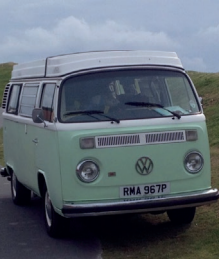
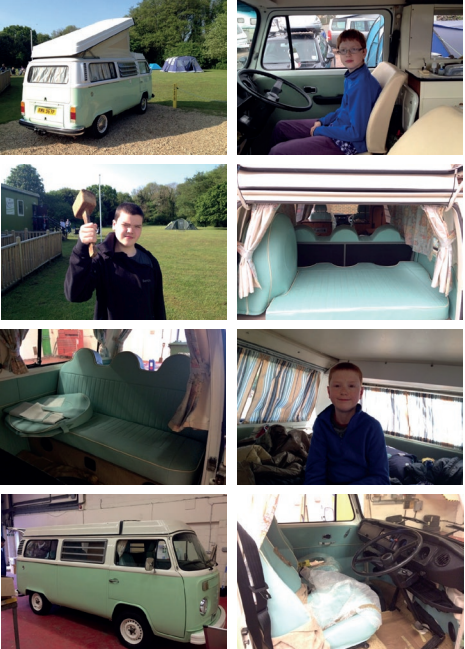
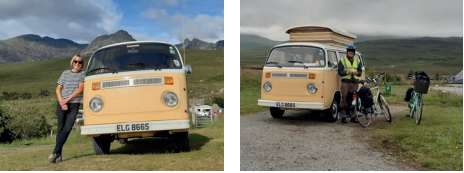
For this edition of Member’s Motor, we look at Mel’s Bay, called “Platybus”. This is what she had to say about it. Back in 2010, my husband Mark announced one day that he’d always fancied getting an old camper van. This was news to me, but I figured it was just a passing fancy and that he’d soon get over it! Anyway, to cut a long story short, he did some research and after a couple of false starts, eventually found a van that someone in North Wales was selling.
The van had originally been imported from Australia and had eventually ended up in sunny Wales. She’d been converted to run on both petrol and LPG. Bearing in mind that Mark had never driven a camper van before, he persuaded a mate to drive him to Wales and then Mark would drive the van back! As you can imagine, my main concern was that the van would break down on the way back and I would have to go and fetch him from goodness knows where. Fortunately, the van behaved itself and he got safely home, after an epic 5 hour journey. Over the next 3 or 4 years, our family had a couple of trips in it down to Wales and 2 trips to Devon. Despite a couple of hiccups, we got there and back in one piece. Then about 5 years ago, we went to an open day at Just Kampers down in Hampshire. We’d already discussed having a full restoration on the van and we met a chap from a company called Voodoo VW. We duly agreed to take the van down to his workshop in Newbury so we could talk about what we wanted done on the van. We felt totally reassured that they would carry out the work we wanted done and basically left them to get on with it. You know the saying “be careful what you wish for?”.
Well, unfortunately things didn’t pan out the way we wanted them to; the company went bust and we had to fetch the van from down near Newbury and pay someone to fix the bits that hadn’t been done properly. We eventually got the van back and at present it’s sitting on the forecourt of a friend’s garage, waiting for the engine to be taken out to investigate an issue with the hydraulics. We love the van, she’s been brilliant when she works, but it’s like they say, it’s been a labour of love.
She’s called the Platybus, because when we were cleaning out the glove compartment, we found an Australian coin with what we thought had a platypus on it. It transpired that it’s actually a Spiny Anteater, but we decided to stick with Platybus. I really hope that one day soon we can get to go camping again in the bus and that we can iron out all the little niggles we’ve discovered since the van was “restored “. We’ve since discovered that the chap who ran Voodoo VW is back running a company restoring camper vans, after declaring to us that he wanted nothing more to do with the VW scene… ! Hey ho…” Best wishes, Mel
The Club on tour – Just Kampers, Odiham, Hampshire
June 10 to 12 2022
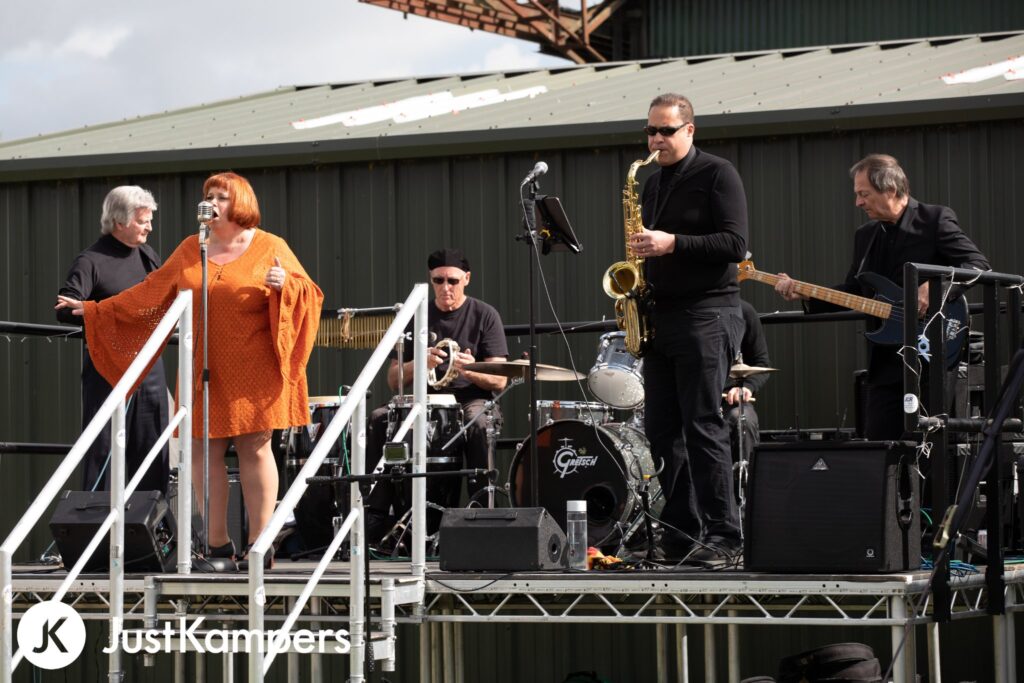
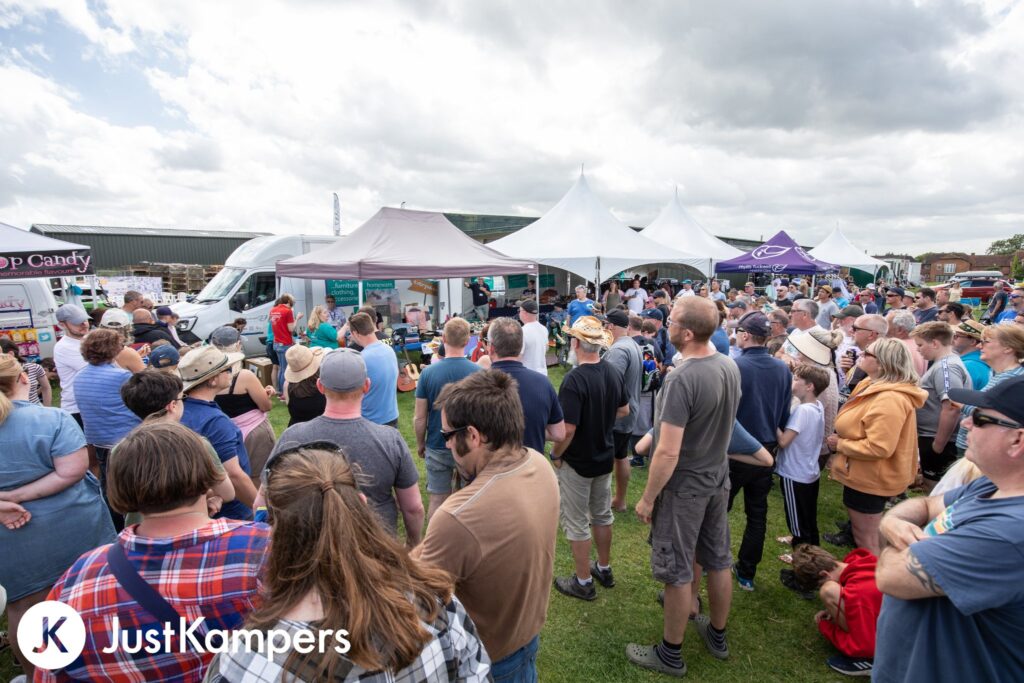
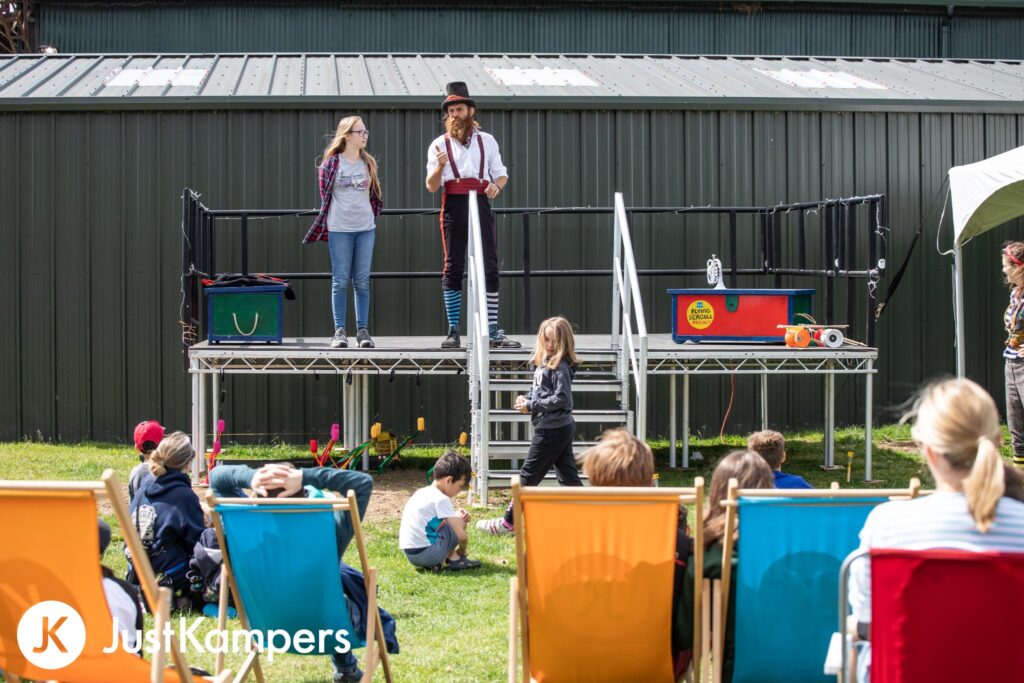
6 members were in the dedicated club field with more coming over to say Hello. 15 new members joined on the day, lots of money raised for charity for the Phyllis Tuckwell hospice. Live music from multiple bands, open air cinema on Friday (Breakdance) and Saturday (Karate kid), a big raffle with prizes worth up to £700 each.
Another great weekend at JK.
BuddyThe bandThe raffleMalcolm at the standThe entertainer
We head into Aberystwyth to pick up some essentials; dog food, milk and petrol! Not wanting to waste the trip into town, we head to the seafront and take a drive along the promenade. We are pleasantly surprised by the lovely Victorian buildings and a funicular cliff railway too! Stocked up with supplies and the tank full to bursting with petrol, we head north and are looking forward to today’s route which will take us on a B road that follows the coast around the southern part of Snowdonia rather than going through it and then into the National Park to camp for the night. The start of the coastal road happens immediately after crossing the river/estuary at Machynlleth via an old stone bridge and then turning left off the main A road and following the river on your left. As roads go, this one is beautiful. The surface is smooth, with a stone wall on one side and a cliff face the other, it undulates over and around the coastal features, giving us amazing views over the river and sea. As we get closer to the coast, the road becomes lined with old oak trees, growing out of the cliff and hanging over the edge. Our first stop on this route is a small seaside town called Aberdovey. There is a golf club, a beach and beach related stuff. We drive through, noticing people pointing and commenting at the camper… this often happens and I sometimes wonder if they are pointing at something falling off! But you get used to it and you soon realise that driving a bright blue camper van with an exhaust that announces your arrival everywhere you go is going to get you attention. The road picks up as it comes out of Aberdovey, but its only a short run before the next small town called Tywyn. On our way in we notice the large amount of static caravans surrounding the area. The town is pleasant and has all the makings of a seaside location, with a decent looking Co-Op if you need supplies! The beach is clean and there is also a narrow gauge steam railway here too.
From Tywyn the road heads inland to avoid another river estuary and make the crossing via a bridge.
There is a ferry that can take you across, but we took the road to save time. Once you cross over the river, the road heads back towards the coast and is it does, starts to climb. As the road meets the coast you are met with one of the most beautiful coastal roads we have driven. There are numerous lay by areas to pull over and appreciate the view, which we did. We followed the coastal road until reaching the larger town of Fairbourne. To continue from here there are a few options; a ferry direct to Barmouth, a modern road bridge several miles inland or an old rickety wooden bridge that resembles a seaside pier… guess which option we went for?! The old wooden bridge at Penmaenpool is a toll bridge, costing 80p for cars and £1 for motorhomes. We are technically driving a Motorhome, despite being car sized, but I don’t mind paying the extra 20p to keep the bridge maintained. The crossing is bumpy as the wooden sections are uneven, but we make it across safely without encountering any trolls who want to eat us for their supper! After crossing the bridge we head into Barmouth. Barmouth is a seaside resort with everything you would expect; amusements, chip shops, sandy beaches and a long promenade. It was busy. Really busy. We stopped for a while on the promenade and watched the crowds but didn’t venture out of our own space inside the camper. From Barmouth we follow the road all the way to the end of the coastal route at Penrhyndeudraeth and make our way up to the campsite which is only 5 minutes up the road. Nearby is the village of Portmeirion; a tourist village, designed and built by Sir Clough Williams-Ellis in the style of an Italian village, which is now owned by a charitable trust. We didn’t visit as we didn’t have any time left in the day, but it’s worth a look if you’re in the area!
In the evening we pop back into Penrhyndeudraeth to look for some dinner and find several takeaway options including a Chinese, Indian, kebab and chippy. What a fantastic selection. We opt for the Indian and head back to the site to rest up in preparation for the next day – Snowdonia!
We set off from our site the next morning heading for Anglesey. It’s a shorter trip today, taking in the sites that Snowdonia has to offer. On the route we pass through Beddgelert, which has an interesting story. The town is home to a legendary site called Gelert’s Grave. In the legend, Llywelyn The Great returns from hunting to find his baby missing, the cradle overturned, and his dog Gelert, with a blood-smeared mouth. Believing the dog had savaged the child, Llywelyn draws his sword and kills Gelert. After the dog’s dying yelp Llywelyn hears the cries of the baby, unharmed under the cradle, along with a dead wolf which had attacked the child and been killed by Gelert. Llywelyn is overcome with remorse and buries the dog with great ceremony, but can still hear its dying yelp. After that day Llywelyn never smiles again. You can park in the village and walk to the site, however the morning has brought much rain with it and so we decide to carry on with a journey.
We follow a road that takes us past a beautiful lake called Llyn Dinas, there are a few spots along the side of the road to stop and if you’re brave enough, take a paddle
The road starts to meander and climb slowly, this becomes more apparent as you come past Llyn Gwynant. There are some tight bends on the climb and I notice views in my mirrors! We eventually come to a small car park which boasts a view of Snowdon. The Peak of Snowdonia and the highest peak in England and Wales at 1085m. We get a few snaps here as the clouds break over the mountain and also take advantage of the ice cream van parked here too… it’s never too cold or wet for an ice cream! We continue our journey through Snowdonia, past Snowdon, and Pen y Pass, where there were many cars being turned away as it was so busy. We climb up and over the pass that flows in the valley on what started as a miners track, down to the village of Llanberis. You can walk Snowdon from here as well and if your legs aren’t up to it, take the train up too! From Llanberis we make our way out of Snowdonia, the landscape changes quickly from Mountains to flat land and trees. We arrive at Bangor, singing the famous song as we do and then travel over to Anglesey on the Brittania Bridge. We notice the large amount of farming and gorgeous rolling countryside. We stop at some beaches at Cemaes in the northern part of the island and on our way to our campsite stop off at a lovely harbour in Amlwch Port. The next part of our journey will see us leaving Wales and heading north towards the Scottish border, stopping over in the Lake District en route. Phil Aldridge “Tales From The Driving Seat” is on Instagram @talesfromthedrivingseat and blogspot www.talesfromthedrvingseat.blogspot.com
The summer is here and that hopefully means that we are experiencing warmer air temperatures. With warmer air temperatures, comes warmer engines. Those using aircooled engines will find it even harder to keep the engine cool during the summer months and we have all seen the odd VW at the side of the motorway! Don’t let that be you (not through overheating anyway!)
Although it may seem like a small detail, to ensure cooler engine temperatures, it is absolutely vital that the tinware and engine compartment rubber seals are all present and intact. This ensures that there is cool air above the engine and hot air below it. These are known as the cool and warm zones. If tinware parts are missing, or the seals around the front and back of the engine are torn or broken, hot air will be drawn from the cylinder heads and exhaust back into the cool zone around the top of the engine and then sucked in by the cooling fan and re-circulated over the cylinders and heads, causing the engine temperature to rise, potentially to a critical level. This can cause all kinds of problems over time, some of which may not be immediately obvious, from hot starting troubles, to cracked cylinder heads, up to and including a seized engine. If you’ve just bought a van/bus, it is well worth checking the condition of the tinware and seals and also making sure that there are no foreign bodies stuck in the cooling fan (remember to do this with the engine turned off!) If you are fitting a reconditioned or new engine, don’t just rely on refitting the parts that were on the old engine, as they may not be correct either. The thermostat is another vital piece in the cooling system. There is a set of flaps inside the fan shroud, that actually block cooling air when the engine is cold, in order to warm up the engine more quickly. These are opened by the thermostat, located between the cylinder barrels and if this part is defective your engine will very quickly overheat. Check the function of the thermostat and flaps and if required, replace. The alternative is to completely remove the thermostat and flaps, which while it certainly simplifies matters, is not ideal. It means that your engine may never reach the correct operating temperature in cold weather conditions. The last few points to consider are your ignition timing, air leaks and fuelling. Poor ignition timing can cause your engine to run too hot, it’s unlikely to be visible if it’s wrong but you should hear it. Fuel mixture is equally important, so ensure the carburettor jetting is correct for the size of the engine, fuel starvation will raise the engine temperature internally. Your fuel system could be setup perfectly, but if your engine is sucking air in elsewhere through a split hose or a broken gasket, then the whole fuel/air mixture is compromised and the chances of running lean and therefore hot, are increased too. Spraying the intake system with Wd40 whilst running will help to detect this, an air leak will suck the spray in, using it as fuel and changing the engine note at the same time. I hope there are some helpful tips for members to help stay cool this summer.
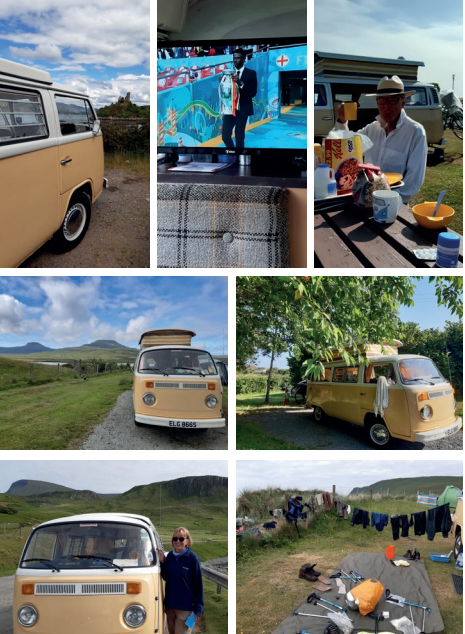
It was a real treat to head north in Dennis the Dormobile last month. We had three glorious weeks in Scotland in July (despite the roadside Yellow Storm Warnings on route!). We broke journey in Crianlarich and travelled on to Skye the next day. Probably busier than usual, the island was far from overwhelmed and Dennis loved the rolling single track roads. We did notice a huge expansion of motorhome hiring since last year. We were surprised by our 1978 T2 having become a rarity and a conversation piece; several people asked to take his photograph! All of which made the campsites even more sociable than usual. Set up in Glen Brittle, we hiked up onto the rugged Cuillin Ridge and got our only soaking of the trip on the way down. From Dunvegan, we used our bikes to explore a landscape that is still only a generation or two away from the crofting life. There was a whole trail of makers and artists on Skye and we dropped in on a weaving shed and a print and glass gallery.
We had been keen to follow the last stages of Euro 2020 despite being away, which meant listening to a crackly quarter-final radio commentary on the road to Crianlarich (did they just score??) and also the semi-final at Dunvegan (the only pub in the village wasn’t open on a Wednesday…). At the small site near Staffin, we asked about the nearest pub for the Sunday night final and the lovely owners told us that they had a couple of spare TVs and they could lend us one to set up in Dennis. So with a low tech but safe hook-up and a bent wire aerial, we watched the match! A first for us. More hiking and cycling to explore the stunning Trotternish ridge and the coastline, before heading down to Loch Rannoch and a campsite near a remnant of the ancient Caledonian forest and some hot and sunny Munros. The evening midges were repelled successfully with some Miss Haversham-style headnets! Three nights with friends and family around Glasgow and north Ayrshire also gave us the chance to do a washing load (!) before our final week down in Galloway in Scotland’s overlooked southwest. If you get the chance, see if you can book a space at quirky North Rhinns campsite. It’s not many miles from Stranraer, but it’s another world; 12 or 15 pitches tucked among a small wood, well looked after by the enthusiastic and sociable owners, who would love to host a T2 rally sometime!! Linda and Stewart Shuttleworth
The Club on tour – Barnstones Caravan and Camping Park, Banbury, Oxon
May 12th to 16th 2022 saw the Club’s annual AGM, BBQ and Club Camp (ABC camp) in Great Bourton. Convenient for the M40 allowing many people to join us, we had nearly 30 vehicles after some late dropouts due to mechanical trouble. Over 60 people spent the weekend together with a lot of laughter, plenty of burgers and maybe the odd glass of something.
In addition to the AGM and BBQ, we also had the FA cup final televised in one gazebo, Eurovision later in the evening and some singing from our resident jazz singer Lorna.
On the plus side, 5 people joined the Committee. On the minus side, Derek Leary stepped down from the Committee after several decades shaping the Club into what it is today. We’ll miss you Derek (and Christie).
The hugely popular JK Weekender is back! Having been cancelled due to COVID, last year’s tickets are still valid in a rollover way to this year.
Set in a field next to the JK headquarters just outside Odiham in Hampshire, Mark and the team give us a chilled out, music, outdoor evening movies, stalls, displays and of course their shop.
Our club enjoys a dedicated club field for members only which includes a disabled toilet. We get plenty of space in a prime position and the club lays on a club tent for congregating is you feel sociable plus we are doing our famous BBQ on Saturday evening – come and get a free burger and have a natter!
If you are lucky, our very own Events Manager Lorna will be singing again! Check out the Events page on this site or see the latest edition of Transporter Talk
The Club on tour – Petruth Paddocks, Cheddar, Somerset April 22 to 25 2022
The first club camp of the season saw us down in the pretty down of Cheddar at Petruth Paddocks, hosted by the wonderful Jules.
What did you miss? Burgers, fire pit, marshmallows, bacon baps. Cheddar village, Cheddar gorge, the caves. Locally made cheese, 16 club member dogs, 33 adults, 2 children, live singer on Friday and Saturday and a lot of laughter.
Here is some feedback from a member:
“We have been VWT2OC members for a few years but had not previously got involved in meetings or attending camps. What have we been missing? The St George’s camp at Cheddar over the weekend was a fantastic event. The campsite was beautiful, clean and friendly; the club negotiated camping rates that could not be beaten; the Saturday evening social around the firepits, with burgers provided and lovely entertainment from Lorna was fantastic; and the coffee, tea and bacon rolls provided on Sunday morning was very welcome. I had nothing to do than enjoy myself. Big shout out to Lorna Williamson, Nick Gillott, Malcolm Marchbank and Val Lewis for all the hard work planning, organising and delivering the camp. You are stars. We were already booked in for the May BBQ & AGM, now we are looking forward to it more than ever.”
Here are some photos from the weekend:
Blus is a good boy!Chef and his apronSue and ElsaDown the avenueSaturday around the pitAnd againDarkness and fireside chatHarry’s early bayAndrew, Jane and HollyThe club gazeboThe view from the endThe view from the other endEmpty area as the last one leftOnions for the burgersChopping the onionsThen separating them!All set up for sleepTony the bay and Steve in shortsMonday lunchtime, just 2 vans leftSaturday after the singing
Spring has sprung and those classics will be starting to come out of hibernation. After months in the garage with the occasional start up to keep it ticking over, your engine can suffer. I have personally experienced this after months of an engine sitting during restoration work and being moved from one side of a workshop to another. Once the work was complete, trying to drive away from the workshop, my T2 Bay Campervan wouldn’t accelerate down the road. Reason – fouled spark plugs.
I have also had a spark plug with a closed gap (don’t even ask how that happened, but it involved losing part of the carburettor through the engine… lucky it didn’t do any other damage!) The condition of your spark plugs can make a massive difference to the running of your engine, so it’s worth checking them every so often, especially after a period of time unused. Hopefully the following information will help to make you a spark plug expert. Before starting work on checking your plugs, it is helpful to have the right tools to hand; accessing the rear two spark plugs at cylinders 1 and 3 can be a real fiddle, especially on later twin-port engines where access is further compromised by the inlet manifolds. A short 21mm socket and universal joint may give you a bit more flexibility. When checking the plugs, it can help to remove each lead and plug individually so that you don’t get them mixed up. This will cause an incorrect firing order and your engine will not run. When removing the ignition lead from the plug, be sure to pull it off by the connector, not the lead itself, as you’ll run the risk of pulling the lead off the connector (trust me!) If you notice any damage to a connector or if a lead is a lose fit, it is best to go out and buy a new HT lead set. Make sure you have the socket on the plug properly when you’re undoing them and it’s also best to do all this while the engine is cold to avoid burning yourself! Once the plug is out, take a good look. Is it brown, grey, sooty or oily? If the engine is running right, it should be light brown or grey. If it is sooty but dry, your engine is running rich and not burning all the fuel. If the insulator is white and flaky then your engine is running too lean. Either way, you’ll need to tune your carb to adjust the fuel/air mixture. If the plug is wet and oily, there are a couple of possibilities. The first is that you’re not getting a spark, in which case you may have noticed a misfire. If this is the case, check the HT lead connection at the plug and also where it pushes into the top of the distributor cap. A worse scenario is that your engine has worn piston rings and/or valve guides, which means a rebuild is on the cards. If there is serious carbon build up on the plug, or what looks like molten bits of metal, chances are your ignition timing is out. Whatever their condition, while the plugs are out of the engine they will benefit from a good clean up using a brass wire brush. While you are at it, check the spark plug gaps using a feeler gauge. For most air cooled engines the gap should be 0.024” or 0.6mm, however check your workshop manual because the gap will be different on some engines. If the gap is correct, the gauge should slip in and out without much resistance. If it is too loose, you can adjust it with a gentle squeeze in a vice to close it slightly, or if the gap is too tight, carefully prise open the contact with a flat bladed screwdriver. Spark plugs should be checked every 3000 miles and replaced every 10,000 miles as part of your service routine. If you suspect a poor running engine there is no harm fitting new ones sooner, they are relatively cheap for a set. When refitting, always start screwing the plug back in by hand, only using the socket for the final tightening, otherwise you risk forcing a cross thread. If you feel any resistance early on, unscrew and carefully try again
The mechanic has noticed a recent uplift in questions and concerns surrounding the upcoming introduction of E10 fuels. The following is information provided by the Federation of British Historic Vehicles Clubs that we hope members will find useful. Federation of British Historic Vehicles Clubs – Introduction of E10 petrol After an extensive consultation process, the Department for Transport has announced that they will legislate to introduce E10 petrol as the standard 95-octane petrol grade by 1 September 2021. They will also require the higher-octane 97+ ‘Super’ grades to remain E5 to provide protection for owners of older vehicles. This product will be designated as the ‘Protection’ grade. The introduction of the 95-octane E10 grade and the maintenance of the Super E5 protection grade will be reviewed by the Government after 5 years to ensure they remain appropriate to the needs of the market: In relation to the E5 protection grade, such a review will examine market developments over the period. HM Government have sought to reassure FBHVC members and historic vehicle owners that, without a suitable alternative becoming available, it is highly likely the Super E5 protection grade would continue to be available. Filling stations that stock 2 grades of petrol and supply at least one million litres of fuel in total each year will need to ensure one product is the Super E5 protection grade. While not all filling stations meet these criteria, almost all towns across the UK will have a filling station that supplies the ‘Super’ grade and currently one major retailer, a national supermarket group, has committed to offer the product. The main exception to this is in certain parts of the Highlands, north and west coast of Scotland, which will be covered by an exemption process and allowed to continue to market the 95-octane E5 grade. The Federation therefore recommends that all vehicles produced before 2000 and some vehicles from the early 2000s that are considered non-compatible with E10 – should use the Super E5 Protection grade where the Ethanol content is limited to a maximum of 5%. To check compatibility of vehicles produced since 2000, we recommend using the new online E10 compatibility checker: https:// www.gov.uk/check-vehicle-e10-petrol . It should be noted that some Super E5 Protection grade products do not contain Ethanol as the E5 designation is for fuels containing up to 5% Ethanol. Similarly E10 petrol can contain between 5.5% and 10% ethanol by volume.
Product availability varies by manufacturer and geographical location and enthusiasts should check the situation in their location.
Latest News: The federation’s fuels specialist Nigel Elliott has received some new questions with regards to ethanol and the use of E10 in historic vehicles and his thoughts are as follows: There are three key areas of concern with Ethanol compatibility with historic and classic vehicle fuel systems: Corrosion of metal components Elastomer compatibility – swelling, shrinking and cracking of elastomers (seals and flexible pipes) and other unsuitable gasket materials Air/fuel ratio enleanment Corrosion of metal component Ethanol has increased acidity, conductivity and inorganic chloride content when compared to conventional petrol which can cause corrosion and tarnishing of metal components under certain conditions. These characteristics are controlled in the ethanol used to blend E5 and E10 European and UK petrol by the ethanol fuel specification BS EN15376 in order to help limit corrosion. Corrosion inhibitor additives can be very effective in controlling ethanol derived corrosion and are recommended to be added to ethanol in the BS EN15376 standard. It is not clear if corrosion inhibitors are universally added to ethanol for E5 and E10 blending so as an additional precaution it is recommended that aftermarket corrosion inhibitor additives are added to E5 and E10 petrol. These aftermarket ethanol corrosion inhibitor additives often called ethanol compatibility additives are usually combined with a metallic valve recession additive (VSR) and sometimes an octane booster and have been found to provide good protection against metal corrosion in historic and classic vehicle fuel systems. Elastomer compatibility As the ethanol molecule is smaller and more polar than conventional petrol components, there is a lower energy barrier for ethanol to diffuse into elastomer materials. When exposed to petrol/ethanol blends these materials will swell and soften, resulting in a weakening of the elastomer structure. On drying out they can shrink and crack resulting in fuel leaks. Some aftermarket ethanol compatibility additives claim complete protection for operating historic and classic vehicles on E10 petrol. The FBHVC is not aware of, or has tested any additives that claim complete fuel system protection with respect to elastomer and gasket materials for use with E10 petrol. The FBHVC therefore recommends that elastomer and gasket materials are replaced with ethanol compatible materials before operation on E10 petrol. Air/fuel ratio enleanment Ethanol contains approximately 35% oxygen by weight and will therefore result in fuel mixture enleanment when blended into petrol. Petrol containing 10% ethanol for example, would result in a mixture-leaning effect equivalent to approximately 2.6%, which may be felt as a power loss, driveability issues (hesitations, flat spots, stalling), but also could contribute to slightly hotter running. Adjusting mixture strength (enrichment) to counter this problem is advised to maintain performance, driveability and protect the engine from overheating and knock at high loads. Modern 3-way catalyst equipped vehicles do not require mixture adjustment to operate on E10 petrol because they are equipped with oxygen (lambda) sensors that detect lean operation and the engine management system automatically corrects the fuel mixture for optimum catalyst and vehicle operation. Operating classic and historic vehicles on E10 petrol If you should decide to make the necessary vehicle fuel system modifications together with the addition of an aftermarket additive to operate your classic or historic vehicle on E10 petrol. The FBHVC strongly recommends that you regularly check the condition of the vehicle fuel system for elastomer and gasket material deterioration and metallic components such as fuel tanks, fuel lines and carburettors for corrosion. Some plastic components such as carburettor floats and fuel filter housings may be become discoloured over time. Plastic carburettor float buoyancy can also be affected by ethanol and carburettors should be checked to ensure that float levels are not adversely affected causing flooding and fuel leaks. Ethanol is a good solvent and can remove historic fuel system deposits from fuel tanks and lines and it is advisable to check fuel filters regularly after the switch to E10 petrol as they may become blocked or restricted. If your vehicle is to be laid up for an extended period of time, it is recommended that the E10 petrol be replaced with ethanol free petrol which is available from some fuel suppliers. Do not leave fuel systems dry, as this can result corrosion and the shrinking and cracking of elastomers and gaskets as they dry out.