Category Archives: Member’s Stories

Trips, restorations or anything else you think might be of interest

Eric the Viking – a restoration in many parts – February 2025

Spend since last report: £231. Total hours labour since last report: 16.75
Winter is cold and we all feel like hibernating. Or maybe it is just me. The damp garage can stay damp, the cold garage can stay cold, I’m staying indoors in the warm and the dry. The front seats are mostly done although I did find that one of the zigzag metal serpentines has snapped meaning I need to remove the fabric, the horsehair and weld that up but it is not the end of the world.

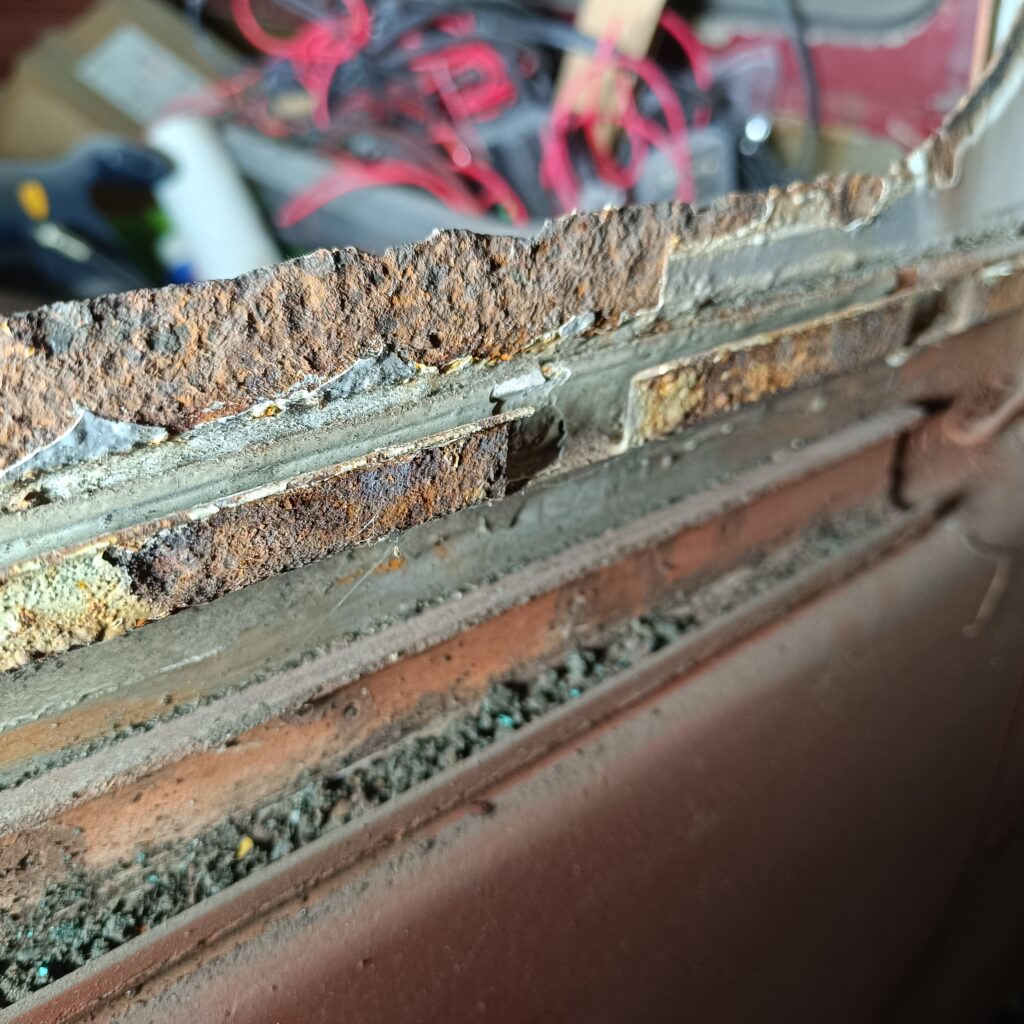
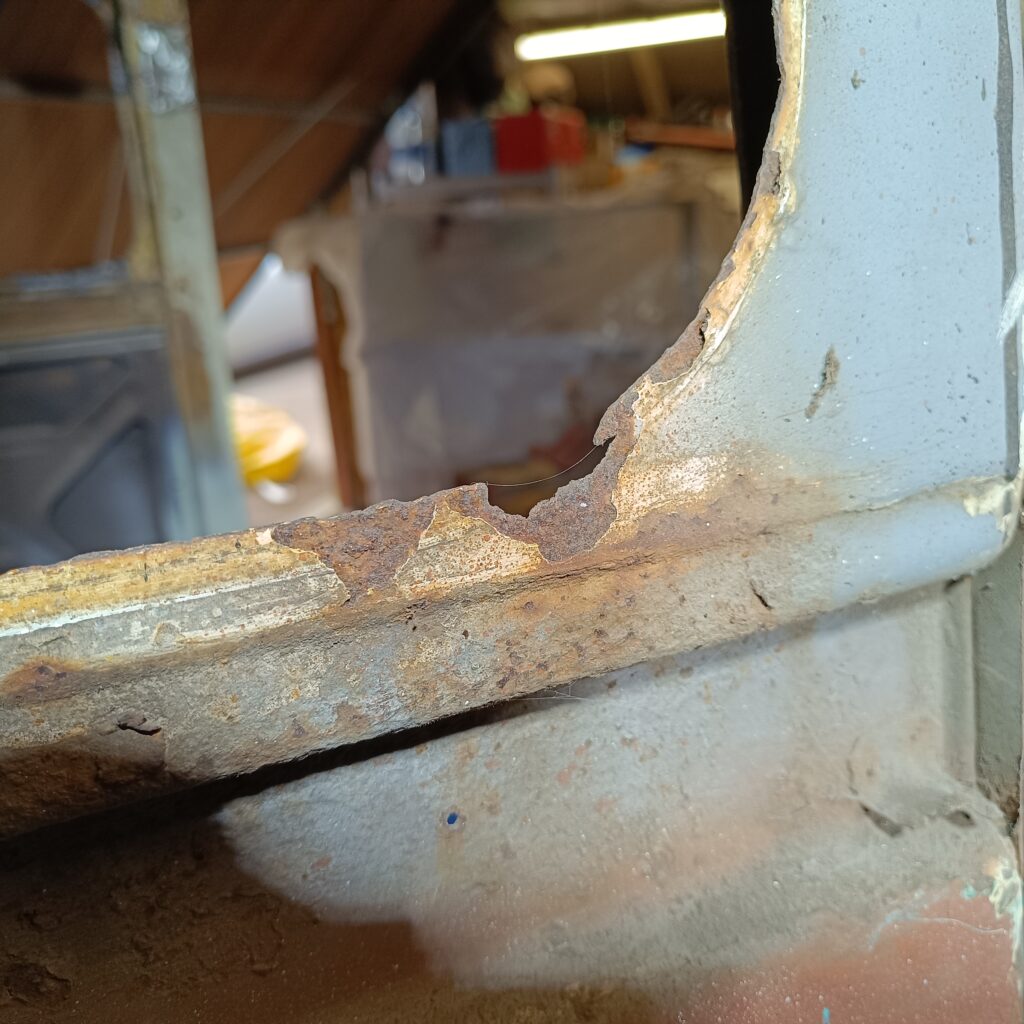
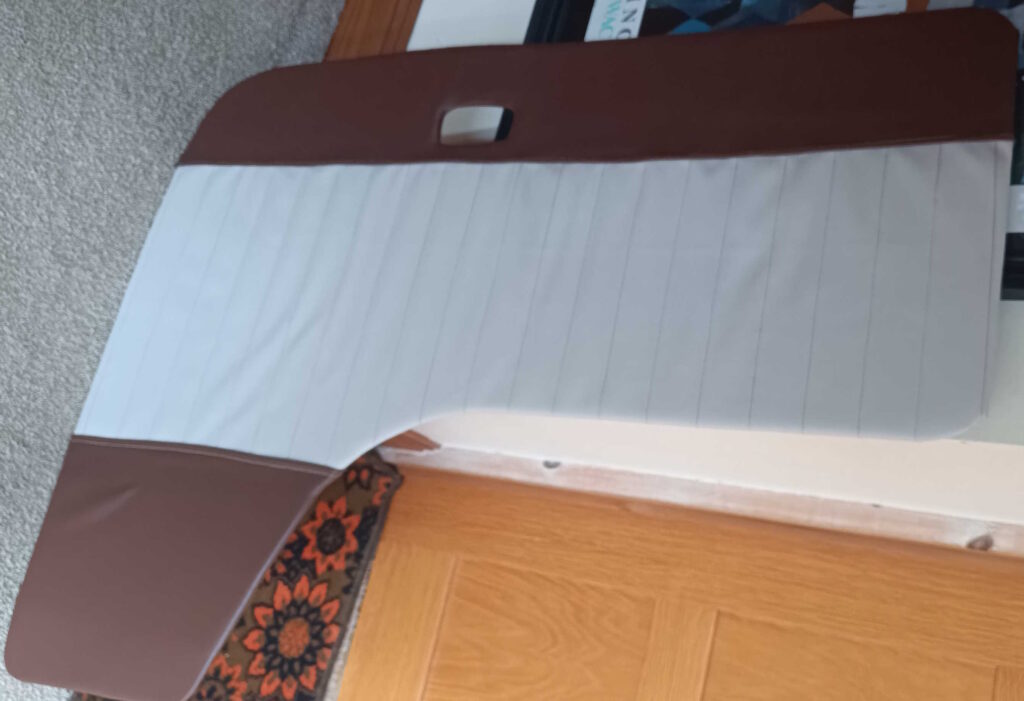
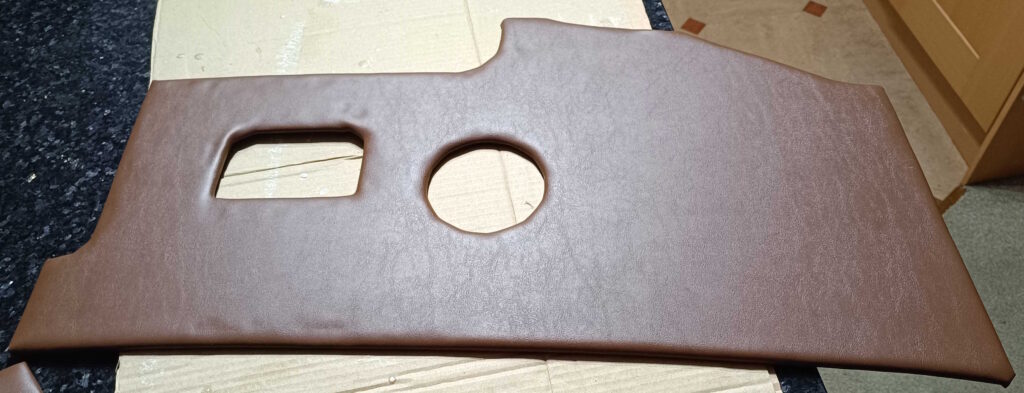
Following a post-Christmas period of inactivity, I got my Eric head on and started on the door cards for the front doors. Since the front doors have water designed to run down the outside of the winding window and some goes past the door rubber, the door can get a little water inside. There are channels at the bottom of the door to let the water out, although these block over time causing water to sit at the bottom and rot the door frame. Oh boy does Eric have rot there. Since the inside therefore could be somewhat damp, I elected to varnish the front door cards with an exterior grade clear varnish to help keep the MDF from soaking up the moisture which should reduce the chances of it warping. Two thin coats to each side and the same with the kick panel cards that go in front of the front seats.

The door cards that are normal height are to be 2 tone reflecting the original brown leatherette supplied in the panel van (as it was) in 1973. I chose a slightly darker brown than original as the other option was a mocha which was too pale and insipid. In the middle of that is to be the ivory of the seats that were completed at the back end of last year with their dark brown piping and once finished, it should look quite smart.

The piping foot of Sally sewing machine has been very useful and I am getting much more confident now. Create a dark brown striped of fabric about 7 inches tall with piping along one long edge. Another about ten inches tall.  The ivory middle has no piping but has pleats / seams every 2 inches / 5 centimetres vertically to match the ones on the seats. This matches a lot of bay windows that I have seen but our other camper van Poppy has the original door cards from 1972 which have horizontal stripes. Both have their merits, and I like both.

Once the 3 pieces have been completed along with the ivory having 3-millimetre foam sewn behind it, it is assembly time. Sew along the existing sewing line next to the piping to join the dark brown to the ivory top and bottom, looking to ensure that the gap between the two sewing lines is 36 centimetres all of the way along. This is done with a high-tech pencil line along the ivory fabric.

Then I sprayed some glue on the door card and carefully glued the piping section to the door card along another pencil line. With that fairly straight, I glued the rest of the ivory then glued foam to go behind the dark brown sections before folding the entire fabric around the edges of the board and spray glueing the fabric to the back with about an inch of fabric on the back.

The contact adhesive spray needs to wait a minute or so to become tacky at which point you can almost press the fabric on, and it is finished. However, for completeness I clip the fabric down for 5 minutes at each section I am working on.

The end result is not completely straight as I am not a professional, but it is straight enough and looks great. I cut a hole for the door opening catch and glued the back of that but have yet to cut holes for the window winder or the closing strap. With the driver’s side finished, I repeated the process for the passenger side and then trimmed both kick panels in plain brown as they sit low. Trimming those is a simple case of glueing the 3-millimetre foam to the board then glueing the brown fabric around the rear and trimming as you go. The cutouts are for the warm air and the filler point for the windscreen washer fluid. Downstream, I may cut a further hole for some speakers that are in the loft in readiness.

With both front door cards and both kick panel board complete, I did the straightforward panels in the boot, one at each side and the one for the boot lid. Again, all plan brown reducing time as there is no piping required.

The sliding door follows the same idea as the front doors, a central stripe of ivory with vertical pleats and dark brown top and bottom. I did not notice the piping was wonky on the top creating a slight arc which meant that either the piping can be sewn to the ivory in a straight line leaving a rucked top or the top can be flat, but the piping is curved. It was not huge, but you see the sliding door panel quite a lot and I knew that it would irk me. Unpicking piping takes forever!

With straight piping, once again I joined the dark brown top and bottom sections to the central ivory and glued it all to the board. I am pleased with the result.

There is a panel on each side of the main sofa that need making with piping and multi fabric, then it is just 2 plain brown panels, one behind each front seat and the door cards are complete.

On the purchasing front, I jumped in and purchased a new 39mm Solex carburettor to replace the original 34mm Solex carb that needs a rebuild. I have the rebuild kit but the extra capacity will help with engine power plus it matches the one purchased last year for Poppy and with the same engine, same air filter and almost everything else, having two of everything may come in handy.

With the weather starting to warm up and the sun peeking through the incessant cloud of the last few months, perhaps I might get some progress that is not sitting at the dining table!
Member Report – Travels with Dennis the Dormobile by Linda Shuttleworth

TRAVELS WITH DENNIS THE DORMOBILE by Linda Shuttleworth

Years ago, we had a trip to Picardy in northern France with our two boys; our first venture with Dennis overseas, and we thought at the time that was probably about as far as we could reasonably expect to go with the van. However, last year we ventured into northern Spain and Portugal for most of the month of May, covering around 1500 miles without any major problem (until we broke down near Rugby on the way home, and missed the Embsay T2 rally!). That gave us the taste for continental travel with Dennis (as well as Mateus Rose!)

This year, the inspiration was Hanseatic ports. The Hanseatic League was a powerful medieval trading network which began tentatively in the 12th century, and continued until the mid-19th century. Many of the Hanseatic port cities have retained some of the architecture and townscape built in their prosperous glory days. Nijmegen in the Netherlands, and Bremen and Lubeck in northwest Germany suggested themselves. Lubeck is so close to the Danish border, that it would have been rude not to take the opportunity…we planned to visit first the southern Danish island of Lolland, then Copenhagen, and Odense on Funen. With the return journey back by Leer in German Friesland, and a couple of nights near Rotterdam, that took care of August!

To relieve ourselves of unnecessary driving miles, we took the overnight ferry from Hull to Rotterdam. This comes with small and comfortable ensuite cabins, two restaurants, bars and entertainment, a good start.

From Rotterdam Europort, we drove to Nijmegen, and camped south of the city at Heumens Bos for the first four nights. This was about an hour’s cycle from the city, no chore in cycle-friendly Netherlands. It was actually lovely to be in an area of woods, smallholding farms and waterways. We had two days in Nijmegen itself, and a day around the villages and fens. There are memorials everywhere to the post D-Day Allied efforts to take the bridges and liberate Europe, which was an additional interest for us, as Stewart’s Dad had been in Nijmegen in 1944 with the Royal Artillery. The campsite was green and peaceful, broken up into smaller areas with trees and hedges, a small shop, bar and café, swimming pool – and an outdoor gym!

Then to the Hanse campsite by a lake in a massive park in the outskirts of the majestic city of Bremen, good facilities again including a lakeside restaurant, a shorter cycle into the old heart of the city. We also enjoyed exploring the river and the harbour area.

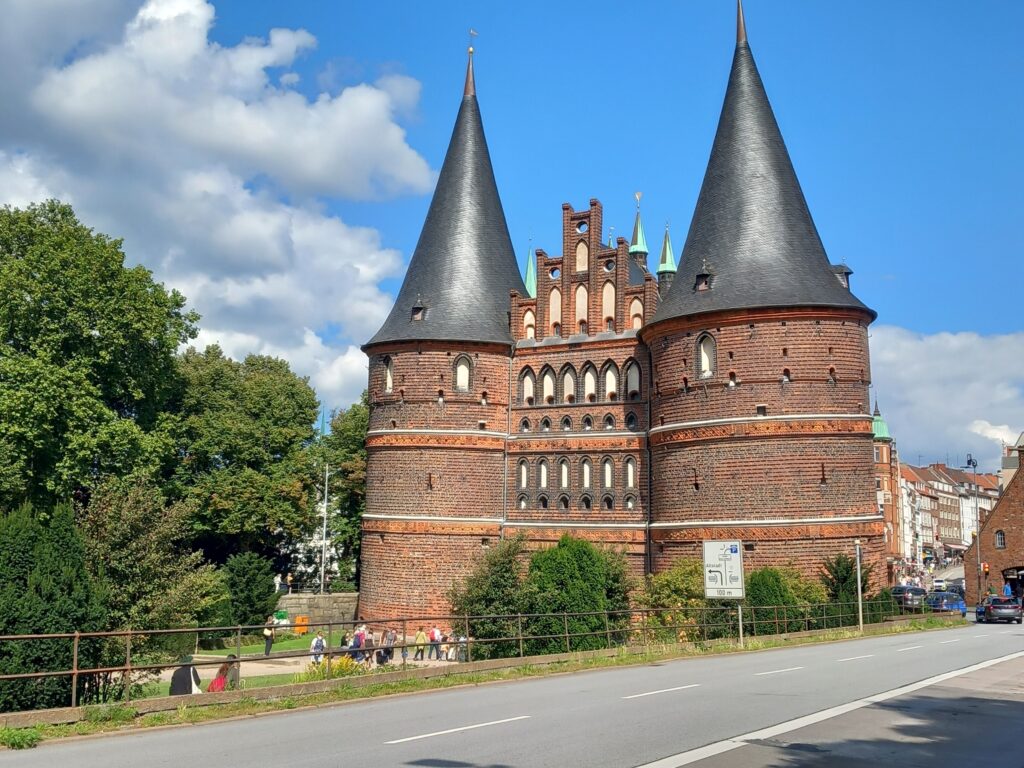
It was a short drive to our friendly Campingplatz on the edge of Lubeck, and near open countryside. Lubeck was stunning for its towers and spires, city walls and other buildings, a medieval cityscape on steroids! It was the cradle and most important city of the Hanseatic League. The historic old town, densely built on an island in the river, is Germany’s most extensive UNESCO World Heritage site.

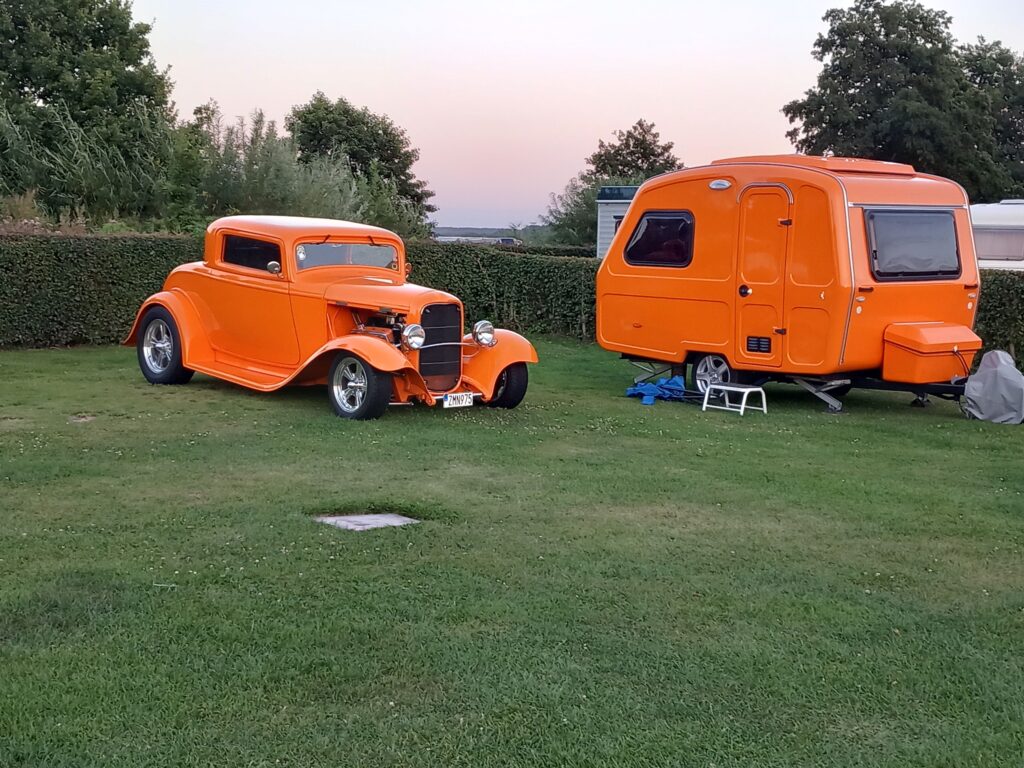
It felt dramatic to cross to Denmark by ferry, something that will soon be a thing of the past, as a massive tunnel on the seabed is being constructed right now, section by section. We visited the exhibition centre about the tunnel, which was fascinating. We had a lovely campsite by woods and a lake, within a short walk of the small town of Maribo. We had the best spot by the edge of the trees, with the bonus of the first night of ‘My Fair Lady’ belting out from the outdoor theatre behind us! We were also lucky to be there at the time of the two-yearly international gathering of vintage vehicles with souped-up engines (hot rods), which paraded themselves in and out every day.

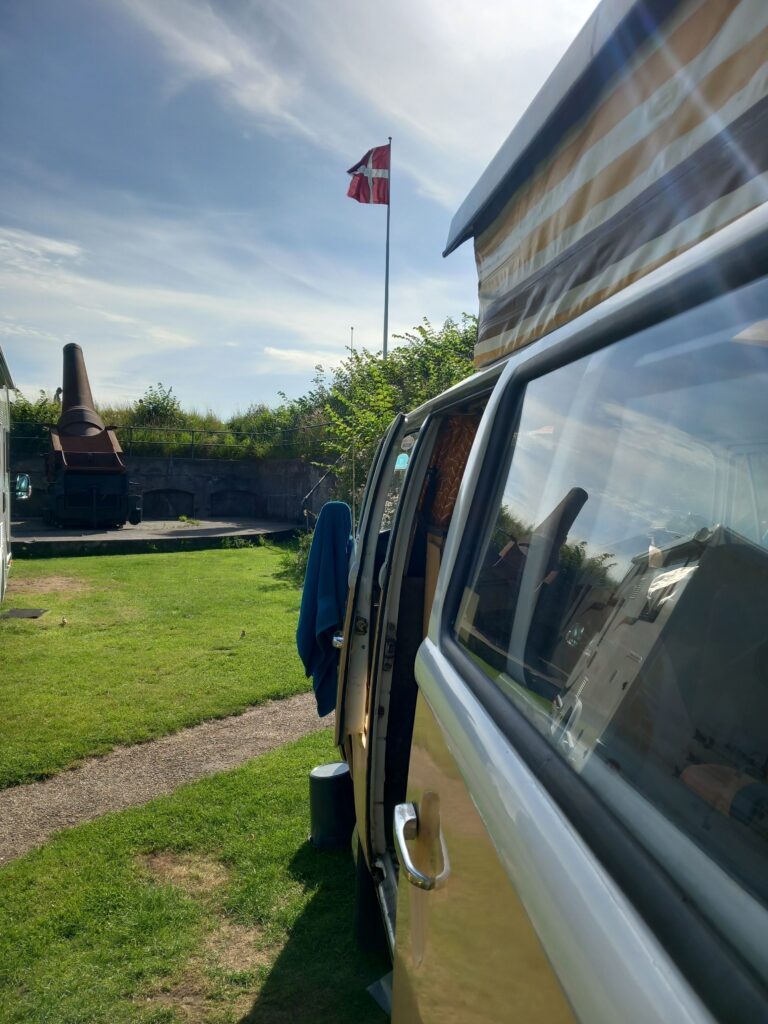
Tunnels and bridges between the islands (we hadn’t realised how many islands there are in Denmark) took us to Copenhagen, and the unique campsite tucked within the star shaped ramparts of the 19th century fort at Charlottenlund, complete with 1912 Howitzer guns still pointing at the sky. On the seaward side, the Baltic is fringed by a popular sandy beach, good for swimming. Even Linda got in and swam in the Baltic! The campsite information had mentioned the Morning Sing, slightly to our bemusement. And at 9 am, sure enough, there was a communal singing of Danish folksongs! We were impressed at how easy it was to cycle in and around this, the capital city of Denmark. We found being in the cycling rush hour at the end of the afternoon quite exhilarating. Of course, we had to go and find the Mermaid on the first day (she’s stunning, even with all the attention around her).

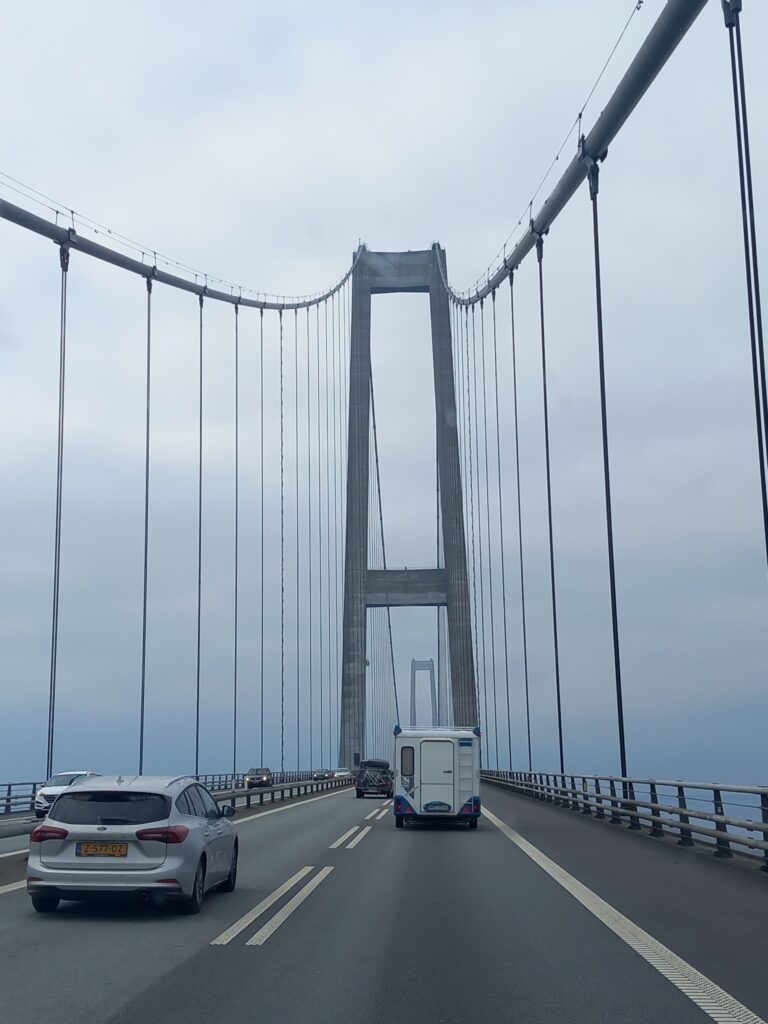
Odense was an unexpected joy, the third city of Denmark, and the centre is almost entirely traffic-free and green. Bikes and trams are the order of the day, both in the old quarters, and the twentieth century precincts. Hans Christian Andersen is perhaps the most celebrated son of the city. To drive there from Copenhagen takes you over a very familiar (to viewers of Scandi noir) and enormous Bridge in two distinct parts, 18km in total length. It was awe-inspiring, especially to be travelling over it in our old friend Dennis.

It was a relatively long drive from there to Leer, in German Friesland, which we had picked as a convenient break of the journey back to Rotterdam. The campsite is a little out of town, by a former marina (which is turning back into a wildlife wetland) on the river Ems. Leer turned out to be delightful, a historic town and harbour with equally historic boats, and the surrounding countryside blends into that of the Netherlands, with waterways, dykes and polders.

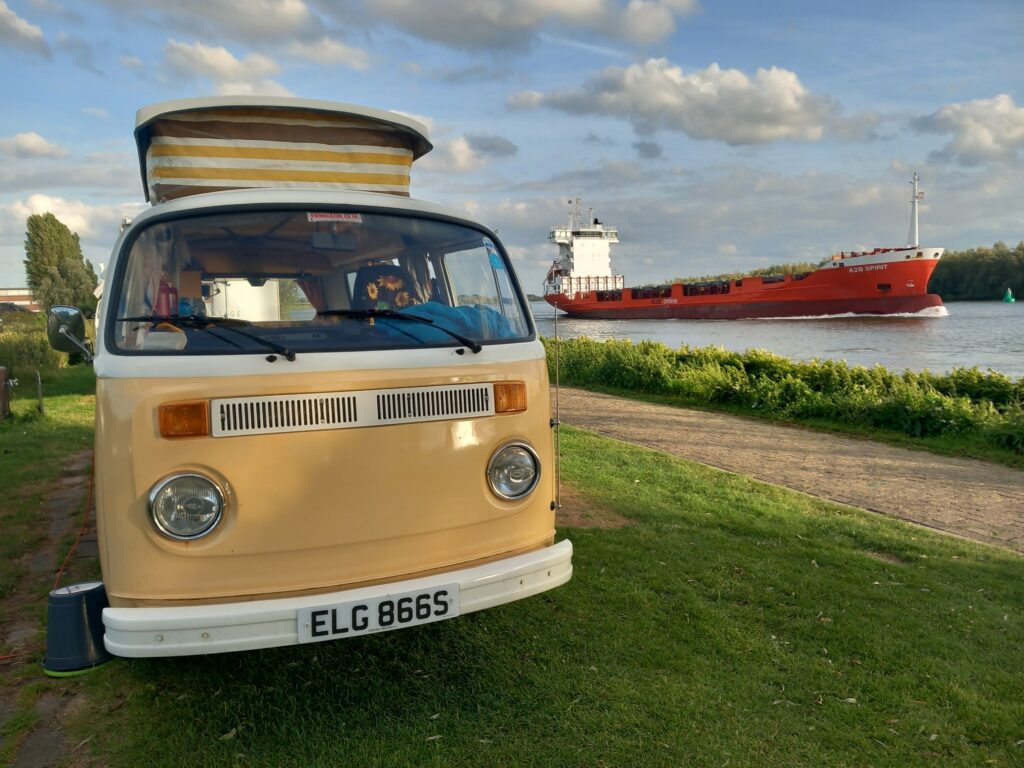
Finally, we crossed the border back into the Netherlands, and to the rather alarming outskirts of Rotterdam, at one point driving in the midst of two parallel motorways, twelve lanes of traffic and muttering ‘thought this was a cycling country!’ Having said that, it was well signed, and with one of us keeping an eye on navigation, we were fine. Suddenly we were driving along quiet narrow roads on top of dykes and through villages to our campsite southeast of the city, by the huge Oude Maas River. This site did have a functioning marina, and to our delight, some pitches on the banks of the river, very windy but with the most incredible amount of commercial traffic. Riverboats and barges were passing every few minutes, to Stewart’s unspeakable delight!

Rotterdam is a big city to take in on a day, and after walking our socks off, we had a lovely late afternoon trip on a heritage tram, which took us round both the old and the quirky modern aspects of the city. We spent our final day in Dordrecht, a few miles east of the campsite. Like Leer and Maribo, we had never heard of it before this trip, and like them, it took us by surprise. With the old heart of the city built on three islands, Dordrecht has Venice-like streets of houses built right into the water. We happily wandered around, taking it in, before treating the navigator to a large G&T and both to tiny poffertjes pancakes, and heading for the overnight ferry…and our first T2 rally at the Embsay and Bolton Abbey Railway!

Linda and Stewart Shuttleworth, summer 2024.

Eric the Viking – a restoration in many parts – December 2024

Spend since last report: £136. Total hours labour since last report: 54.6

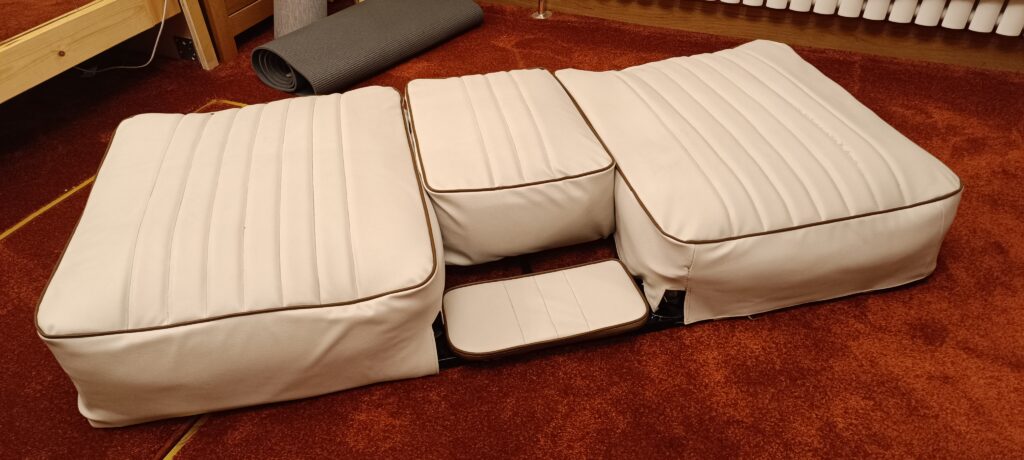
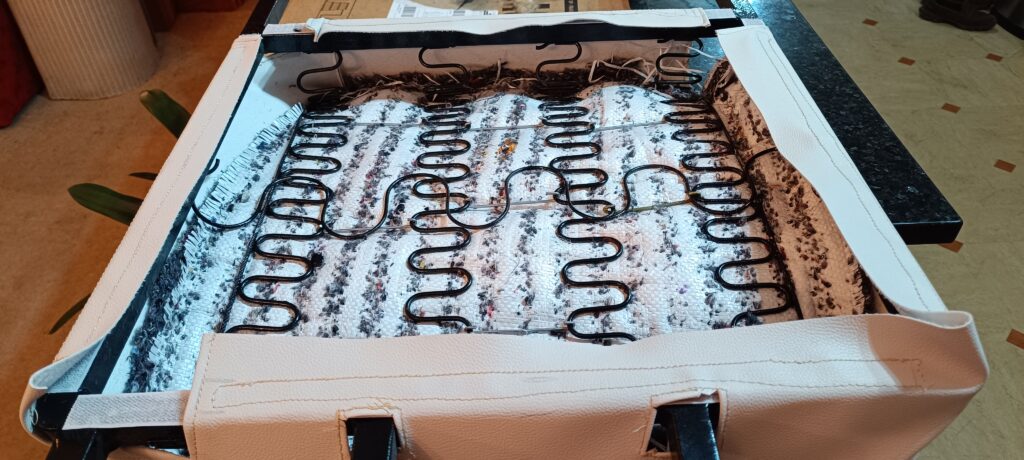
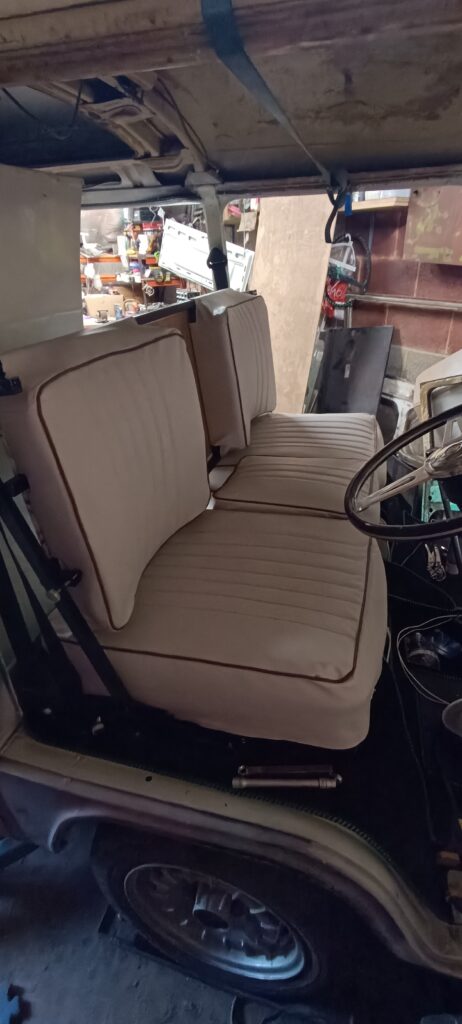
The last two months have been productive but mostly not in the garage. To “be nearby” as Lorna convalesces and frankly, to be warm, I have been busy wielding “Sally Sewing Machine”. The front seats that were originally in Eric are now in Poppy as we decide how to upholster them now that they have got rather old and soggy plus at least one piece needs welding. In their place in Eric, I made a frame for two seats that I wrote about some time ago – they are the same size as original ones and use the same spring and serpentine arrangement but they are mounted on a 20mm box section steel frame to allow them to be inclined correctly when facing forwards or backwards. With some bent metal staples added between the serpentines for support, I brought the base frame indoors and started cutting the material for the base trim.

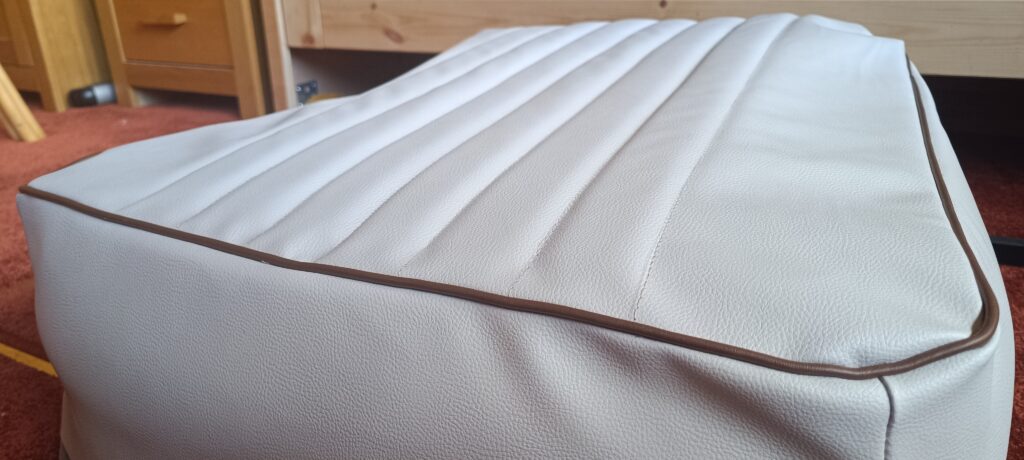
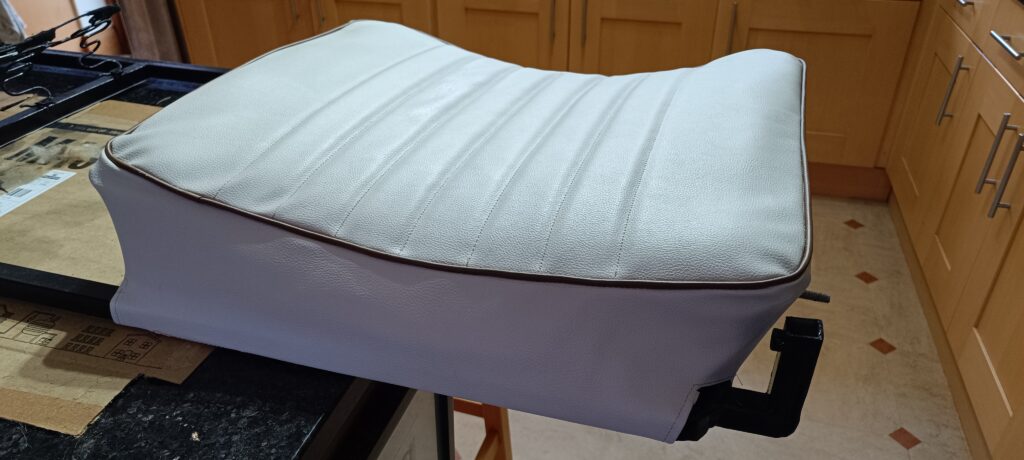
The first piece of material is the seat base top that you sit on, which I cut with a 10mm seam allowance and placed it on the metalwork – already it looked marvellous! Then I took the 10mm scrim foam and cut a piece to match. The new Somabond thread is high strength nylon and is 3,000 metres long – that’s towards two miles on the reel which is enormous. With a practice on a scrap, I found a way to get both material and foam under the presser foot of the sewing machine (it is a domestic one from Hobbycraft, not a professional one with a walking foot so it is a bit more tricky!) and get the pleat roughly straight. Then onto the real thing – a pencil line down the middle marked the first front to back pleat and 3 on each side of the middle at 5cm apart makes 7 pleats plus about 12cm of cheeks on either side. Pencil lines along all of them to guide things and I pushed the material through. The first one had around 1mm of movement along the straight line on a couple of the pleats but that was mainly to do with the domestic machine being asked to sew more material than it can comfortably eat.

The pencil lines can then come off and we have a rectangle of material with a foam backing and 7 pleats that look rather like the real thing. Quietly pleased with myself, although it took a while.

Then I took two full width pieces of the brown door card material (I did side to side and according to the Internet, piping should be cut from a diagonal but that is hugely wasteful), sewed them together into a 3-metre-long piece of 26mm wide and changing to my piping foot on the machine, I made brown piping.

Next up, I took a long rectangle of the cream material which will form the sides of the seat, long enough to go all the way around the seat base. The piping was sewn onto this rectangle of cream.

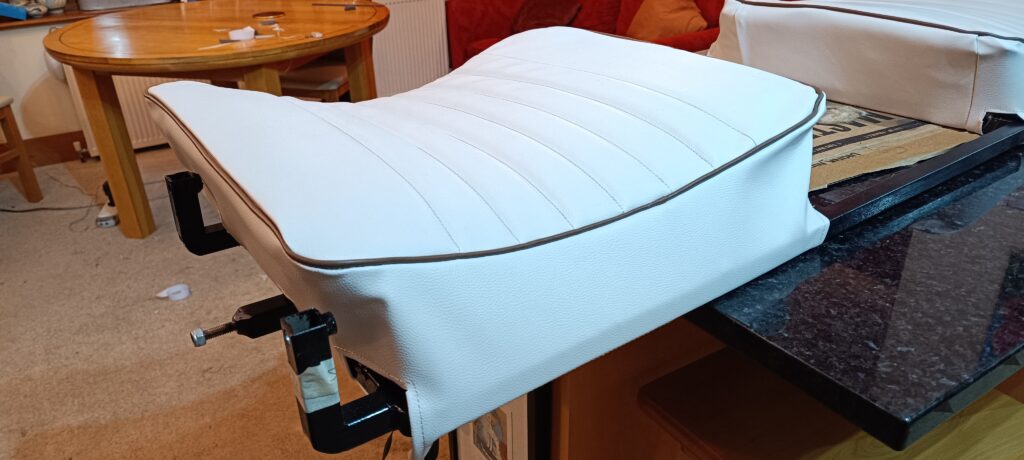
With my top and my sides made, I then ran a pencil line around the top where I wanted the piping, put on my big boy pants and set to work, the machine now sewing through the top, the side and both pieces of material that form the piping. Once the tension was adjusted high enough, the machine coped – the corners were a bit fiddly but went well. Eventually, I had a cover and once on the metalwork looked rather nice.

Under the cover, I added some man-made horsehair and it was very lumpy, even in a sewn bag that went under my evening sofa chair for a week. Layers of lambswool produce a much flatter, albeit slightly less soft, seat.

Rinse and repeat for the other front seat and already the pleats are coming out more defined and straighter as I get my eye in. Then a middle seat / arm rest / dog seat that is mounted on board and goes from the front to just in front of the arm rest so that the seatbelt buckle can emerge and a small upholstered flat piece for a drinks table when you are facing backwards.

Both seat bases received ears of fabric to allow a drawstring to be used underneath to pull everything tight, then on to the seat back!

The seat back metalwork is more sculpted to curve around the back of the user, which presented the issue of how to get the material sewed correctly to avoid and bagging. The main piece was made as previously with the foam underneath. The rectangle for the side similarly and the piping similarly as well. The piping was sewn straight for the sides, and in a curve at the top and bottom to match the curve of the metal. Once that had been worked out, it was then a case of repeating the attachment of the bib to the side piping and sewing up the start of the side to the end of the side.

Each of the covers has to go around metal in places which needed careful cutting and seaming.

And then the padding can be smoothed out, Velcro added to the metal (self-adhesive) and to the seat cover (sewn on for strength) and get a final trim.

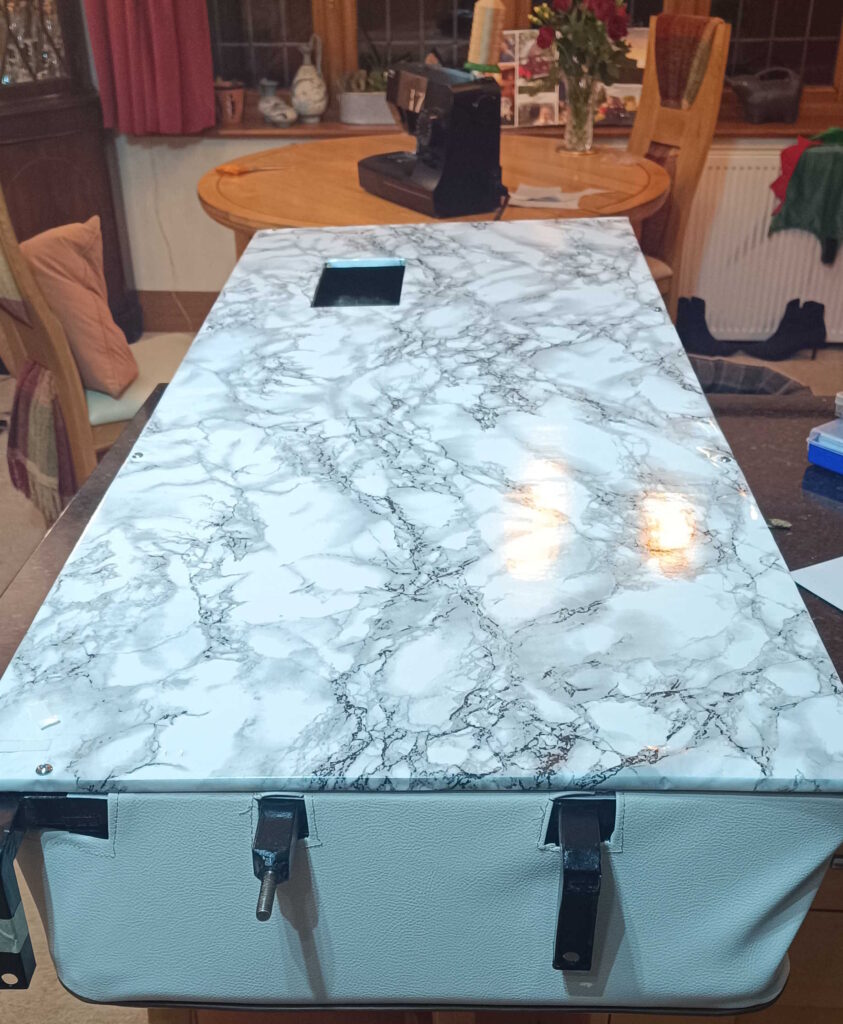
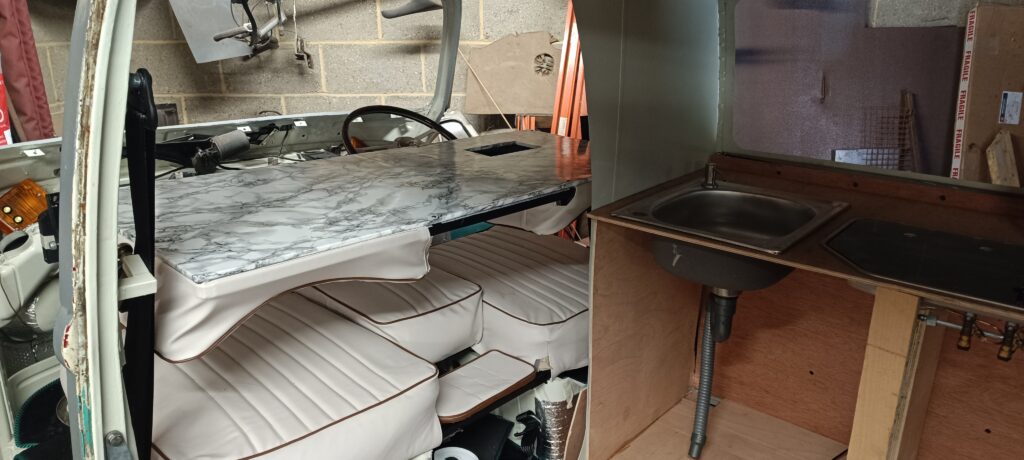
With the material complete, the seat back now needs the rear to be made pretty as you do not want to see the serpentines all the time. When not driving along and not sitting on the seat, I want the option to use it as a table – 3 jobs in 1! I removed the upholstery to keep it clean, cut a piece of 9mm exterior hardwood board and trimmed the edges to fit the metal of the seat back. With a suitable hole for the bottom of the steering wheel cut, I then came in and added some marble effect sticky back plastic and the back was finished.

The dining room was requisitioned for sewing, the office was heaving full of rolls of material and the back bedroom was being used to cut material on the floor. With Christmas coming, it all needed to be tidied away to allow us to have pigs in blankets, or “relatives staying in the spare room” as some call it (sorry Mum and Dad, I know that you have heard that plenty of times before, but it is quite clever). The rolls of material, foam, sewing machine and everything else were tidied away, the upholstery stores converted to bedrooms and the seats removed from the house and into Eric both to empty the house and verify it all fits.

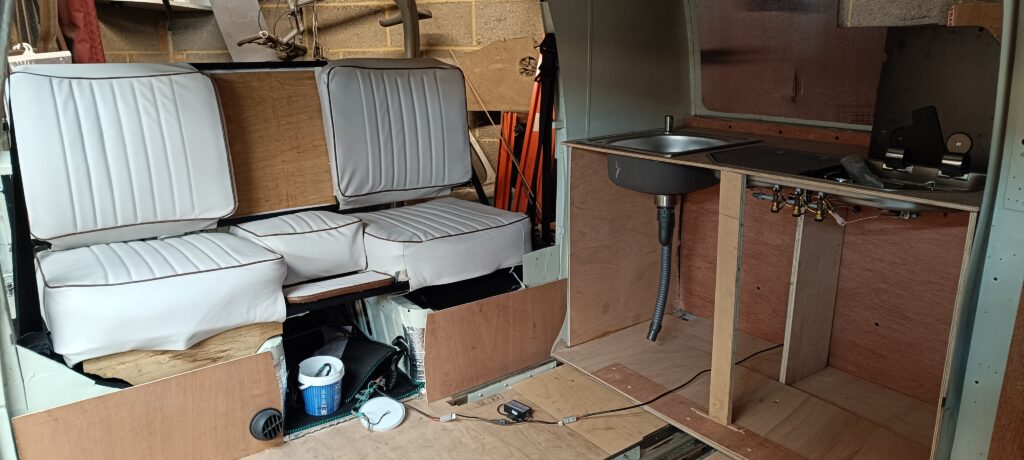
I was rather pleased with the result. This configuration gives me seats for driving, the same seats facing backwards for camping and a table for storage / dinner prep.

I will admit that in addition to the upholstery, I made a start on the wiring as well. After a full review of the wires, I added a battery to the right place, added the wire that ought to be on the alternator to the battery as well (since there is no alternator and no engine). As I turned on the side lights, headlights, beam, hazards and windscreen wipers, each fuse showed 12 volts as the right time. I was rather heartened and finished the day in a celebratory mood. The next day, I joined the right fuse to the actual side lights, headlights, beam, and windscreen wipers. Nothing worked, not a single circuit. Which was a key reason why Sally Sewing Machine came out.

A job for another day, perhaps I can persuade Malcolm to pop down and help me get it all sorted?

Day Trips by Neil Elliott

If, like me, work (school staff) gets in the way of a weekend away, don’t miss out on some fabulous days out. Winter or summer get some use out of that VW. You don’t have to go far.

We live in a small market town near Skegness and often just drive into the Wolds for the day, but it’s not the only local gem. Within 30 minutes we can be parked at Gibraltar point, a marvellous nature reserve with long or short walks, within an hour to an hour and a half we’re parked on the front at Cleethorpes, in a field next to a castle, walking along a river or wandering around the ruins of an Abbey!

Yesterday (Saturday), we took two of our children to Cleethorpes. My Daughter Elizabeth has quite severe Autism and loves our days out. We had a wonderful walk to the ice-cream kiosk and along the Prom’. Then it was back to the T3 for cheese on toast before a steady drive home.

You’ll be surprised how many of us just don’t bother with or even know what is on our doorstep. Get your maps out and take a look, you’ll be pleased you did. And why not put the word out, meet another VW, I’m always up for an impromptu meet up that’s only up the road.

Happy days

Neil.

Member’s Motor – Mark Broad-Holcombe

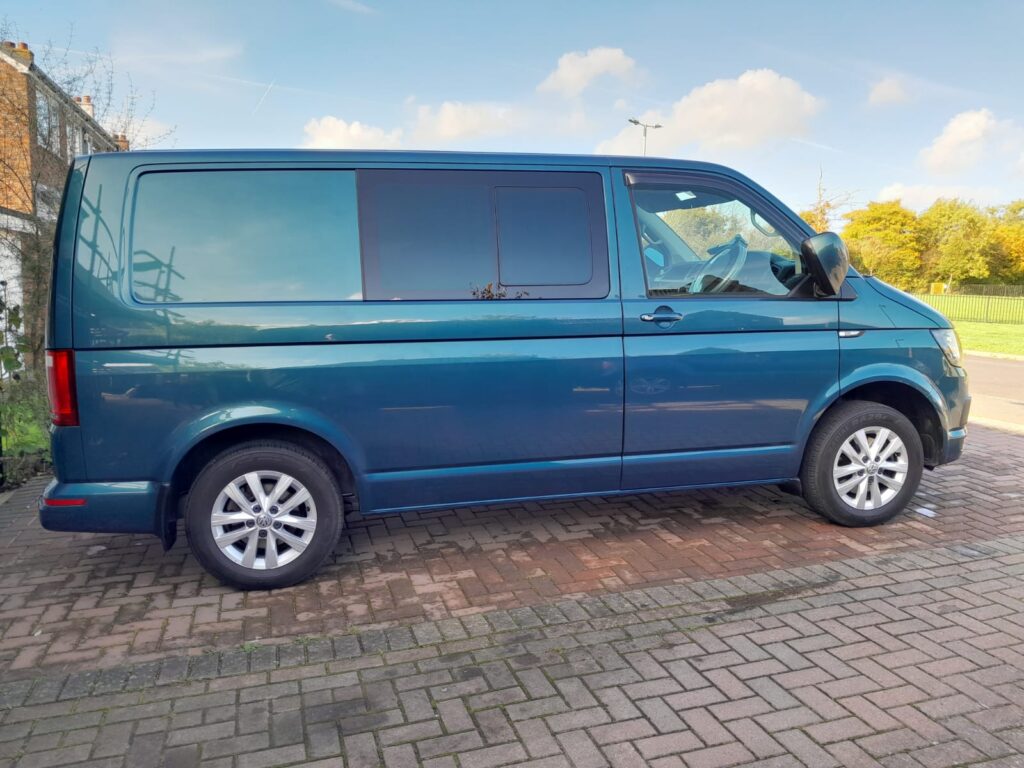
The unreliability of our beloved vans is not the sole ownership of the air-cooled bays and splits. Helen and I waved summer 2023 travels goodbye due to our 2019, 18,500 miles only T6 Kombi developing an EGR fault.

Back in May we were literally just pulling onto the drive after a trip to Derbyshire and Suffolk to visit family when an engine fault light lit up on the dash. My usual mechanic was able to diagnose the fault as EGR problems but as the van was so low mileage reckoned I should try to get VW to fix it on goodwill.

Now the fun begins. Yes, VW will look into the fault and possibly fix as a goodwill gesture but there’s a three month wait for a garage slot! Bye Bye summer camping. The appointment eventually arrived and despite a few niggles, VW did indeed fix the fault on goodwill (the new manager was very helpful). An EGR flush was carried out.  I did have to pay for a forced regen which wasn’t so bad as you all know put the word Volkswagen in the mix and costs reach for the sky.

It seems this problem isn’t uncommon with the newer Euro 6 transporters due to the ever increasing tightening up of emissions basically blocking the EGR valve with carbon. Pottering around town, which I try not to do seems to be the arch enemy and I have been told by a few knowledgeable people to minimize carbon build up red line it and drive it like you stole it!!!

After having the T6 EGR flush and forced regen carried out in early September 2023, I thought that the engine might behave for a while. It did, but only for nine months and not a lot of miles. On the return journey to Bristol from South Gloucestershire in early June on the M5 joy of joys engine light came on. Managed to book into the local garage within a week. Diagnostic results came back; EGR insufficient flow. They fixed it there and then but I picked it up at the end of the day with a bank balance £1,100 pounds lighter! Most of that bill was for parts.

By all accounts the EGR flush is basically like sticking a plaster on the problem. I suppose I did get nine months out of it.

Eric the Viking – a restoration in many parts – August 2024

Eric the Viking – a restoration in many parts – August 2024

Spend since last report: £73. Total hours labour since last report: 16.1

The last issue was reserved for the Germany trip, so this is actually 4 months of very minor and rather eclectic updates.

I bought a diesel heater some years ago which in the short term was on the garage wall to take the edge off the winter cold. This was dismantled and built into the wasted space under the passenger seat. It took a little fiddling as the space is large enough for the heater but the entrance was too small. A section of bracing was removed and welded in a few inches away allowing the heater to pass into the hole. A hole was cut in the floor of that area for the exhaust pipe and air inlet and the 2mm thick steel plate provided with the heater was bolted into place. A 70mm hole was cut in the rear of the bulkhead to allow hot air into the cargo area as well. I have fashioned a very small fuel tank that also sits in the same area to run the heater at night. It is very discrete as well as functional.

The kitchen pod has been filled, sanded, epoxy primed and top coated on the inside and looks rather good. It cannot go in until the B post and C post are finished and top coated though, so it is sitting forlornly at the side of the garage. That left nothing needing white paint that was finished, so I sanded the dashboard, pedal and steering column sections before spraying them black and trial fitting them back in.

The wiring loom was removed some years ago and had been subjected to some “upgrades”. This included a lot of bullet connectors to join the front to the rear and plenty of extra wires serving unknown purposes. Every wire was removed from the fuse board, inspected, cleaned and the coil, ignition and main live cables from front to rear were replaced. The entire plastic shrouding from 1973 was hard, brittle and missing sections, so it was removed and discarded. The fuse board was filthy and slipped out of my hands, accidentally landing in the dishwasher whilst Lorna was out. Along with some of the plastic air vents. Once it was all clean and ready, the smaller cables like rear lights and indicators were rejoined, the whole loom rebuilt into the fuse board following the 1973 wiring diagram and the long snake hung from the fuse board.

Several rolls of fabric tape were used to give me a neat finish from the fuse board for about a metre. This was then passed through the hole in the floor in front of the passenger’s feet and onto the garage floor.

The brake lines were still not right, so to finish both brakes and wiring, Eric went onto his side again.

All brake joints were dismantled, checked and put back together or replaced. Malcolm’s advice was that making the end is all well and good but to finish it, you wind it down into the correct place.

With the van on his side, the rest of the wiring from front to rear was taped up and run as far as the engine bay. Then the reversing light switch on the gearbox received a pair of new cables in more fabric and that ran into the engine bay as well. Then finally, the brake light switch on the new master cylinder also received a new pair of cables in fabric up to the fuse board. All told, that looked rather nice.

The rear windows had also seen better days and needed some attention – very frilly metal was removed, new sections added, and welds tidied up. The external covers on each side sit on clips nearly a metre long which had also perished and have been removed. New ones are a continuous U-shaped steel section, the old ones were more like fingers which makes them very fiddly to make. JK came to the rescue (with club discount) supplying the simple rectangle of steel folded over. There were no mounting holes either, so I drilled holes ready to weld them to the body.

Brake bleeding again.  The plastic reservoir on top of the master cylinder was leaking, cylinder removed to the bench, issue traced to it not sitting correctly. Master cylinder refitted.

Brake bleeding again. The master cylinder was now leaking on the joint heading to the rear brakes. I’m not playing that game again – just that one end removed, and new flare added. Every time I remove a pipe leaking at one end, the other end leaks!

I would have done more, but since the last report, we have been to the AGM, Germany, the Cider farm, Cheddar, Herefordshire again, RAF Odiham and that is just club events. I’m going back to work for a rest!!

Member’s Motor – Penny Lane by Philippa Symington

Our story is probably not at all typical of your members – all amazingly enthusiastic about their old campers!

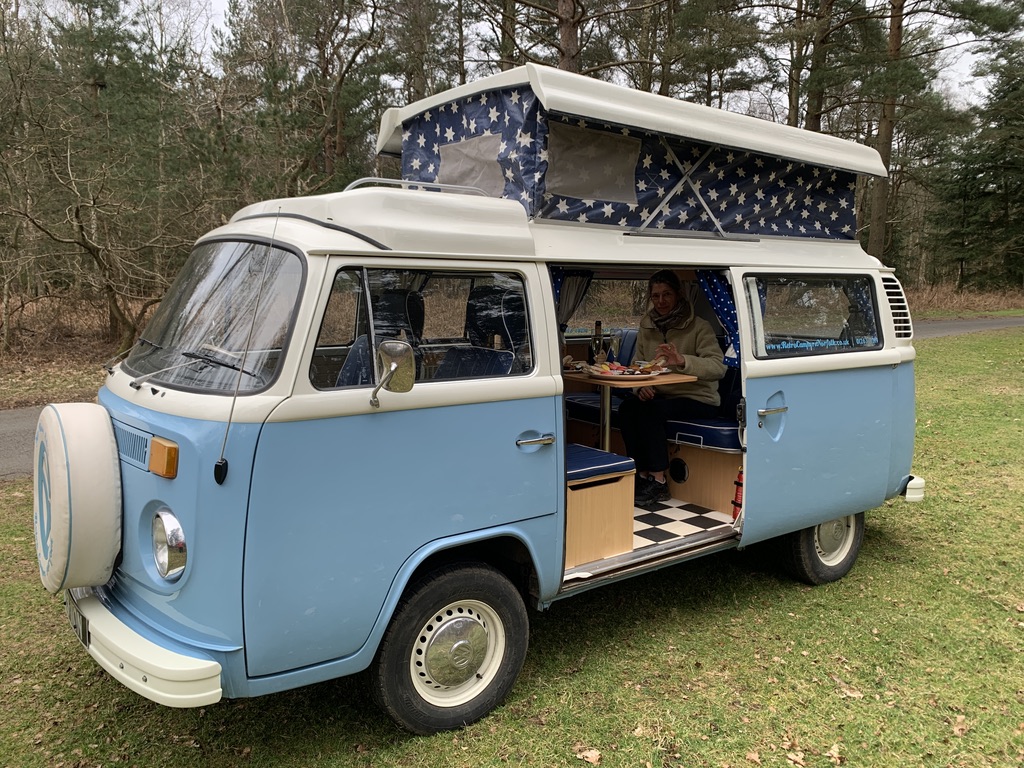
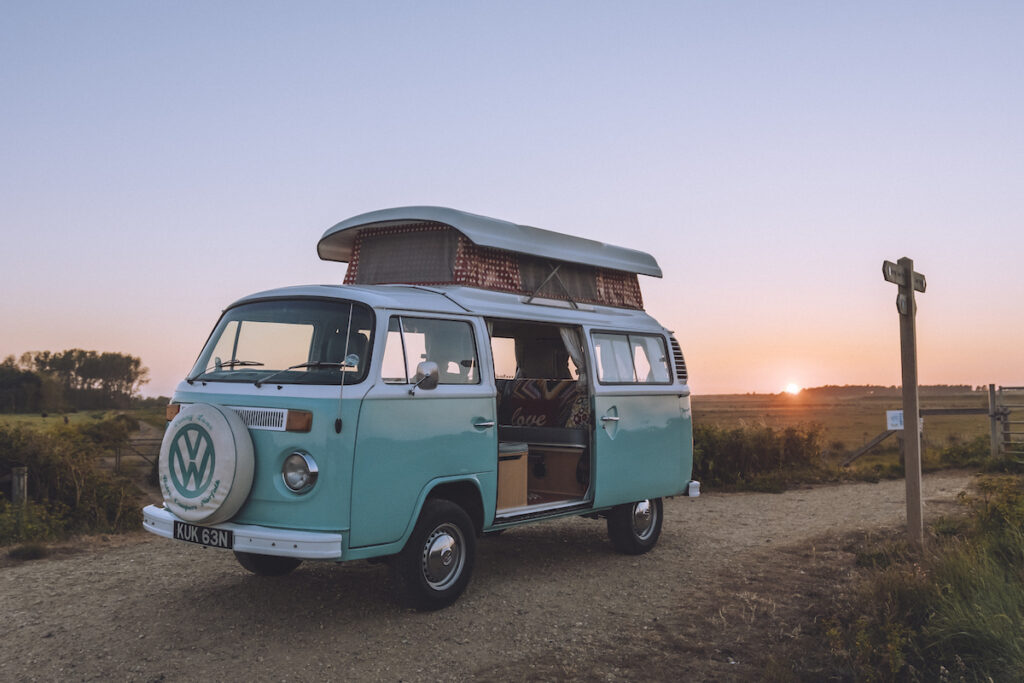
My husband and I rather fell into the purchase of our first campervan, Penny Lane, a 1975 T2. Jamie is a 4th generation farmer running a big business on the Norfolk/Lincolnshire border. We’ve been thinking over the years of how to diversify and how to make the most of old buildings no longer suitable for modern agriculture. Not quite on the tourist trail, and not convenient enough for a business park.

Then a friend mentioned that they knew of a local couple wanting to downsize their campervan rental fleet, knowing that our son is a classic car enthusiast (his first car at 17 and all through university was a 1969 Imp – and it’s still running). We were intrigued, and met the then owners of Retro Campers Norfolk, which has been running since 2011. Their main issue was storage – they had to pay silly money for inadequate, often damp and not very convenient winter storage of their 5 classic campers and decided they needed to sell at least two of them to continue with holiday rentals of the others, and we agreed to buy Penny Lane. They then started to think they’d sell the whole business, and we thought why not? A new adventure, we have lots of space, and our enthusiastic son could help with maintaining the vehicles. We could do this!

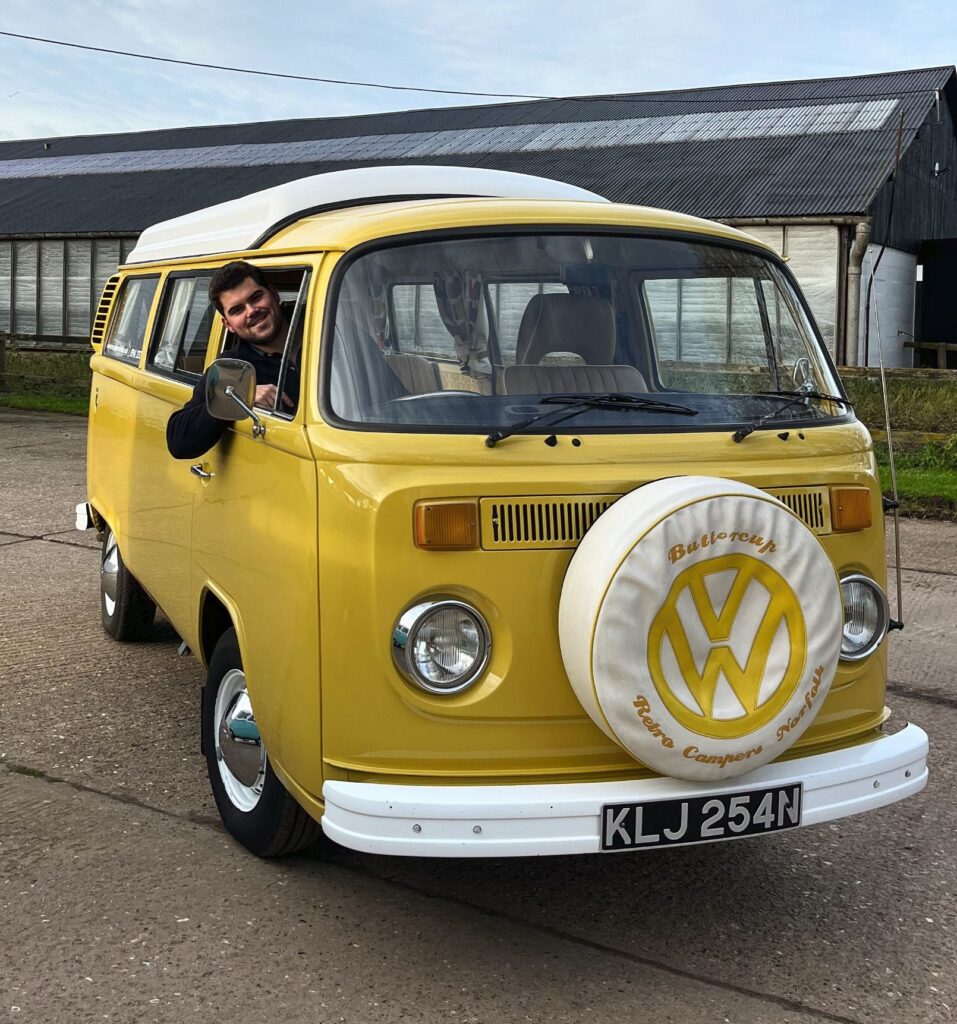
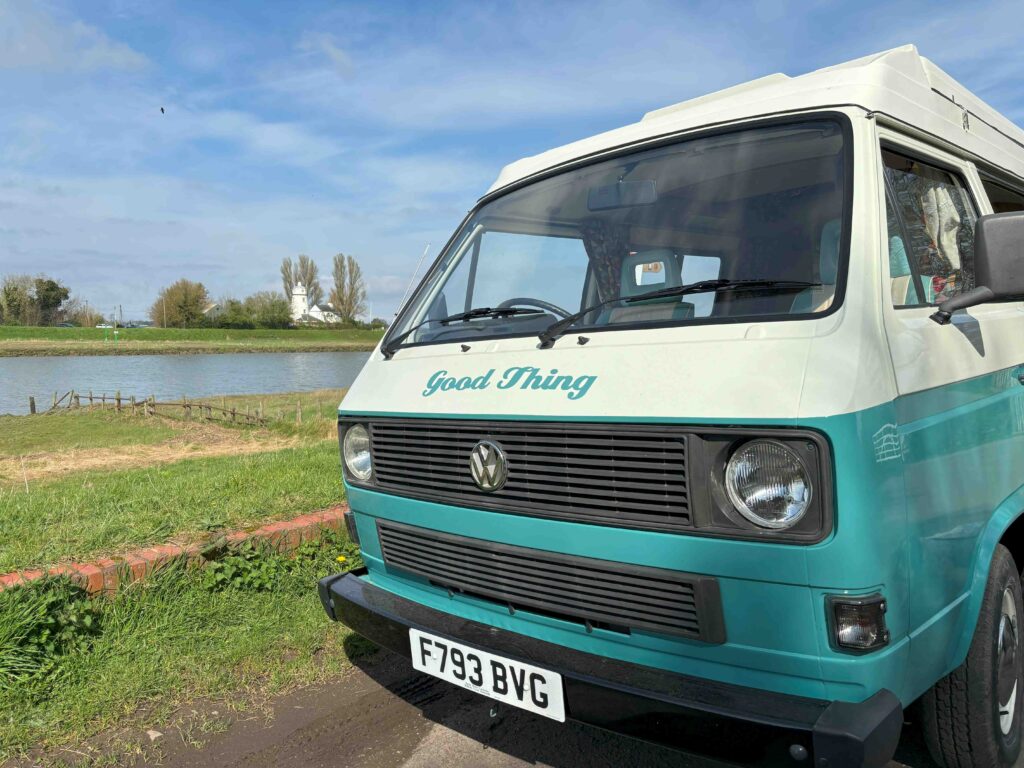
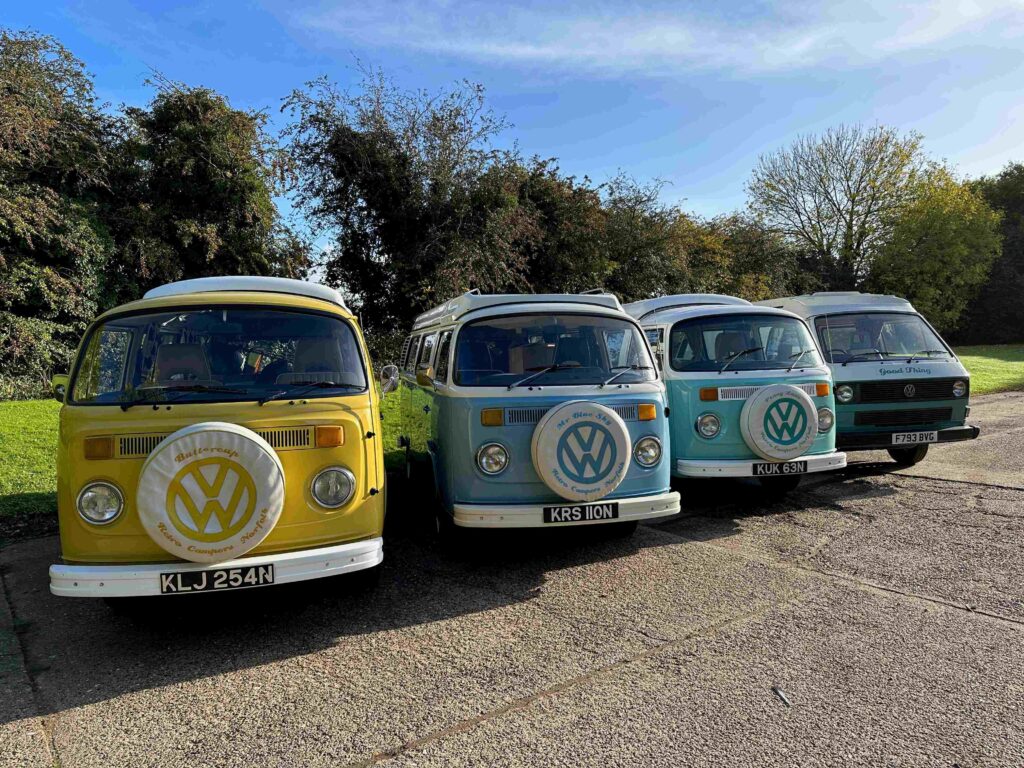
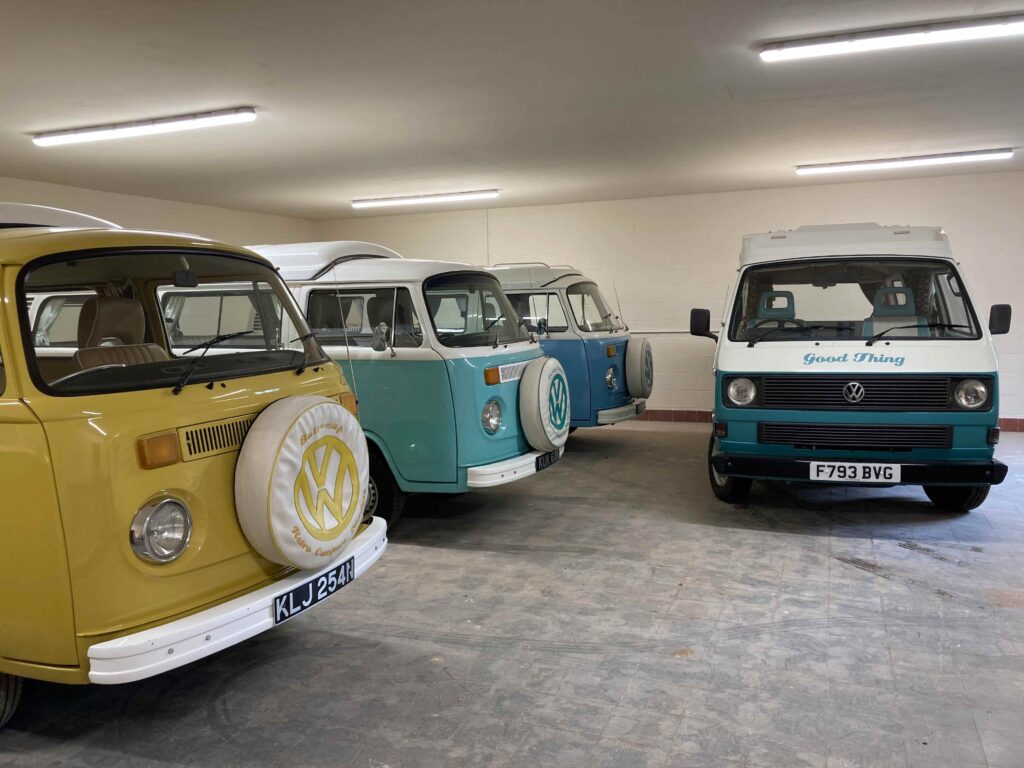
By autumn 2023, we had ourselves a new venture on the farm, and we became the proud owners of Penny Lane, Buttercup and Mr Blue Sky – all RHD 1975 T2s in excellent order, plus Good Thing, a funky 1989 T25 – perfect for the holiday rental market. We spent much of the winter (and considerable expense!) converting a redundant building into their new home. Plenty of space for customers to get the hang of the gears and non-power steering in our farmyard and along quiet country lanes before they reach the main roads around King’s Lynn, ready for their camping adventures. Whilst we don’t have a mileage limit, we do ask customers to stay within a 60-mile (as the crow flies) radius of King’s Lynn, so most explore the Norfolk coast and Broads, but our area also includes Suffolk, the Fens, Rutland and Lincolnshire.

As you can imagine each camper has its own little quirks, and each new customer has to be carefully taken through how to drive and live in a classic camper. But our first major set-back was Buttercup needing a new engine! Despite having a pre- and mid-season service each year, you never quite know what’s round the corner with old vehicles. We are lucky to have Jason at Dubs and Classics nearby, and he put a new VW Engine Company engine in, plus various other tweaks. Despite being reasonably mechanically-minded on the farm, we are very much novices when it comes to old VWs, and feel reassured to have Jason and other local experienced guys to call on. The vans have to be in tip-top condition to hire out.
And running the new business has been quite a learning curve too! I’ve had to learn how to run a website, booking system and social media, but they say learning something new keeps our brains younger…
Personally we’re looking forward to a long weekend away with friends very soon – we’ll take two campers to the Norfolk Broads, so look out for us on the roads!

If any members of the T2 Owners Club would like to hire a camper for a few days (maybe yours is off the road, or you have friends who’d like to join you?), please get in touch – we can offer a 15% discount off any booking by members. Please see www.retrocampersnorfolk.co.uk or email info@retrocampersnorfolk.co.uk.  

Member report – Germany by David Eaton

Germany Trip May 19th to 6th June 2024

Chapter One

Well, what do we say – a very exciting and fun trip for our three vans.

First of all, a massive thank you to Lorna for all the hard work she and Nick put in to make it work so well. A group WhatsApp was set up so that we could all follow each other, which was a terrific bonus and we didn’t lose anyone en route. All of the camp sites were amazing. A true testament to the organisation of the trip.

Sunday 19th May

Departure day … we all travelled separately to our respective campsites before crossing the channel tunnel the following day.

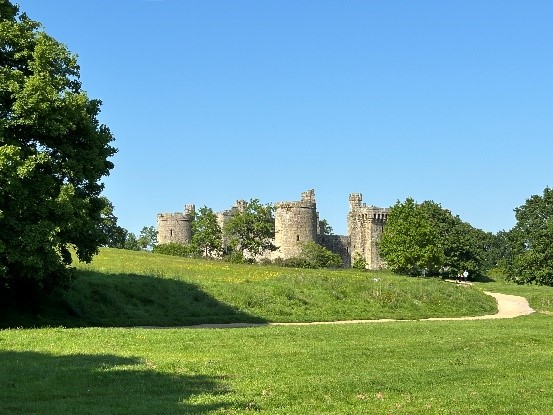
We set off for Park Farm Campsite about 30 miles from Folkstone as we wanted the train journey to be stress free. We set off from home around 9am and had the day to get there. The campsite was spotless and virtually empty at this time of year. A great start for the coming trip to France the next day. We arrived late afternoon and so we took a walk to Bodium Castle. There was a pathway from the campsite alongside a river. A beautiful walk in the sunshine and had an evening meal in the local pub next to the castle.

Monday 20th May

The next morning, we packed up early and set off for the Channel Tunnel. This was the first time that we had been on the tunnel, and found it interesting and exciting. It could not have been easier. We arrived early and were told that we could take an earlier train than our ticket specified, as it was not busy. We took this opportunity to go to France early and I would certainly use the Tunnel again.

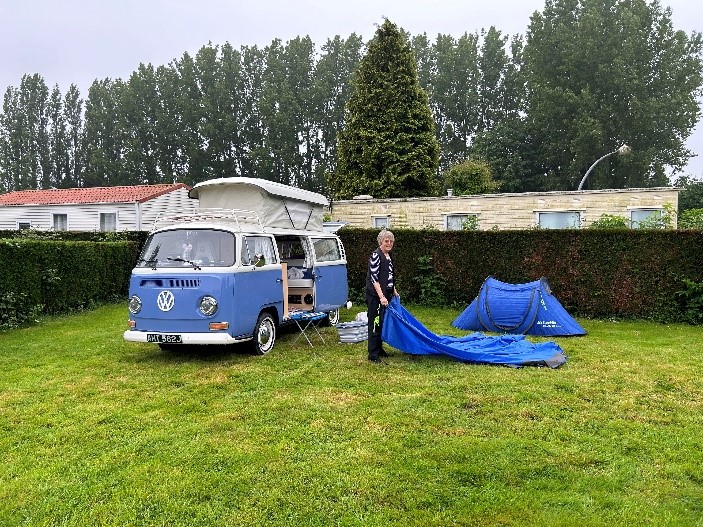
Arriving in France 35 minutes later we decided to go to Dunkirk, as it is nearby and I have been fascinated by the stories and films of WW2. This was well worth the small trip. We then headed for the campsite at Renescure. We arrived first out of our group and so set-up pitch. The pitches were individual and quite large. Val, Malcolm, Lorna and Nick arrived about an hour later having been shopping for supplies. The place was so nice. Each pitch had its own electricity and water supply. I did not bring a French plug convertor (against my wife’s advice) but the Campsite owners lent us one. They were such lovely people.

And so the trip had really begun.

Tuesday 21st May

The next morning we set off on a 240 mile journey through France, Belgium, and Holland and on to Germany. Although this was quite a number of miles, we stopped for meal / toilet breaks or whenever someone felt they needed a further stop. It gave the drivers a chance to get used to the ‘other side’ of the road.

Taking the bypass round Antwerp was quite an experience, as the roads were extremely busy and it was raining hard. We all noticed the extreme number of huge lorries on the roads particularly on this section. And when we say big, they were enormous. Apparently, this is a trade route so this could be expected. But this was all part of the Adventure.

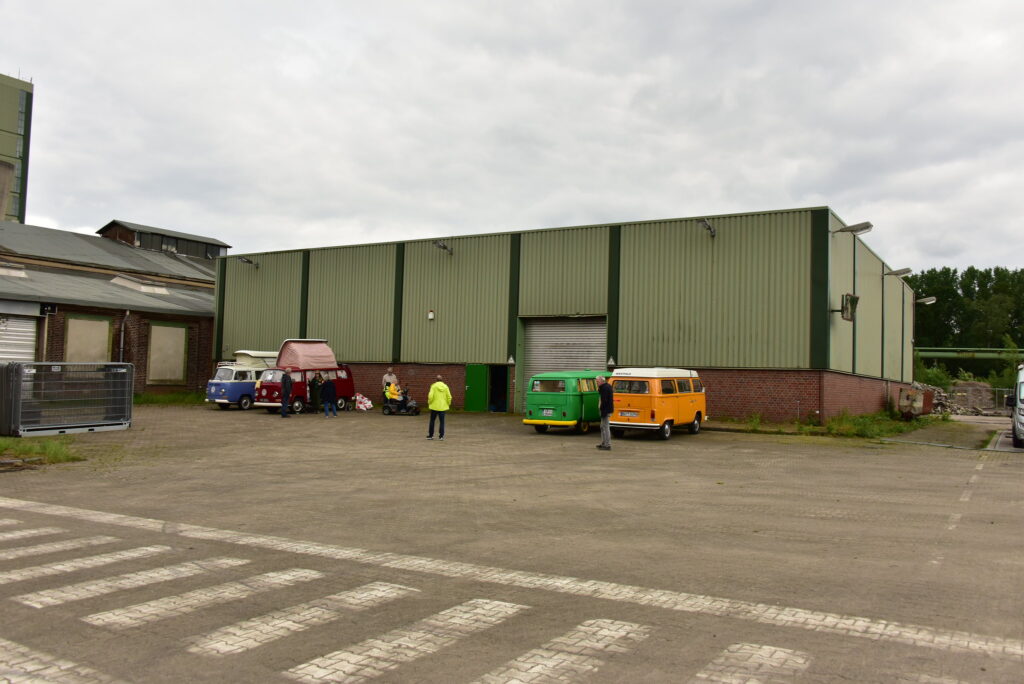
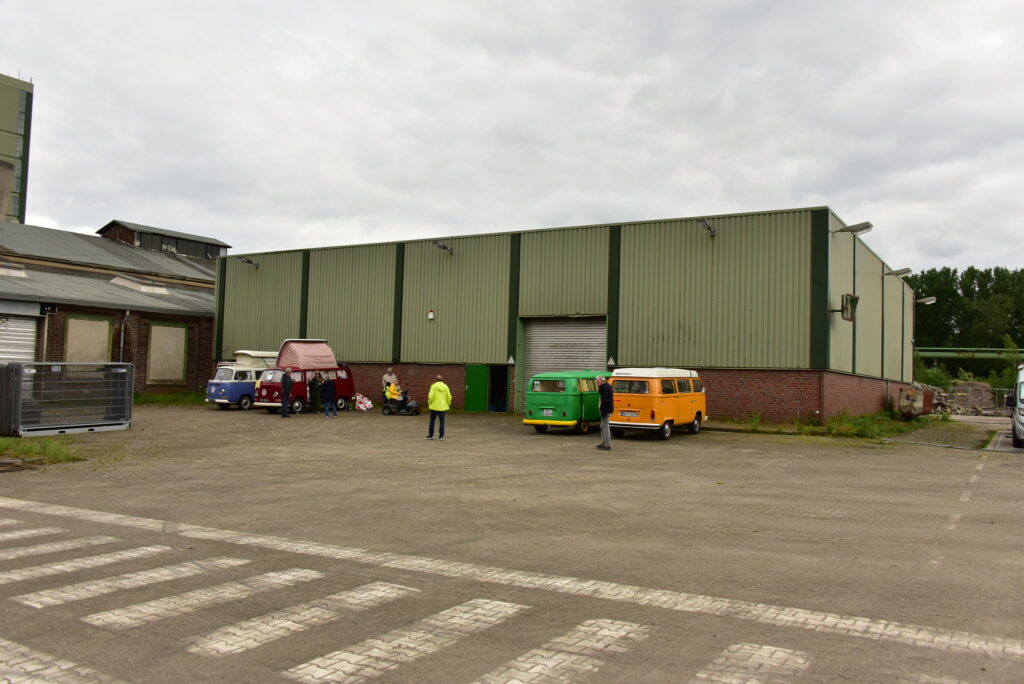
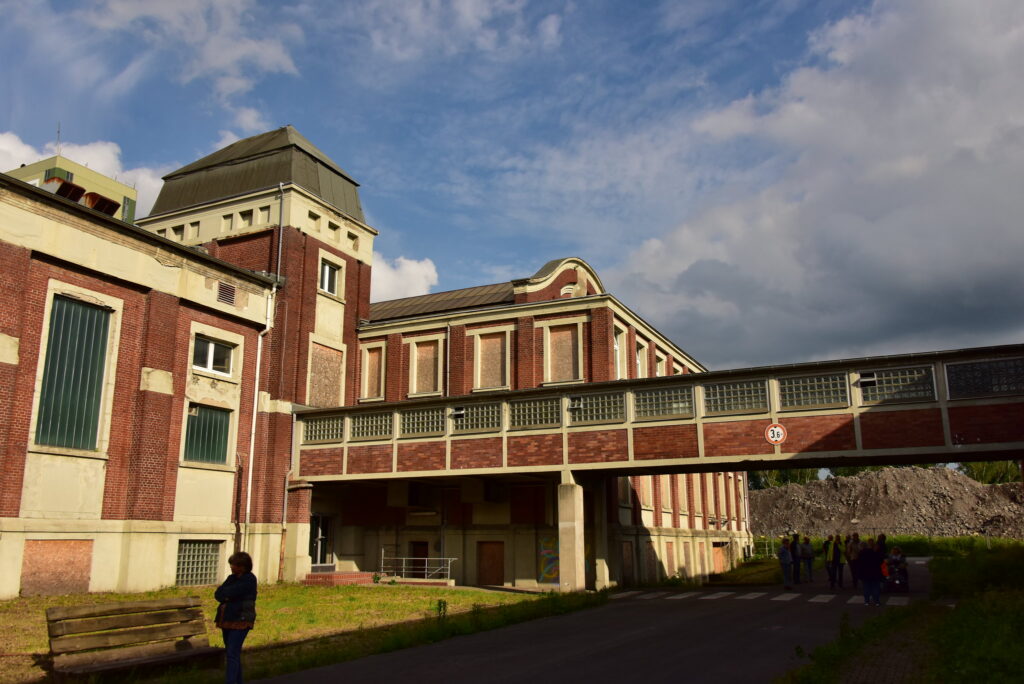
Leaving Antwerp the road opened out and we made good progress. Our first stopover was to be in a disused coal colliery, and we wondered what we might find there. We had just stopped to decide if we were in the correct place when someone hailed us to follow them which we did. We arrived at the Bulli Museum in Gelsenkirchen.

One of the buildings was used by the T2 Club in Germany to store all their vans and parts. Roland greeted us and made us very welcome. My word when they opened the doors and we saw their fabulous collection (many under wraps), we all got very excited.

After showing us where the facilities were, we had a general chat and were invited out for a meal. We camped in the car park which was not as bad as it sounded as a water supply and toilets were available in the Museum which remained open during our stay.

Wednesday 22nd May

Bright and early our hosts arrived including Detlef (who was the German organiser of the trip) and Ulf (who became our driver to certain events) together with a few of the Club members. We couldn’t wait to have a look at their collection. Most of the vehicles work or at least they will when completed.

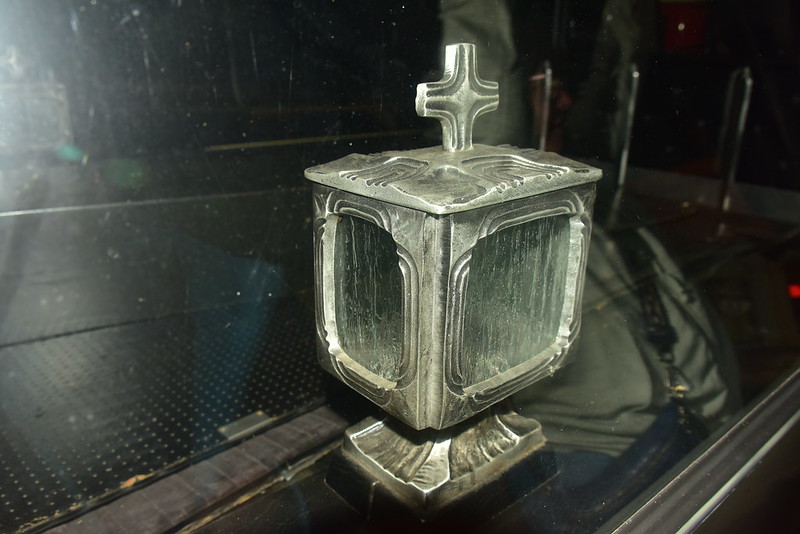
A lot of the vehicles had individual stories attached to them and one by one we were shown them. There was even a fire truck and 2 hearses; one reminded us of the Victorian times as it was decked out with lace fringing and carriage lanterns.

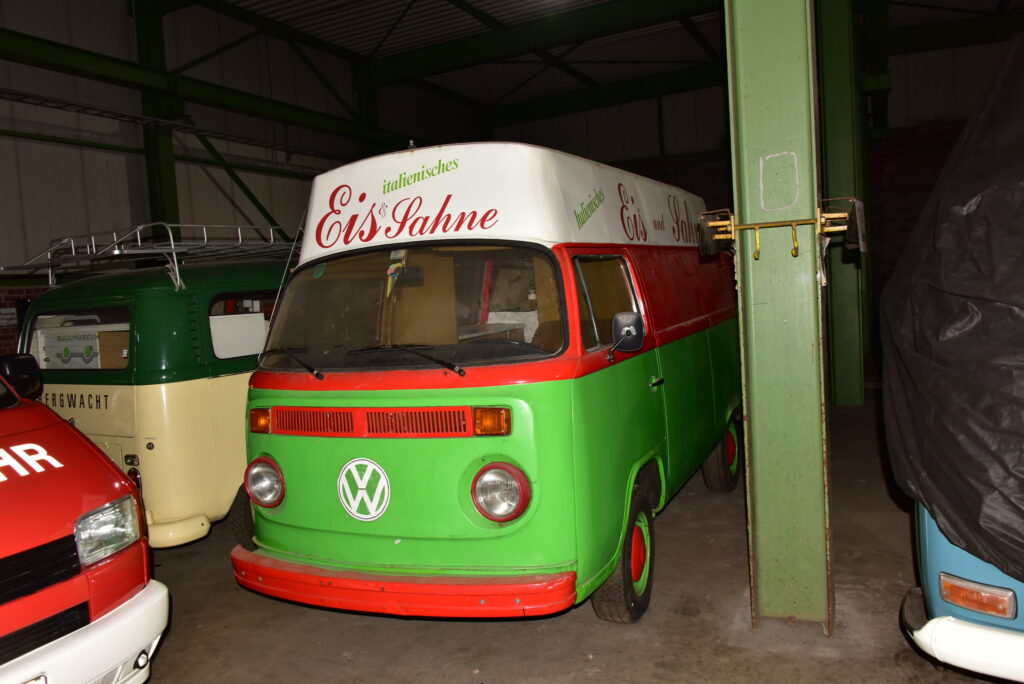
It was amazing the number of different kinds of vehicles. One was used at the airports with a lookout tower on the top, another had a crane used for carrying lamp posts. An ice-cream van and a Police radar van were also there. The vehicles ranged from Split screens to T4s. Each one was unique.

In the afternoon, we were given a guided tour around the colliery by a man who was working on the buildings and site. The whole site is being preserved and put to use in different ways. The Bulli Museum (Bulli being the German name for VW transporter vans) is working towards making a bigger area in order to display their vehicles to their best advantage.

We look forward to a possible return trip in order to see that!

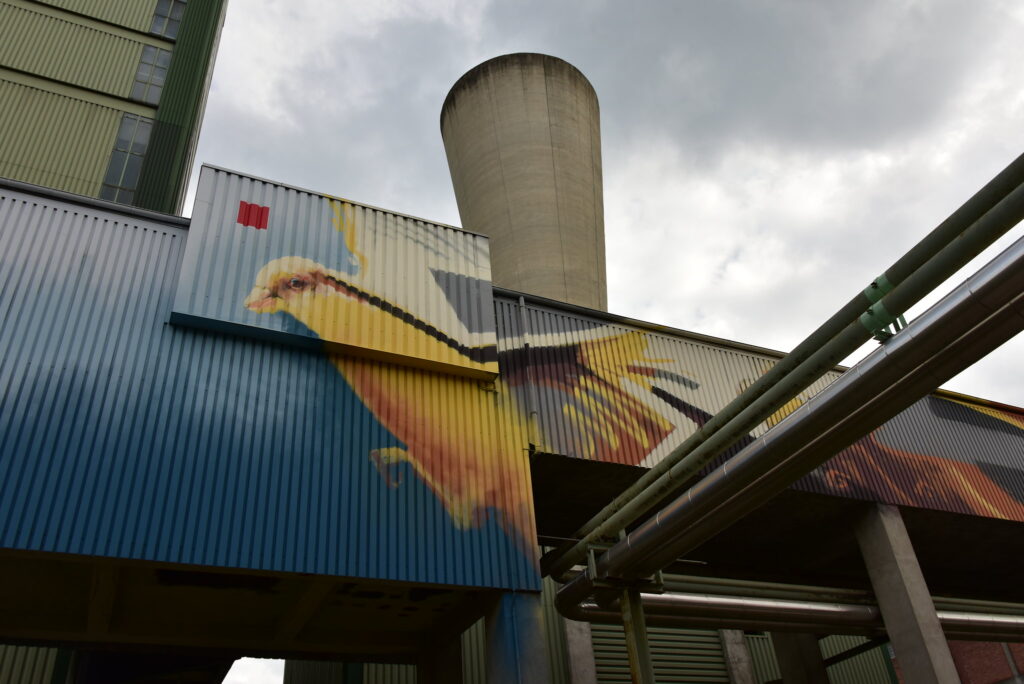
There had been an art celebration a little while ago and many of the buildings had been painted with different artwork and writing. CAN YOU SPOT THE DELIBERATE ERROR IN ONE PIECE?

Some beautiful artwork included Canaries representing the birds taken down the mines to give an alarm when gas is detected.

It was interesting to know how the colliery had been worked and what the buildings were used for. One room was for the injured and there was a doctor’s house on site although this is not going to be used as part of the regeneration of the site.

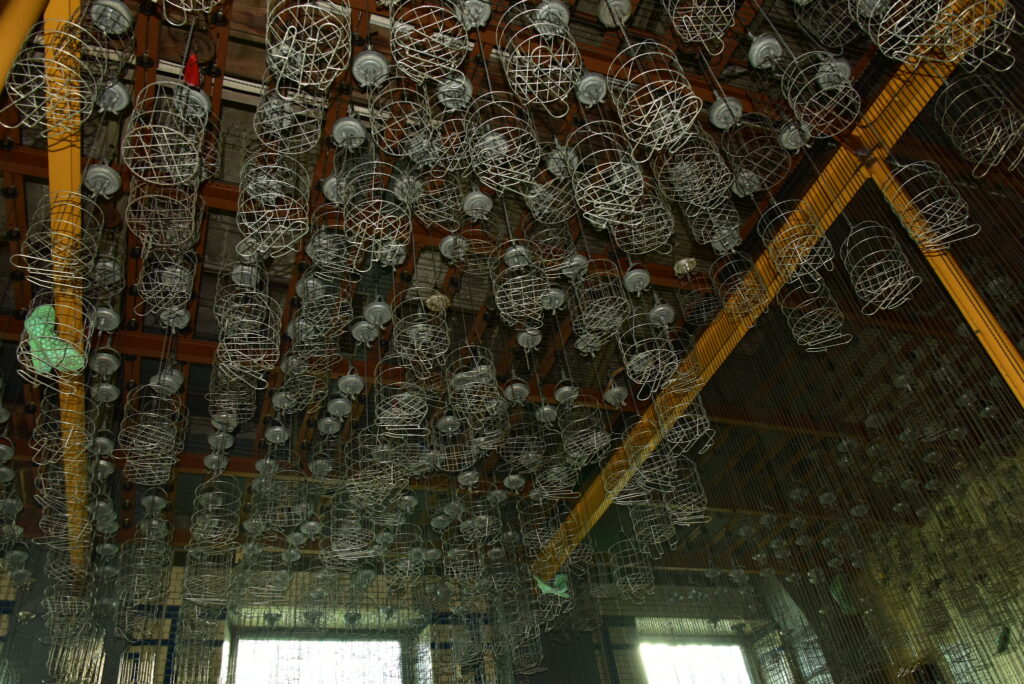
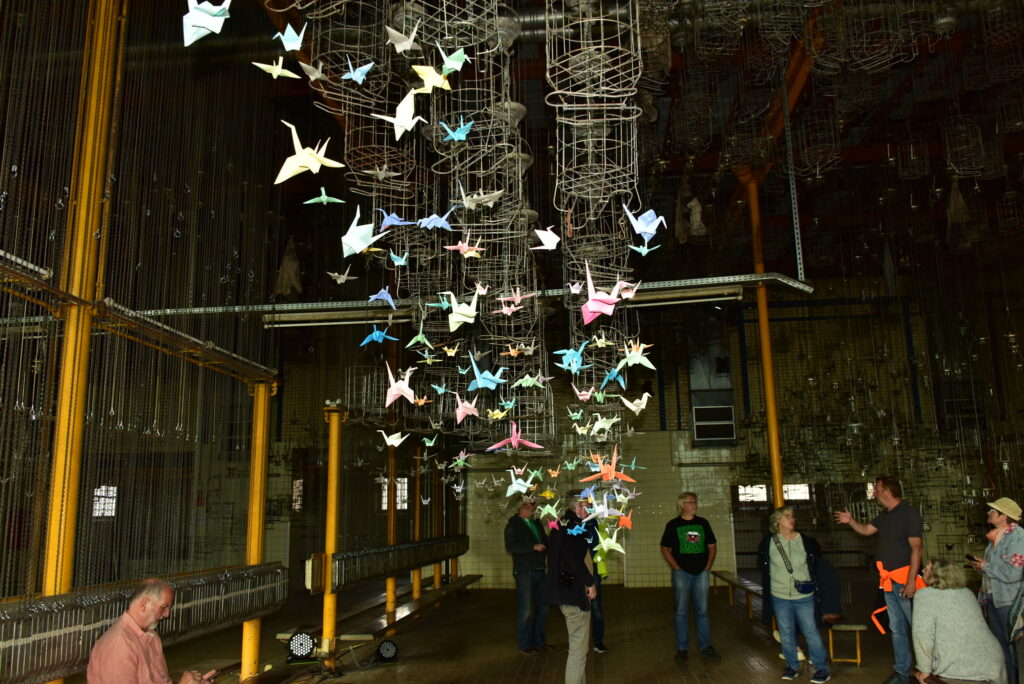
One area contained many metal baskets which were hanging from the ceilings on long chains with an individual padlock on each one. These were for the workers to leave their clothes in when they changed into their working clothes in a different room. At the end of the working day they put their dirty clothes down into a special hole in the room where they dropped into the laundry area. They then took a communal shower and were so close to each other that they could wash each other’s backs.

As part of the art exhibition an artist had made origami birds. These were coloured from black to grey to a variety of colours depicting the coal dust to clean. The birds were then put in the cages. A lovely spectacle.

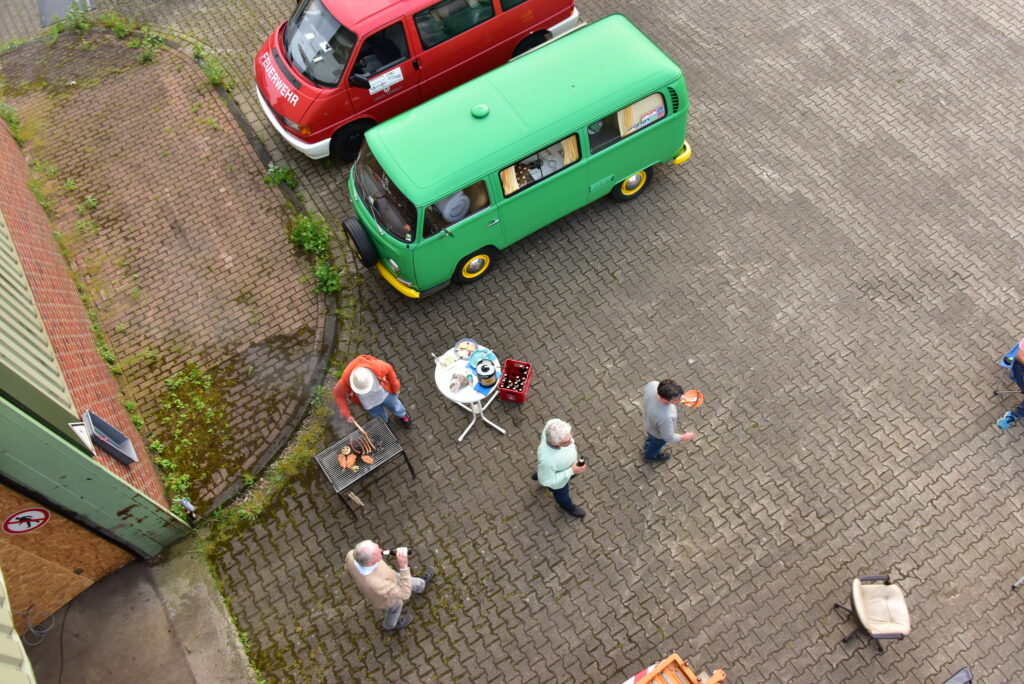
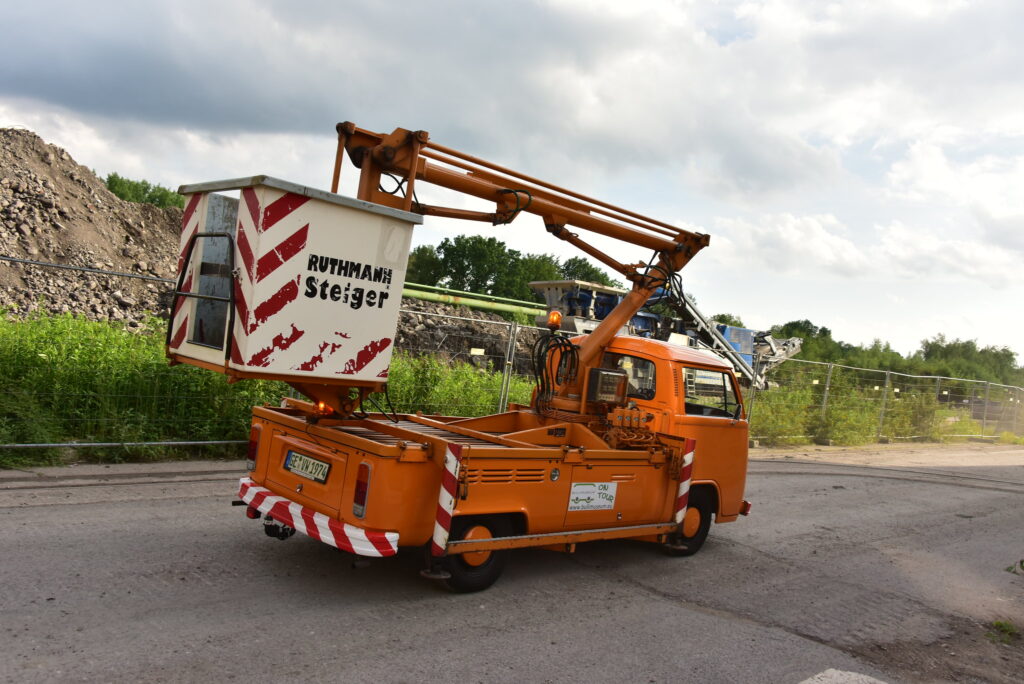
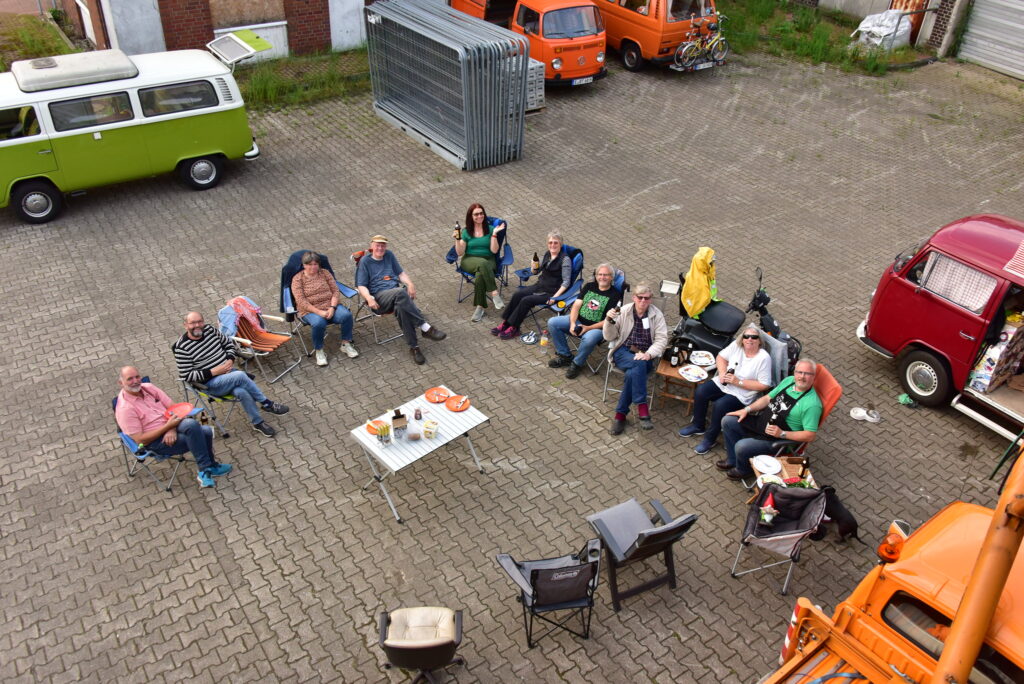
Being nominated ‘unofficial’ club photographer I was asked by Nick and Lorna to take a picture of us all from the top of the Bulli Museum building. I needed to get high, so I was offered this vehicle as the platform (Editor notes that “I needed to get high” means elevation, not smoking!). This vehicle is owned by a member of the German VW Club.

The resulting picture shows the fun were we having with the German Club. They laid on a BBQ for us with plenty of food and drink of all varieties including some incredible German sausages made by Roland’s next-door neighbour who is a butcher.

This was just the first day with the German Club members.

More to follow next time.

Inspect A Gadget – Engine Fire Fighter by Mark Broad-Holcombe

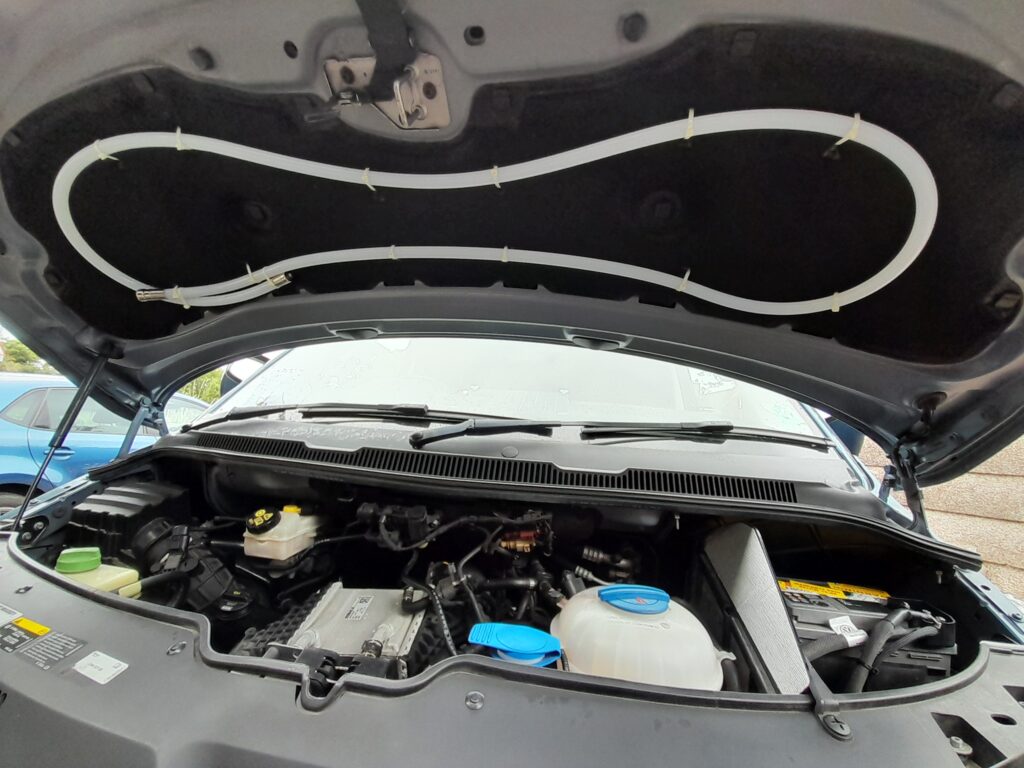
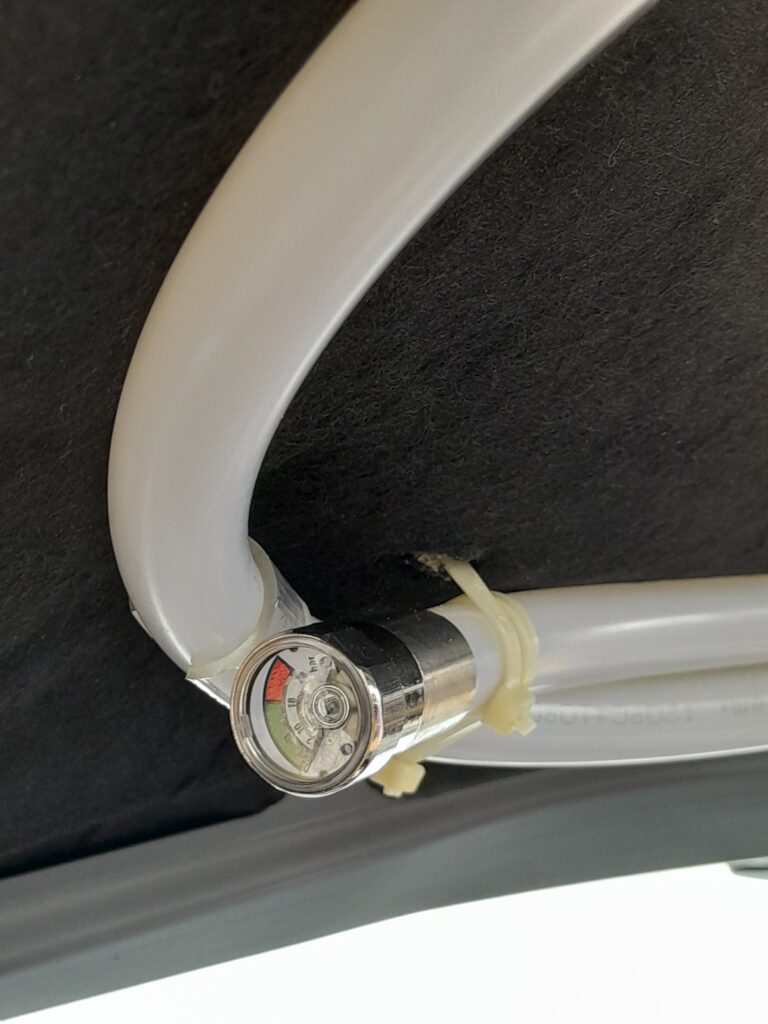
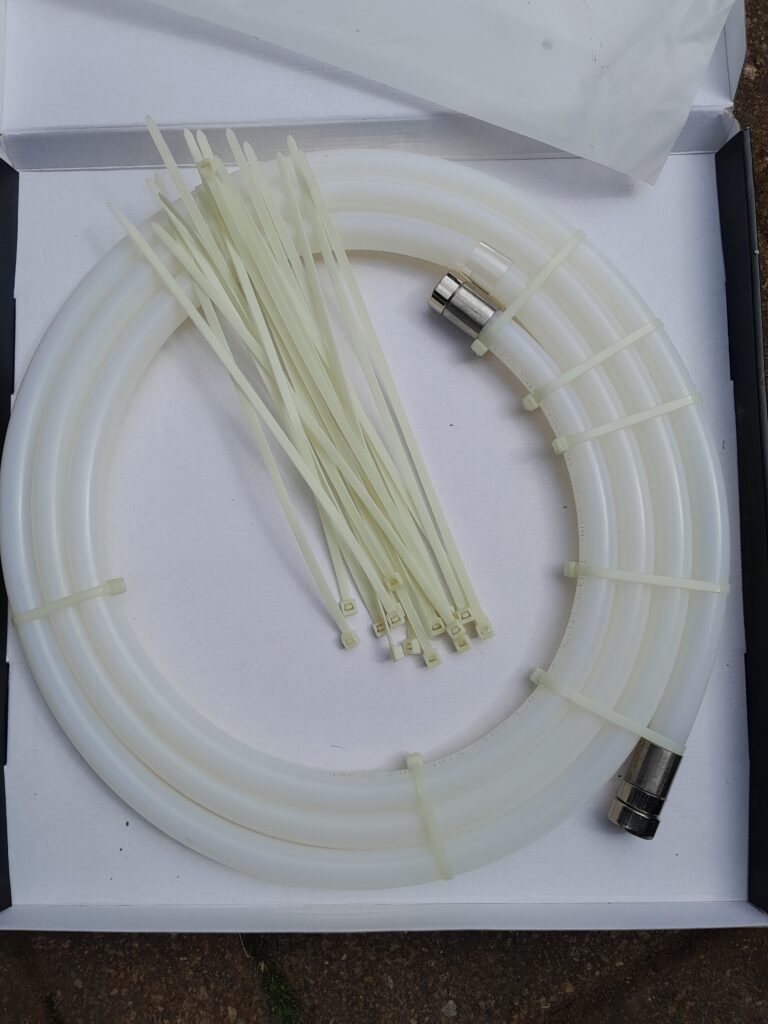
Fitting my competition prize (at last). Quite a while back I was lucky enough to win an Engine Fire Fighter, Automatic engine fire suppression device in one of the club competitions as supplied by our friends at Just Kampers.

It’s 3m in length, has a burst temperature of 120 degrees centigrade, fire rating class A,B,C,E and only takes five minutes to install (as long as you don’t have to work around other fittings such as an under bonnet insulation pad that is). It’s still not a long job though!

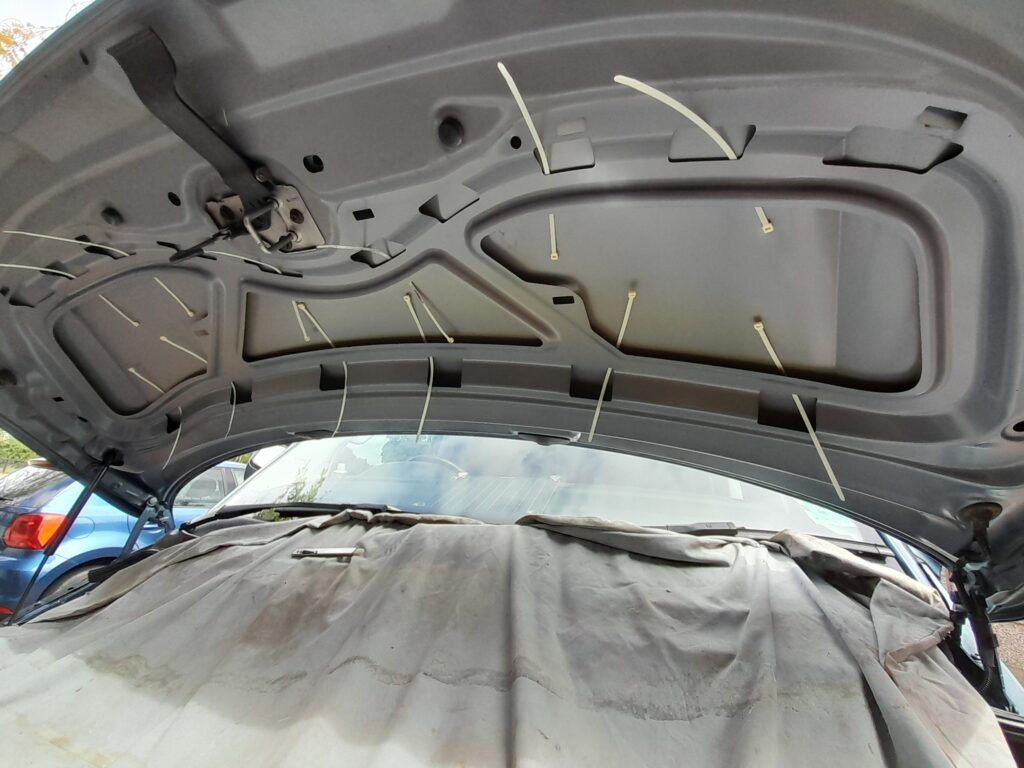
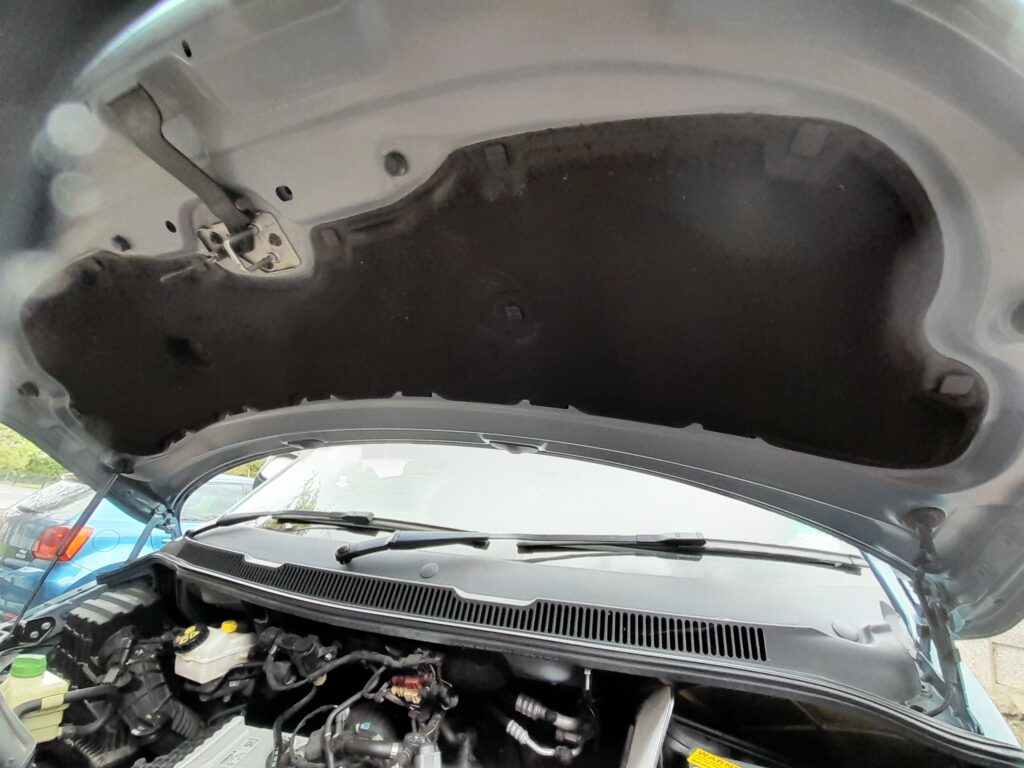
I decided to remove the pad and utilize the bonnet framework to attach the included cable ties to secure the extinguisher to the bonnet. 

It is advised to use these cable ties as opposed to wire because part of their job is to melt in the eventuality of an engine fire and allow the extinguisher to drop onto the engine.

Passing the ties behind the framework wasn’t too hard, although I did have to make some small holes through the factory mastic in a few places. Next, I marked and made holes in the bonnet pad to enable it to be put back in place. This was the trickiest part, achieved by temporarily taping the two ends of each cable tie once passed through the pad and when all were in position I could reattach the pad to the bonnet. It was then just a matter of cable tying the extinguisher into position and hope it’s never called into action. 

A trip to the Ardennes, Belgium and France April 2024 by Matt Crouch

Introduction

Jayne and I decided to use up a Shuttle ticket that we had carried over since last year.

As she teaches, it had to be Easter holidays. It was a great trip, the Dutch spoke good English, the French were frighteningly helpful but spoke no English. I don’t honestly think this was belligerence, they just have very few UK visitors in this area. Fuel was up to two Euros a litre, we did fill up before we left and arrived back nearly empty. We used Google maps extensively. There is so much information about towns, links to camping and websites.

We planned most of the trip this way, but we left with no itinerary except the shuttle times going and return. To have the best view of this trip, get google maps up and look at the links for towns and campsites – there’s lots of history and pictures.

So, here it is:

Sunday 31st March 2024

Left Somerset at 13.00 hours to Folkestone – Premier Inn – Operation Brock in Situ but good journey with no hold ups. We decided to break the first half of the journey up. Coming from Somerset it was about a four-hour drive to the tunnel. NB One should NOT come off at junction 8 services as have to go back up motorway to junction 7 to re-join motorway. Also note there is a Tesco petrol station at junction 13, worth a last fill up before jolly expensive fuel abroad. Premier Inn at junction 12. Premier Inn is perfectly adequate. There is a restaurant, good beer and adequate food. It does what it says on the tin.

Monday 1st April 2024

Breakfast 7.30 all you can eat- full English or continental. Just 10 mins to the Chunnel check in – perfect. We were able to get earlier crossing (they allow you two hours early free). Arrived France – 11.00 hrs French time.

Calais to Tournai (86 miles) for lunch stop – much longer than anticipated. Nice lunch in the historic square but very slow service – hey we are in France! It’s a very historic town, once ruled by Henry VIII. This could easily have been a day or two in its own right.

Tournai to Dinant 99 miles. – smaller and more enjoyable roads. Route Nationale rather than motorways.

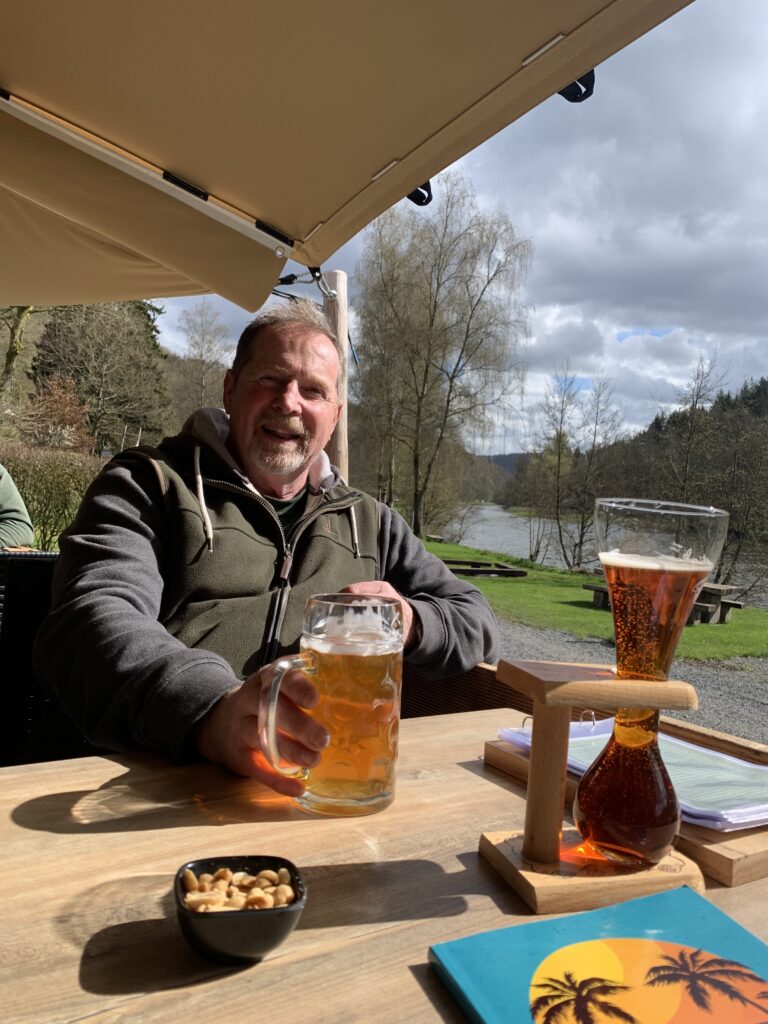
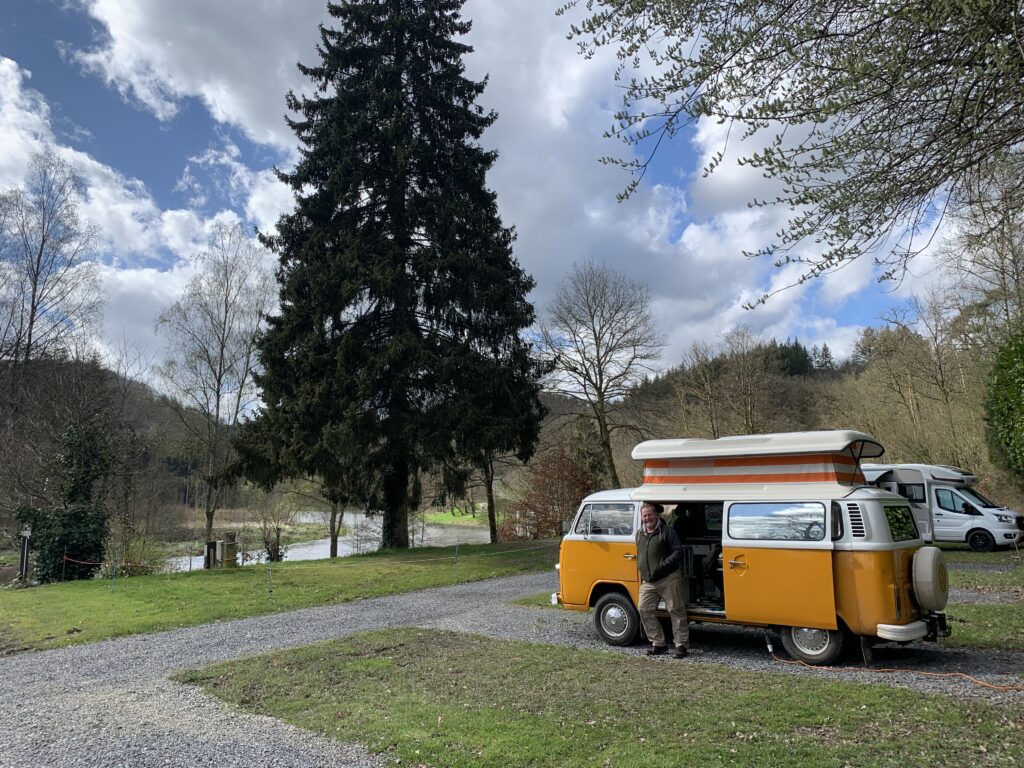
Arrived in Dinant Went straight to Campsite – Camping Parc de vacances Villatoile, Pont – a- Lesse – £ 27 for 1 night with electricity and free showers. Possible to order bread and croissant for morning but we had just missed the time. Beautiful river side campsite with climbing, fishing, kayaking, but super muddy. Bar and café disappointingly closed – one reason why we had chosen it. However, very helpful and friendly hosts – English speaking Dutch. Absolutely stunning setting with old manor house converted into Gites and bar. The sun was shining and Belgium was a beautiful place.

Tuesday 2nd April 2024

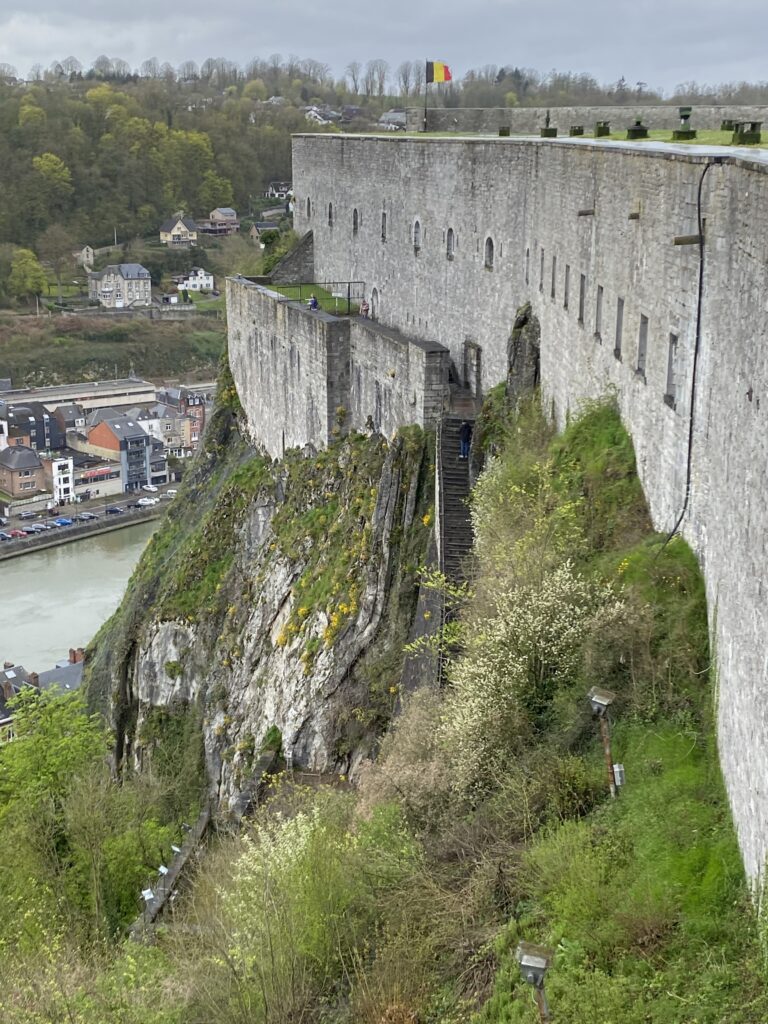
Woke up to warm toasty van due to electricity and 10.5 arctic quilt! Packed up and drove to Dinant – Issue with French parking machine – gave up as assumed they were not working so free parking for us! Coffee and vanilla custard croissants and then up to the cable car to the Chateau. Cable car and chateau 12 Euros. Lovely views, very interesting. On August 14th 1914 in WW1 634 civilians shot as the Meuse was a major crossing point for the Germans. Lt Charles de Gaulle was injured in the leg while reinforcing the French troops. The Germans destroyed the city and shot the civilians. The oldest was 88 years old, the youngest 3 weeks old. Hard to comprehend. Church rebuilt afterwards, beautiful. Home of Adolphe Sax – Inventor of the saxophone. Can imagine superb jazz festivals here.

In the opening weeks of World War One, as the million-strong German army raced alongside the River Meuse in an attempt to outflank the French Army, its troops carried out a series of atrocities against civilians who were not in a position to defend themselves. Area known as the martyr towns – Dinant paid the heaviest price. Suspected to be the base of Belgium’s guerrilla force, the town was torched and the population slaughtered. In one incident, soldiers fired indiscriminately into a crowd that included mothers with babies; in another, 150 factory workers were ordered outside and summarily executed. In all, 674 townsfolk died.

Then 53 miles on to Dohan – Camping Maka – wow! Absolute paradise. No sounds apart from nature, beautiful scenery, great host. 50 euros for 2 nights with free showers. Able to order bread and croissants. Small shop on site with terrace and bar serving basic but good food. The sun is shining. It is the very beginning of the season but everything is open and we have everything we could possibly need. Decided to eat in the bar – superb pizza and ambience. Extremely helpful host – Nancy. Slept wonderfully to the sound of nature. We love it here – absolutely love it. Could stay forever. This is probably the nicest campsite we have ever done this lifetime so far!! – No WiFi, no phone signal, no TV, no loud music permitted. Certainly look that one up guys.

Wednesday 3rd April 2024

After coffee in the easy chairs in the bar, we headed for Herbeumont upon recommendation for friends. Tres Bien – well worth the visit. Chateau de Herbeumont – ruined fort. Even in the rain it was stunning and we could imagine just how fantastic it would be in the sunshine. Beautiful views of the meandering Semois river amongst pine forests.

Drive to Bouillon along route nationale – beautiful scenery en route. Boullion – great river side town with cafes, restaurants, hotels but dominated by the elevated by the castle above us. The town is known as the Pearl of the Semois. It survived WW1 and 2 unscathed although the Germans Panzers stormed through the town in preparation for the Battle of the Bulge.

After a coffee in a riverside Brassiere, we headed along through the tunnel along an avenue or beautiful pollarded Lime trees and into the castle itself. Free parking outside with stunning scenery. Entrance a mere 10 Euros each for a fabulous journey back in time. Louis XIV seems to feature rather a lot. Castle hewn out of solid rock. Running from 800 BC to present day. Well worth a visit. Stopped and enjoyed a picnic in the rain with our fishing umbrella enjoying the fabulous views. We want this trip to be many weeks rather than one.

On to Sedan, Quick drive around the castle – absolutely huge, lively city, possibly worth a day or two in its own right but for us, we were castled out and our hearts were calling us back – back to paradise at Camping Maka – Wine – cheese – dinner – peace and tranquillity.

Thursday 4th April:

Journey from Bouillan to Preux-au-Bois – Camping la Foriestier – 91 miles. Weather absolutely tipping it down. Headed towards Cambrai but destination in La Foret de Mormal now part of the Regional National Park of the Avenois. Camping la Foriestier – 17.6- euros per night free showers. Very rustic and old facilities but very clean and super friendly host. Enjoyed a sunny 6 mile walk around the forest – from acorns of WW1. Cambrai was the first time tanks were used in battle. Screech owls, birds singing.

The Forêt de Mormal (Forest of Mormal) is a forest in France, near the Franco-Belgian border. It is best known to the British for its role in the retreat from Mons in August 1914

Battle of Cambrai nearby, British offensive (November–December 1917) marked the first large-scale, effective use of tanks in warfare. Unfortunately, the museum in Cambrai was not open.

Friday 5th April

Preux au Bois to St Omer 89 miles for lunch stop and a bit of reminiscing for Matt. St Omer nice river side town. Large canals and irrigation systems in fields where our crops are grown.

The market town of Saint-Omer was for centuries a key staging post between London and Paris. It has an impressive network of canals in the lower town.

Another 33 miles later and we arrived in Escalles – camping Opal – Blanc Nez, just outside Calais. Very convenient ideal stop over. 18 euros per night with 1 euro shower tokens.

Walked to Calais beach and looked around a couple of old WW2 defences. Could see the white cliffs of Dover.

Saturday

Just under 8 miles from tunnel, we stopped off at Cite Europe to stock up. Don’t rely on Sat Nav to get you to the correct terminal from here though as Gloria (satnav) sent us to the freight area and had to be escorted out. The French guy thought we had been drinking until I showed him my phone screen. Top tip – don’t head for terminal tunnel – head for Flexiplus tunnel!!! Still managed to get on an earlier train and back in Blighty for midday before a busy but not too arduous journey back to Somerset.

For the Belgians, an ‘s’ makes all the difference between one country and another. Signs in Belgium that are inscribed with ‘Ardenne’ refer to the Belgian region, whereas those with ‘Ardennes’ are on the French-side.

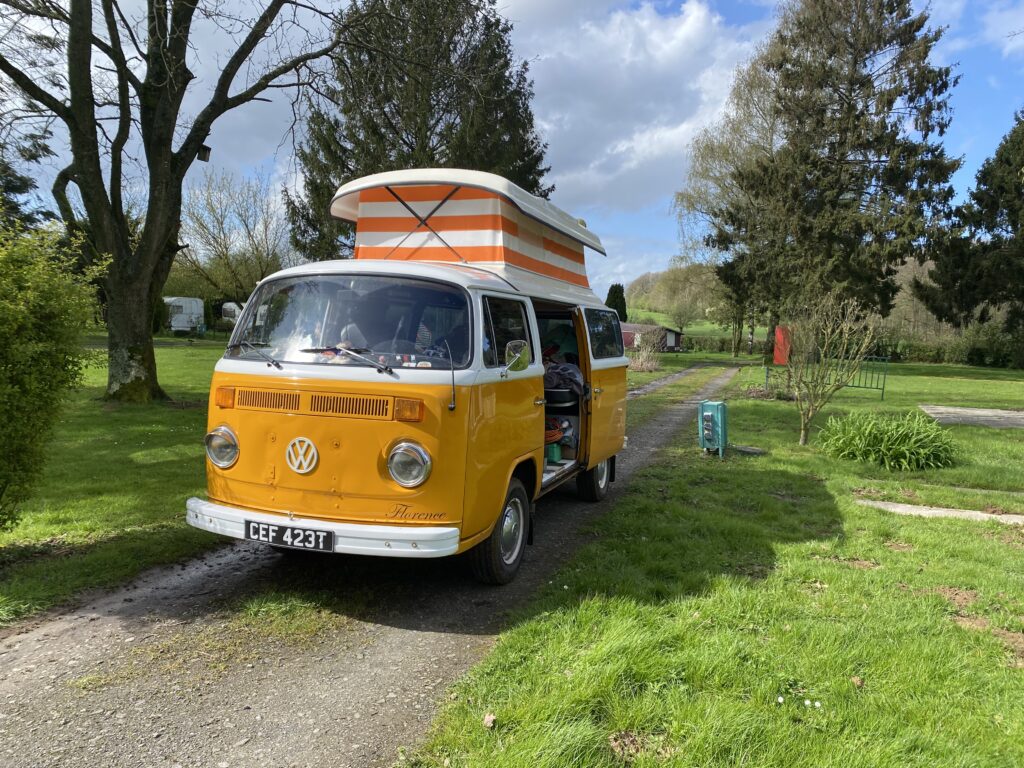
Julius Caesar called the Ardennes ‘The greatest forest in all of Gaul’, lots of history in this area, particularly WW1. It was a great trip and superb scenery. Campsite of the trip award is definitely Camping MAKA. It was a week of sunshine and torrential showers. Florence didn’t miss a beat in the 950 odd miles of the trip. Love and hugs to all Matt and Jayne