A variation to the Mechanic this time as so many people at club events ask Malcolm and/or Nick about solar. If you want to be off-grid / not using expensive hook up on a site or when that is simply not an option, you can keep your leisure battery topped up with a solar panel.
To help members, Nick got in touch with Just Kampers (owned by one of the club founders Mark Reynolds) to ask about their Solar Charging Screen, to see what it does and how it works. Josh from the JK Team got back to us straight away and told us the following.
He says:
“I’m a big fan of the JK Solar Charging Screen, after getting involved with bringing it into the range and having put it through its paces at VW shows and photoshoots for Just Kampers. For anyone who hasn’t seen one, the charging screen is a solar panel array which folds out from tote bag size to give you twelve solar panels for capturing that elusive sunlight to turn it into electricity. There’s a power outlet hidden away on the back of the screen, which has three USB outlets for charging up phones, as well as a DC outlet you can use to charge up your main vehicle battery or leisure battery.
The kit also comes with six really strong suction clamps, which you can use to mount it to the inside or outside of your vehicle’s windscreen. We designed it to fit the inside of a VW T6’s windscreen, but it’ll go onto any vehicle, and it’s just as useful when you just spread it out over the ground or hook it onto your windbreak.
We took one on a JK photoshoot last summer to keep our phones topped up, and it worked really efficiently. It’s definitely something I’ll take next time I’m camping, to keep our tablet charged up (and therefore my kids quiet while we drive!), and to ward off a flat battery. I usually work on the theory that you’ve got spares and tools and stuff for a breakdown, you’re somehow less likely to actually have one!
If you’ve got some epic adventures or road trips planned for your camper, a JK Solar Charging Screen is definitely worth taking a look at, especially if you’ve got a fridge, interior lights, laptop, camera, etc. on board.
If you do take one on a cool adventure, we’d love to see some photos!
You can read up on the technical specs and other information (like what a monocrystalline solar panel is) at justkampers.com/jk-solar-screen/ or scanning the QR code here.”
On arrival at the gate for display vehicles, we were met by the lovely Wade, who on seeing club entry ticket in the van window said “You must be some of Lorna’s lot” and ushered us to the front of the queue. Lorna, your fame precedes you!
Five vans from the club attended the event. There would have been more but unfortunately it was discovered that dogs weren’t allowed, and so some members had to cancel. Although overcast for most of the day, the weather was kind to us, and it didn’t rain.
There was a great deal of interest in all of the vans, especially from those with young families (future owners perhaps?). The majority of the vehicles attending were Porsches, but there were also lots of other interesting displays from many other vehicle clubs.
The museum itself was amazing, with exhibits of planes, buses, racing cars and motorbikes of all eras and of course the history of Brooklands circuit. At an extra charge of £6 per adult, we had a guided tour of the Concorde which is on permanent display at Brooklands and heard all about its history.
Everyone we spoke to said what an enjoyable day it had been. Hopefully this is something that the club could take part in again.
Displaying togetherInside the museumThe legendary bankingYou can’t sleep in that!
Are you going to this one day event? We have about a dozen club vehicles attending!
A day devoted to all things German as Brooklands welcomes a host of German cars and motorbikes.
Expect a wide range of cars to admire from the Porsche to VW, Audi to Mercedes-Benz – see the best examples of German engineering through the years.
It’s not just German Cars and bikes that will be filling up the site, the Paddock will be alive with German themed entertainment, food and memorabilia.
Sunday October 1st at Brooklands Museum, Weybridge from 10am to 5pm
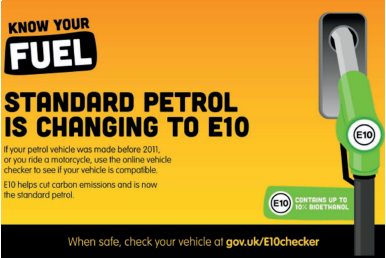
After an extensive consultation process, the Department for Transport has introduced legislation to mandate E10 petrol as the standard 95-octane petrol grade from 1 September 2021 and in Northern Ireland, this will happen in early 2022. They will also require the higher-octane 97+ ‘Super’ grades to remain E5 to provide protection for owners of older vehicles. This product will be designated as the ‘Protection’ grade. The change in fuel applies to petrol only. Diesel fuel will not be changing. Petrol pumps now show new labels designating the grade, the maximum ethanol content and an advisory cautionary notice. Other information regarding the introduction of E10 petrol may also be provided by fuel retailers such as the ‘Know your Fuel’ sticker (shown at the foot of this article). For some time, service station pumps have had E5 and B7 labels consistent with the BS EN16942 standard that has been adopted across Europe. This standard also sets out the labelling requirements for other renewable fuel grades such as E85, B20, B30, etc. that can be found across Europe either on service station forecourts or for captive fleet use.
At the filling station At the petrol station, a circular ‘E10’ or ‘E5’ label will be clearly visible on both the petrol dispenser and nozzle, making it easy for you to identify the correct petrol to use together with the warning text “Suitable for most petrol vehicles: check before use”
Labels on modern vehicles New vehicles manufactured from 2019 onwards should have an ‘E10’ and ‘E5’ label close to the filler cap showing the fuel(s) they can use.
What fuel should I use? Almost all (95%) petrol-powered vehicles on the road today can use E10 petrol and all cars built since 2011 were required to be compatible. If your petrol vehicle or equipment is not compatible with E10 fuel, you will still be able to use E5 by purchasing the ‘super’ grade (97+ octane) petrol from most filling stations.
Our recommendation The Federation recommends that all vehicles produced before 2000 and some vehicles from the early 2000s that are considered non-compatible with E10 – should use the Super E5 Protection grade where the Ethanol content is limited to a maximum of 5%. To check compatibility of vehicles produced since 2000, we recommend using the new online E10 compatibility checker however, please note that many manufacturers are missing and there are some discrepancies regarding particular models. Additional information on vehicle compatibility issues is available on the FBHVC website.
What is ethanol? Ethanol is an alcohol derived from plants, including sugar beet and wheat. Increasingly, waste products such as wood are also being used to manufacture ethanol. Therefore, it is renewable and not derived from fossil fuels.
Why are we using it? Principally ethanol is being added to fuel in order to reduce carbon emissions as Britain heads towards its target of net zero emissions by 2050. According to Government experts, this will reduce greenhouse gases by 750,000 tonnes per year which, they say, is the equivalent output of 350,000 cars.
The move will bring the UK in line with many European countries which have been using E10 fuels for a number of years already. In some parts of the world, such as South America much higher levels of bioethanol have been in use since as early as the 1970s.
What might happen? 1 Corrosion / Tarnishing of metal components 2 Elastomer compatibility – swelling, shrinking and cracking of elastomers (seals and flexible pipes) and other unsuitable gasket materials 3 Air/fuel ratio enleanment Some historic vehicles use materials in the fuel systems that are damaged by ethanol. These include some cork, shellac, epoxy resins, nylon, polyurethane and glass-fibre reinforced polyesters. In later cars these have largely been replaced with paper gaskets, Teflon, polyethylene and polypropylene which are all unaffected by ethanol. Very old leather gaskets and seals are also resistant to ethanol. As the ethanol molecule is smaller and more polar than conventional petrol components, there is a lower energy barrier for ethanol to diffuse into elastomer materials. When exposed to petrol/ethanol blends these materials will swell and soften, resulting in a weakening of the elastomer structure. On drying out they can shrink and crack resulting in fuel leaks. If your fuel system has old hoses or any degradation of components, then ethanol may appear to advance these problems very quickly. You may experience leaks or fuel “sweating” from fuel lines. Some fuel tank repair coatings have been found to breakdown and clog fuel systems, although there are plenty of ethanol resistant products on the market.
What can we do?
The most important thing is to ensure your fuel system components are regularly inspected and renewed as part of a routine maintenance programme for your historic vehicles. Ultimately owners should look to renew fuel system components such as hoses, seals and gaskets with ethanol safe versions as a long – term solution and more of these are entering the market through specialists every day. If you should decide to make the necessary vehicle fuel system modifications together with the addition of an aftermarket additive to operate your classic or historic vehicle on E10 petrol. The FBHVC strongly recommends that you regularly check the condition of the vehicle fuel system for elastomer and gasket material deterioration and metallic components such as fuel tanks, fuel lines and carburettors for corrosion. Some plastic components such as carburettor floats and fuel filter housings may be become discoloured over time. Plastic carburettor float buoyancy can also be affected by ethanol and carburettors should be checked to ensure that float levels are not adversely affected causing flooding and fuel leaks. Ethanol is a good solvent and can remove historic fuel system deposits from fuel tanks and lines and it is advisable to check fuel filters regularly after the switch to E10 petrol as they may become blocked or restricted. If your vehicle is to be laid up for an extended period of time, it is recommended that the E10 petrol be replaced with ethanol free petrol which is available from some fuel suppliers. Do not leave fuel systems dry when storing, as this can result corrosion and the shrinking and cracking of elastomers and gaskets as they dry out.
Engine tuning Ethanol contains approximately 35% oxygen by weight and will therefore result in fuel mixture enleanment when blended into petrol. Petrol containing 10% ethanol for example, would result in a mixture-leaning effect equivalent to approximately 2.6%, which may be felt as a power loss, driveability issues (hesitations, flat spots, stalling), but also could contribute to slightly hotter running. Adjusting mixture strength (enrichment) to counter this problem is advised to maintain performance, driveability and protect the engine from overheating and knock at high loads. Modern 3-way catalyst equipped vehicles do not require mixture adjustment to operate on E10 petrol because they are equipped with oxygen (lambda) sensors that detect lean operation and the engine management system automatically corrects the fuel mixture for optimum catalyst and vehicle operation.
Additives and vehicle storage. Ethanol has increased acidity, conductivity and inorganic chloride content when compared to conventional petrol which is typically pH neutral. Ethanol can cause corrosion and tarnishing of metal components under certain conditions. These characteristics are controlled in the ethanol used to blend E5 and E10 European and UK petrol by the ethanol fuel specification BS EN15376 in order to help limit corrosion. Some aftermarket ethanol compatibility additives claim complete protection for operating historic and classic vehicles on E10 petrol. The FBHVC is not aware of, or has tested any additives that claim complete fuel system protection with respect to elastomer and gasket materials for use with E10 petrol. The FBHVC therefore recommends that elastomer and gasket materials are replaced with ethanol compatible materials before operation on E10 petrol. However, corrosion inhibitor additives can be very effective in controlling ethanol derived corrosion and are recommended to be added to ethanol in the BS EN15376 standard. It is not clear if corrosion inhibitors are universally added to ethanol for E5 and E10 blending so as an additional precaution it is recommended that aftermarket corrosion inhibitor additives are added to E5 and E10 petrol. These aftermarket ethanol corrosion inhibitor additives often called ethanol compatibility additives are usually combined with a metallic valve recession additive (VSR) and sometimes an octane booster and have been found to provide good protection against metal corrosion in historic and classic vehicle fuel systems.
What happens if I fill up with E10 by accident? Don’t panic – your car will continue to run, just fill up with E5 at the next opportunity and avoid storing your vehicle for long periods with E10 fuel.
E5 Petrol E5 petrol can contain between 0 and 5% by volume ethanol. Other oxygenated blend components may also be used up to a maximum petrol oxygen content of 2.7%. There is a variation at the pumps, not just between brands but also between different areas of the country, some will contain a lot less but the absolute maximum is capped at 5%.
E10 Petrol E10 petrol contains between 5.5 – 10% ethanol by volume. Other oxygenated blend components may also be used up to a maximum petrol oxygen content of 3.7%. Again, there is a variation at the pumps, not just between brands but also between different areas of the country, some will contain a lot less but the absolute maximum is capped at 10%.
It should be noted that some Super E5 Protection grade fuels do not contain Ethanol as the E5 designation is for fuels containing up to 5% Ethanol. To re-iterate, product availability varies by manufacturer and geographical location.
Diesel labelling The renewable content of diesel fuel will not be changing and service station fuel pumps will continue to be labelled as B7, designating a biodiesel, Fatty Acid Methyl Ester (FAME) content of between 0 and 7% by volume. New vehicles manufactured from 2019 onwards should have a ‘B7’ and or higher content label close to the filler cap showing the fuel they can use.
This article was published by the FBHVC.
For media enquiries, please contact: Wayne Scott at Classic Heritage PR, 07759 260899 wayne@classicheritagepr.co.uk About the FBHVC: The Federation of British Historic Vehicle Clubs exists to uphold the freedom to use historic vehicles on the road. It does this by representing the interests of owners of such vehicles to politicians, government officials, and legislators both in the UK and (through the Federation Internationale des Vehicules Anciens) in Europe. There are over 500 subscriber organisations representing a total membership of over 250,000 in addition to individual and trade supporters. All our directors operate in a voluntary capacity supported by our secretary. Website: www.fbhvc.co.uk
This event has proved to be so popular that we are now operating a waiting list as we are over-subscribed! If you are not already on the list, please do not book with the site.
The 30th Anniversary Club Camp (delayed a year), BBQ & AGM will be held at Barnstones Caravan & Camping Park, Main Street, Banbury OX17 1QU.
Please get in touch with our Events Manager Lorna at events@vwt2oc.co.uk, or on our Facebook page with any questions.
The Volkswagen Type 2 Owners Club is a UK national club for owners and enthusiasts of the classic Volkswagen transporter van.There are also some most welcome members from outside the UK.
The Club aims to help its members maintain their vehicles both as preserved historic vans and as restored, or otherwise reclaimed, going concerns keeping a family travelling and camping happily. From the technical team helping out with advice, to the mutual support of other owners chatting at events and camps, there is plenty to encourage even the most reluctant restorer. Our members are spread right across the UK, and the Club tries to provide activities and events that everyone can attend and enjoy. Mostly, we run camps and rallies where members meet up and relax. There are also valuations and restoration teaching rallies. Finally, we also have a strong presence at some of the country’s biggest VW events, including Camper Jam, BVF and Busfest.
Please allow 14 days following payment for your application to be processed.
If it is urgent you may be given a temporary membership number on an e mail request to the membership secretaries.
The Chanceller announced in today’s Budget a handful of small measures intended to help motorists.
First was to confirm that fuel duty will be frozen until spring 2015, meaning that the planned rise in September has been abandoned. In his fifth budget, George Osborne described how this would make petrol 20 pence per litre cheaper on average than it would have been under the previous Government.
However, plans to increase vehicle excise duty costs in line with inflation remain, meaning that from April 1 any band from D upwards will rise by £5 or more.
It has also been confirmed that motorists will be able to pay for their vehicle excise duty on a monthly, biannual or annual basis from October 1 2014, . He also confirmed that when selling a car any remaining tax is no longer transferrable.
There was news of a £200 million fund for local authorities to repair potholes, a move that was cautiously welcomed by the Institute of Advanced Motorists: “Every little helps and it will be welcomed in many areas hit by this year’s bad weather,” said Neil Greig , the IAM’s director of policy and research. “With a ten billion pound back log in repairs, however, it is only through consistent long-term funding that the pothole problem can finally be fixed.”
The RAC, however, warns that merely patching up potholes isn’t enough: “We need whole stretches of road to be resurfaced regularly rather than just patching them when they start to fall apart, costing taxpayers more and more money every year. Simply filling potholes is a massive false economy which has now unfortunately become necessity. We really need to put an end to this by making sure roads are never allowed to degenerate to the point where potholes develop,” said David Bizley, the organisation’s technical director.
As per last year’s Budget it was also announced that the exemption from vehicle excise duty for classic cars will move to a 40-year rolling period, which takes effect from April 1 2014. This means that models such as the Austin Allegro, Reliant Robin and MGB V will qualify for tax exemption, which could have a positive impact on their value. Previously only cars built before January 1 1973 were exempt from tax, after the Government abandoned the previous 25-year rolling scale in 1997.
Fans of the classic VW camper rejoice! VW’s venerable old bus may not be dead after all.
Cast your mind back to September last year when we brought you news that the VW Kombi, which has been in production in Brazil since 1976, is finally being killed off, 63 years after it was originally introduced in Europe.
From the beginning of next year, Brazilian legislation will force all new cars to have both ABS and driver and passenger airbags. VW decided that these could not be fitted to the Kombi, announcing its decision to pull the model and launching a Final Edition model to say farewell in the process.
Now, however, it seems that the Kombi may not be destined for the scrapheap after all. Brazil’s finance minister Guido Mantega is reportedly looking at an exception for the VW bus, based on the fact that the model’s ancient design does not allow room for the new technologies.
Mantega has already provoked criticism in Brazil for suggesting that the new safety standards could be postponed over concerns about inflated car prices.
The VW Kombi is still very popular in Brazil, with 26,000 units sold in the country every year. Its popularity is largely down to its low price, practicality and reliability, which has made it a favourite among cash-strapped businesses.
Of course, even if the Brazilian government does make an exception for the Kombi, it remains to be seen whether VW will continue production of the model.
The Volkswagen T2 is one of the most iconic campervans in the world. Its popularity and evergreen design has endured for over half a century with over 10 million having been produced. Caravan Owners Club recently reported that production of this incredibly popular vehicle will finally come to an end on 31st December this year.
Despite still being one of Volkswagen’s most successful products, with output being presold even today, health and safety laws being introduced in Brazil mean that the vehicle’s lack of airbags and ABS system will signal the end of production at the VW plant in Anchieta.
Despite this rather gloomy news there has been a silver lining for campervan conversion company Danbury Motorcaravans, who have seen orders for converted T2’s skyrocket since the end of the Type 2 was announced.
“We are absolutely inundated,” Jason Jones, sales manager at Danbury told Caravan Owners Club.
“People who have thought about buying a T2 but have maybe put it off, now have a limited time in which to order one, because on the 31st December production will stop forever.
“Plus of course the production run always sells out in advance, so if someone is wanting to buy a T2 then the time to order one is now because we have no way of knowing when the production run will be fully allocated. We’ll just find one day that we hit the button to order and find that it is no longer possible.”
When asked whether he thought that the T2 might make a comeback at some point in the future with ABS and airbags fitted Jason replied:
“There is no way that it can be done. It just isn’t possible with this vehicle, these really will be the last VW T2’s ever produced and that’s why we’re going to document the last ever shipment that we receive and put the images on our Facebook page (https://www.facebook.com/danburymotorcaravans) to commemorate the end of production.”
Although those who want to capture the symbolic freedom that the type 2 represents may be disappointed if they do miss out, it’s not all bad news as there are other high quality campervans available as an alternative, like Danburys T5, VW Caddy, or Fiat Doblo conversions.
Danbury’s new double back T5 campervan comes with an unprecedented choice of 10 different wood finishes, 5 different flooring options, and 150 types of fabric and leather finishes meaning that each one is different and is really a bespoke design depending on the preference of the consumer.
So while the 31st December will mark the end of the road for one of the most popular campervans ever produced, you do have a last chance in which to order one if you act quickly.
Links:
You can see the new T5 range here: http://www.danburymotorcaravans.com/models/model.aspx?modelID=2
See what Jason Bradbury of Channel 5’s Gadget Show had to say about the VW T2 after he took one touring around the South Coast here: http://www.danburymotorcaravans.com/models/modeltype.aspx?modelID=1&modeltypeID=7
Danburys Facebook page where they will document the last ever shipment of VW Type 2’s here: https://www.facebook.com/danburymotorcaravans) to commemorate the end of production
See Danburys new T5 range here: http://www.danburymotorcaravans.com/models/model.aspx?modelID=2