A great day out in the heart of England. Just a one day show but you can camp the night before and the night after.
Category Archives: T5
Inspect A Gadget – Exhaust wrap
This issue’s gadget is “exhaust wrap” or “exhaust bandage”. Engines get hot – air cooled or water cooled, it doesn’t matter – there is heat being generated from the combustion of fuel and getting the heat away is a key part. With the exhaust being in close proximity to the engine and the by products coming out of the exhaust, it naturally gets hot and the radiating effect means that anything nearby is heating up.
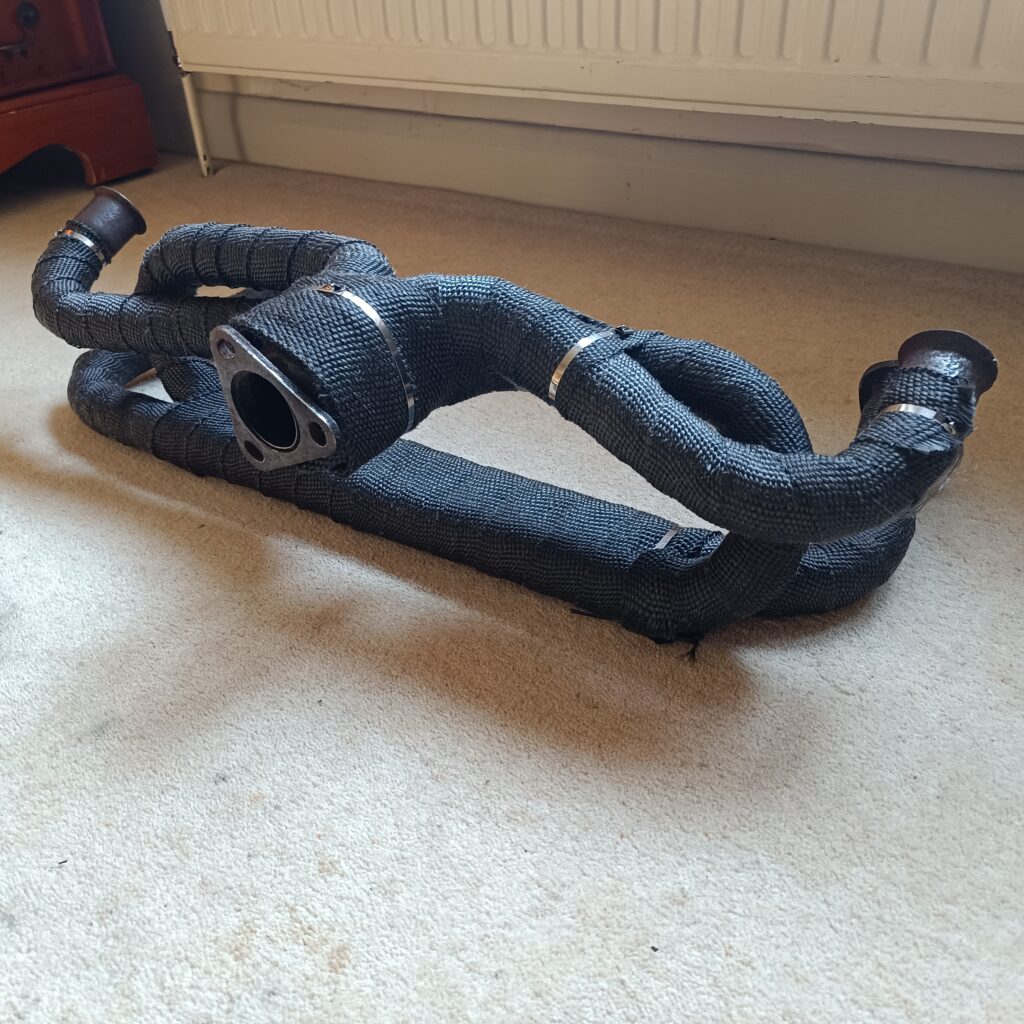
The bandage wrap acts as an insulator, keeping the heat inside the exhaust, thereby keeping the heat away from around the engine. Even if it is only a small benefit, it is a benefit. It also looks nicer than a slightly rusty exhaust manifold.
The wrap is easily available from motor factors and online and costs between £10 and £20, there are a lot available and most comes with metal ties to make a neat job.
Removing the exhaust manifold is optional but was done on this one as the engine was out of the vehicle. Starting at any end, start wrapping the bandage around the manifold tightly trying not to get too many layers on any section. As you get to a suitable point, use one of the ties to stop it unravelling – the start will be kept in place as it is under the next row BUT it is easy at this point to tie that one off as well for completeness. You can wrap it as neatly as you wish, you may as well use all of the ties that come with it.
Some of them are glass fibre or have other heat retardant materials that can make your hands itch, so take suitable precautions.
It certainly looks nicer afterwards!
The next club magazine is on its way – issue 193
The next edition of the club magazine has been finished by our Editors and looks fantastic. It should be arriving through your door soon! If you are enjoying the club magazine and have a story about a trip, an upgrade, a restoration or just a tip, send a contribution to our Editor at editor@vwt2oc.co.uk.
Wakey wakey!

Yes, it is that time again. Hurray! Finally, after the long winter in our non-mobile houses, we can get out our beloved vehicles.
Checklist
Hopefully you all followed the article Time for bed/ to help put your vehicle to bed for the winter. Now that spring is in the air and we are starting to think about getting out and communing in nature, this is a key time to get things ready.
Doors locks – there’s nothing more annoying than a failed lock. get it fixed now before the season really gets going. Door lock issues can be very straight forward but a simple lubrication can be key. Pun intended. A non residue lubricant is best to move the dirt away as WD40 can leave enough gunk to create issues. We favour silicon spray. A little into each lock.
Windscreen wipers – did they perish in the cold winter freezing them to the windscreen. Inspect and replace now.
Water – check the radiator if you have one. Ensure that the bottles that you emptied in the Autumn / fall have no mice, carefully hidden Christmas presents or mildew. Clean with a weak Milton solution if it is drinking water or food related.
Batteries – check the charge on each battery with a good meter. A flat battery can indicate an earth leak. A failed battery needs careful investigation.

Carburettor – Or equivalent. Check for good operation, no stuck flaps or other deterioration over winter. If you are a professional, this will be straight forward. If you are an amateur, a test drive very close to home will highlight problems! But only after the other checks.
Brakes – your vehicle should roll easily, otherwise this can indicate jammed brakes. Parking in gear for long periods of time can be better for your brake health than a jammed set of brakes. Check the brakes for operation. Check the brake fluid level. If it has been more than 5 years, change the brake fluid as it is hygroscopic and slurps up water incredibly quickly. Water is not a good fluid for applying the brake pads to the disks.
Seals – inspect all door seals for any signs of damage, water ingress or other problems and sort them out now. Glue any loose bits back down with the correct glue.
Windows – ensure that they all open and close fully. Or at least as fully as they did last year if applicable!
Ignition – Once you are feeling confident, get in to your pride and joy and turn on the ignition to number 2. Look at the lights on the dashboard. Check there ARE lights! Are they what you expect / are used to seeing? Have you got fuel (for those with a working fuel gauge)?
Crank it over – don’t expect it to start immediately but things should kick into life within a few seconds.
A little test drive on your driveway will allow you to test the brakes, maybe the steering and other important parts. Softly, softly.
Stay local, take your phone with you and warm clothing. Just in case!
Once you get home, assuming that you have a big smile on your face, make a list of snags, get indoors, put the kettle on and start planning for your summer.
Check out the events page and come and see us at a meeting soon!
Cooking – Peri Peri Chicken
Your neighbours will be jealous with this one!

Ingredients – Serves 2
1 pack of about 8 chicken drumsticks
2 green chillies
2 red chillies
2 tablespoons of Balsamic vinegar
2 tablespoons of lemon juice / 1 lemon juiced
1 tablespoon of honey
Some dried mixed herbs
Yes, dried mixed herbs again – a staple in the camper van! Using a sharp knife, slice across the flesh of the chicken down to the bone to allow the spices to penetrate. Add all of the ingredients to a flat dish and get the drumsticks coated. Leave them to marinade for at least 30 minutes but overnight is even better. Wrap the drumsticks in foil but don’t stack them then either cook in a frying pan or on the BBQ tipping the leftover marinade from the dish over the top of them. Cook thoroughly! For adding wow factor, add a little lemon juice and some fresh green herbs on top as you serve them alongside crusty bread and salad. And a glass of something of course!
Inspect A Gadget – Portable projector by James Reeves
Some people like a TV in the camper van for those longer, darker evenings when there is no club marquee to sit and natter. Others like it for specific events such as Wimbledon (which we put on the club TV by the way).
Another option instead of the TV is to use a portable projector. James and Marina Reeves, part of our supportive management team introduced us at a recent event to the Anker Nebula capsule, miniature projector. Just 6 inches / 15 cm high, this little cylinder has a built in battery that lasts 1.5 hours in standard mode and up to 4 hours otherwise. At 200 ANSI lumens, it does really need a dark evening but can project an image from its tiny cylinder onto any flat surface – a 40 inch (1 metre) diagonal picture from 4 feet away (1.14m) up to a colossal 100 inch (2.5 metres) diagonal picture when the surface is 3 metres / 10 feet away. We tried it on a planked shed and it looked incredible.
You can stream anything from YouTube and Netflix, plug in a USB stick with movies on it, there is even a remote control!

The Anker Nebula retails around £320.
Cooking – Sausage pasta
Wonderful smells and an easy dish

Ingredients per person
4oz dried pasta
1 onion
Some mushrooms
1 tin of chopped tomatoes
Dried mixed herbs
3 cloves of garlic
1 large sausage such as garlic sausage or venison or other strong flavour
Small glass of red wine
Oil or butter for frying
Cook the pasta and set to one side. Reuse the pan! Fry the onion until softened and starting to go translucent, then add the garlic, herbs, mushrooms and sausage. Cook all of this for 5 minutes stirring occasionally until nicely coloured. Add the remaining ingredients and cook for a few more minutes. Add the drained pasta to the pan.
Serve with crust bread and perhaps a glass or two of that red wine – it seems a shame to let the rest of it go to waste!
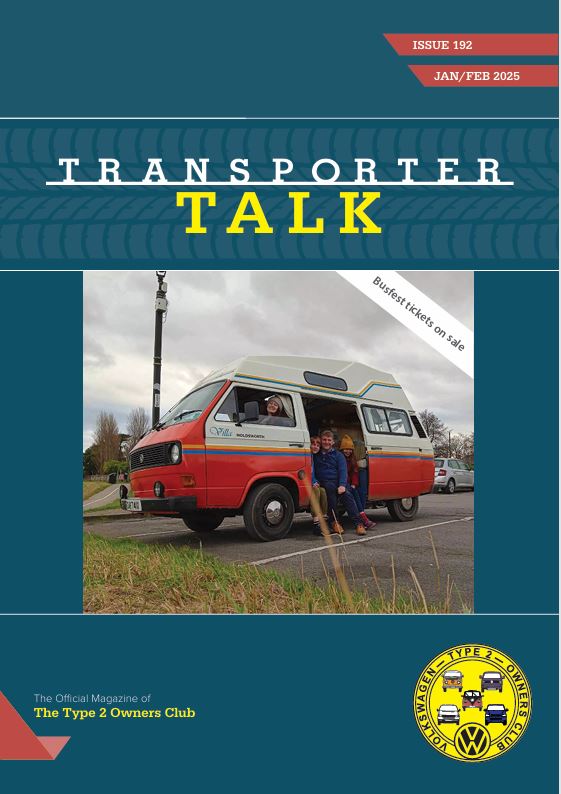
The next club magazine is on its way – issue 192
The next edition of the club magazine has been finished by our Editors and looks fantastic. It should be arriving through your door soon! If you are enjoying the club magazine and have a story about a trip, an upgrade, a restoration or just a tip, send a contribution to our Editor at editor@vwt2oc.co.uk.
The next club magazine is on its way – issue 191
The next edition of the club magazine has been finished by our Editors and looks fantastic. It should be arriving through your door soon! If you are enjoying the club magazine and have a story about a trip, an upgrade, a restoration or just a tip, send a contribution to our Editor at editor@vwt2oc.co.uk.

Inspect A Gadget – USB time!
USB gadgets
Most of us will have a USB socket in the camper van, but are you using it for more than just charging your phone?
Fan
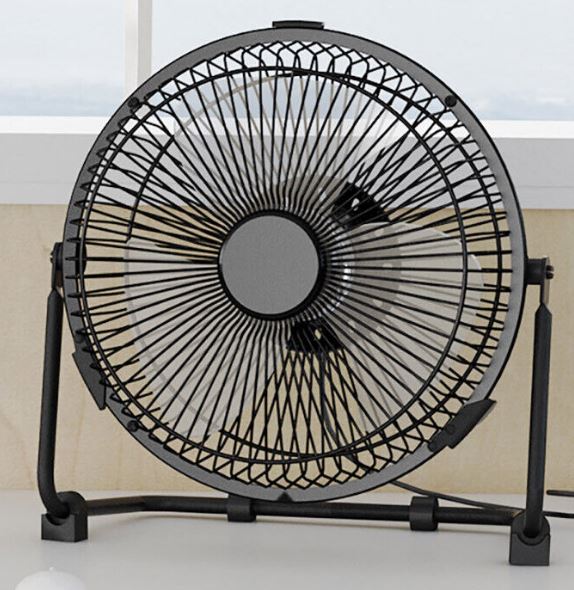
An 8 inch fan powered on USB will keep you cool in summer and can be purchased for under £15. We have one similar to the one in the picture and it hangs neatly upside down from the roof aperture on the Dormobile.
Power pack
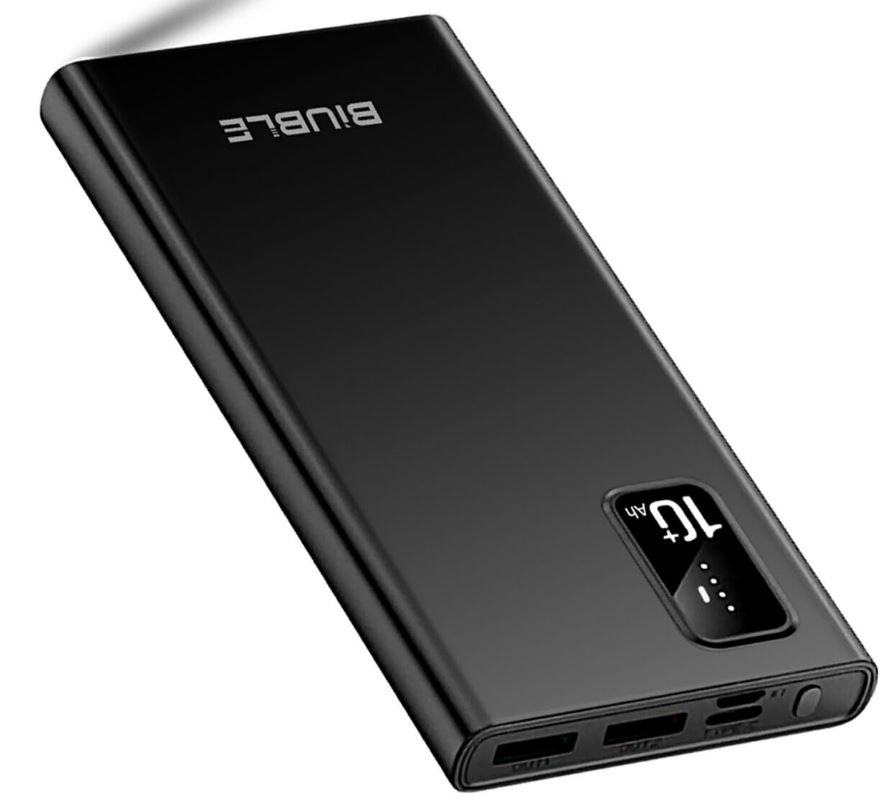
If you are charging your phone then going out, sometimes you need just that little bit extra. Or if you have no leisure battery and only use USB when driving to avoid flattening the starter battery, this is another option.
A Power bank is a battery with a USB or two to keep your mobile charged when away from a power source. You can also use it when outside to power the fan when sitting outside enjoying the warm weather. Power banks are readily available but be careful buying the really cheap ones – they are often very small capacity. Look for at least 10000mAh (milli amp hours) and avoid anything with claims of more than 100,000mAh – they are not that powerful! Expect to pay around £20.
If you own an iPhone, you do not need to buy a battery pack that says that it is suitable for an iPhone. They are all USB and they all work fine!
Toothbrush charger
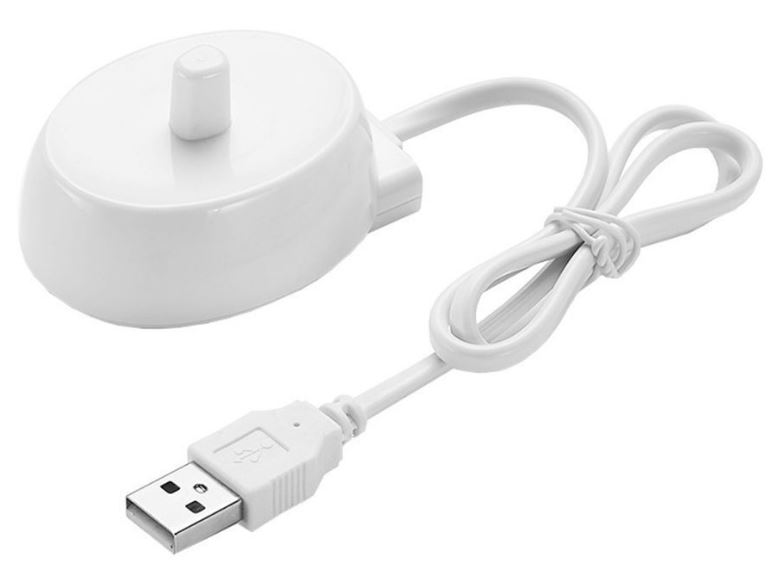
We used to take out bulky toothbrush charger with the 2 pin shaver plug and the 3 pin converter. Then every few days whilst at a camp site with a shower (we cannot go too long without a proper shower and have not invested in the Karcher portable shower as featured last issue), we were plugging that into the socket in the shower blocks! Then we discovered the joys of USB. Now we charge when we want, in the van and the charger is a lot smaller – every little helps! These can be purchased online for under £5 and now we have the big one at home and the little one permanently on board!
WARNING – if you have the 240-volt charger for a toothbrush, do not use it with an inverter on your vehicle. The electronics in the charger will flatten your battery.
Voltmeter
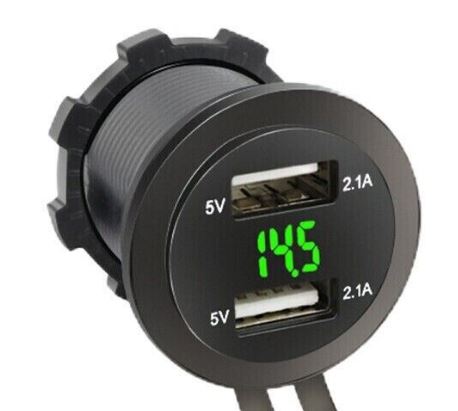
Upgrade your USB socket! Whether you have 1 or 2 USB sockets in the standard round hole, replacing it with a built-in voltmeter will give you easy access to check the charge level of your battery. Available for about £5, there are 2 pins on the back that you can pull the cables off the existing one and replace with a new one. Or supplement a new pair! You can never have enough USB sockets – we have 1 in the front, 2 by the sliding door and 2 each above where we sleep (charge the phone and run the fan at the same time!). Available for about £7 each which is almost the same price as buying a pair of USB sockets without the voltmeter.
Just be wary of buying a really bright voltmeter and fitting it right where you sleep! They can be very bright!