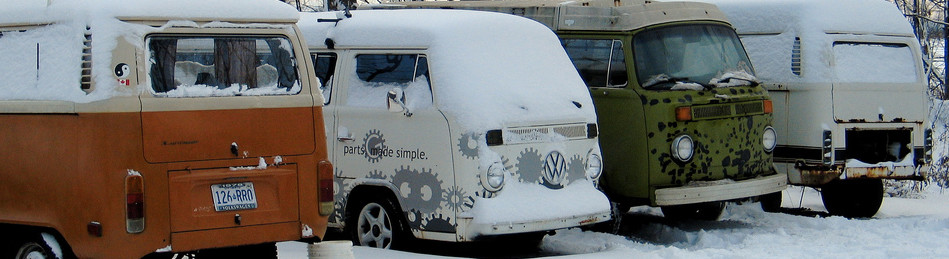
As the long season comes to an end and following on from the recent winterizing post, some owners may elect to cover their pride and joy with a cover.
Please. Pretty please. Pretty please with little chrome covers on. Don’t cover your expensive paint work with a tarpaulin that will get condensation inside it, press that moisture onto your bodywork and accelerate the attack on the paint and the metal underneath.
If you don’t have access to a garage or a car port that will keep most of the weather off, try to invest in a good breathable cover. Get the right one for your vehicle and make sure that the material is not flapping around, abrading where it touches.
Ideally park on hard ground that will not have standing water. Parking on grass at the bottom of the field will collect water underneath which will evaporate upwards into your van and its little cover. A breathable cover will let some or most of that collected moisture out but ideally you should remove the cover over winter every month to let things properly dry out and then put it all back to bed once more.
If possible, get a cover with straps that go under the vehicle from side to side, so that the wind cannot lift the cover off the vehicle. It is disheartening to get home from work in the dark and find your expensive van exposed to the elements and a wet cover wrapped across your hedge.
For those of you lucky enough to have a garage, a dust cover is optional but again, think about the possibility of trapped moisture pressing against the bodywork. Does a quick dusting or a nice spring time wash and wax give more benefit than the winter cover?
Hello, my name is Tish and I’m having a go at writing some camp friendly recipes. We have a small 70s two hob stove like I’m sure many of you do. I carry on board a small and large cast iron saucepan and a none stick frying pan. I’m also a bit of a foodie so I have a small wicker basket on board which always contains – a proper salt and pepper grinder, olive oil, stock cubes, a few dried herbs and cinnamon. I also like to have some chutney/pickle/jam around too. Great for making fancy sandwiches or elevating a charcuterie board when it’s too hot to cook. Whenever my husband complains about fuel economy I just shrug my shoulders.
I tried to incorporate bits you’ll have on board for breakfasts or have at home to use up. With the cost of camp sites going up, and restaurants increasing their prices (understandably) it’s nice to try and save a few pennies where you can.
This can be made on a camping stove, or at home and warmed up on site.
You’ll need 2 hobs
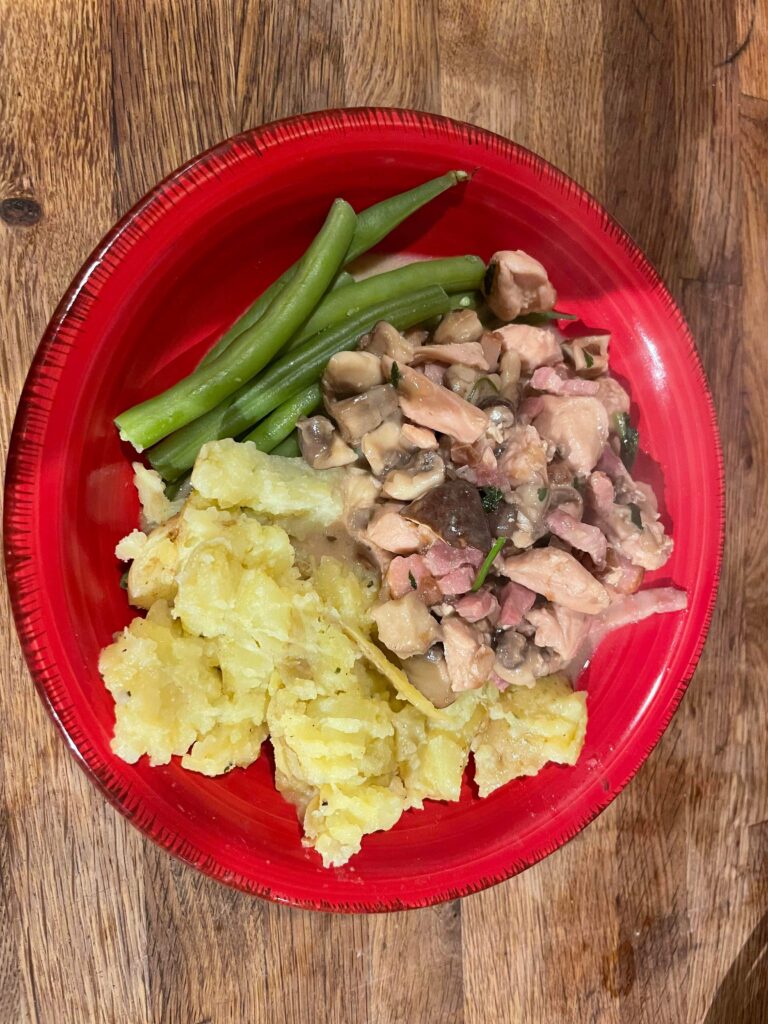
Whatever chicken you have available (about 250g) or vegan alternative. Chopped. Bacon lardons (I used smoked for extra flavour) Mushrooms 200g Chicken stock Cream cheese (at least a tablespoonsworth – useful if you’re using it for breakfast!) Small Waxy potatoes. (You can precook these at home, they travel well – or boil in a separate pan) Salt and pepper and some butter.
Instructions Boil a full kettle. Once kettle is boiled add almost all the water into a small pan, add your potatoes on to boil. (Omit this if you’ve precooked them at home) try reserve about 100ml of water. Add a small bit of oil into a medium saucepan and once hot add in chicken and bacon. After the chicken starts to cook through (about 5-10 mins) crumble in your mushrooms. Leave for another 5 minutes to soften. Now you can add in your stock, soft cheese, salt and pepper with 100ml of water. (I add in some onion chutney here) Leave this to bubble and reduce. At this point you can add your peas into the stew or green beans into the same pan as the potatoes. Neither need very long. Once potatoes are soft, pop onto a plate and crush gently with a fork. Add salt and pepper to taste and as much butter as you like. I’m not your doctor! (If you’ve precooked your potatoes, similarly crush them and warm them up in a pan with some butter, salt and potatoes) If you wanted some fresh herbs now is the time to mix into the stew.
Then divvy up into bowls and enjoy. To make this a one pot lower carb meal, omit the potatoes entirely. Or if you’re low on cooking facilities the stew can be happily mopped up with some bread.
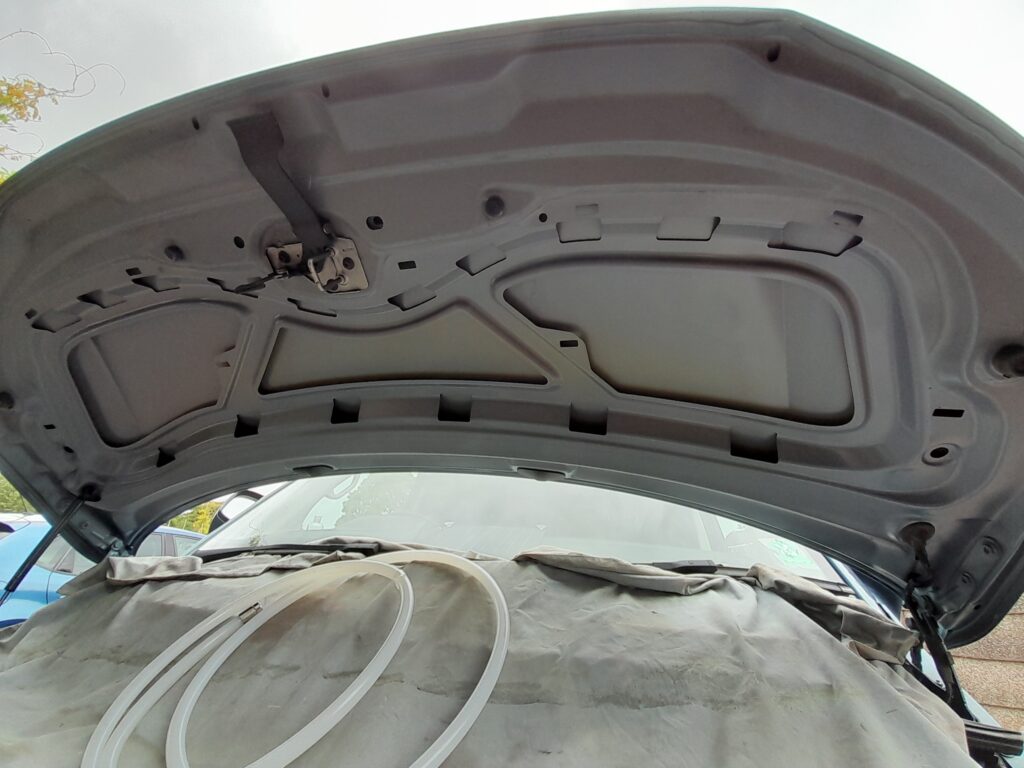
Fitting my competition prize (at last). Quite a while back I was lucky enough to win an Engine Fire Fighter, Automatic engine fire suppression device in one of the club competitions as supplied by our friends at Just Kampers.
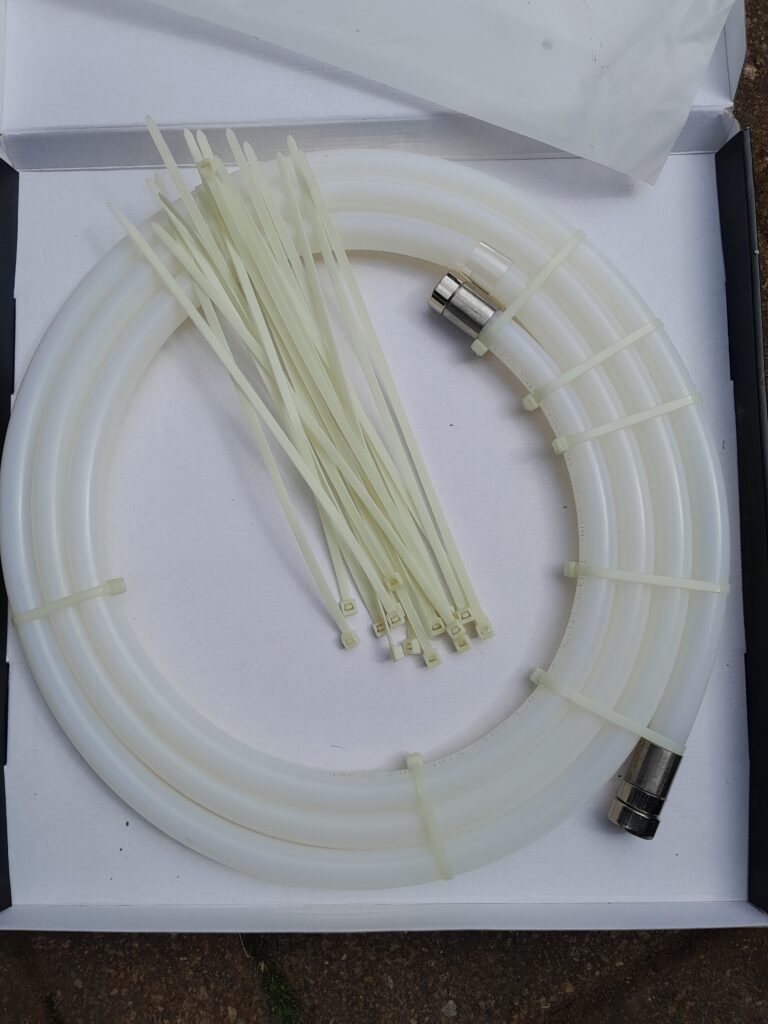
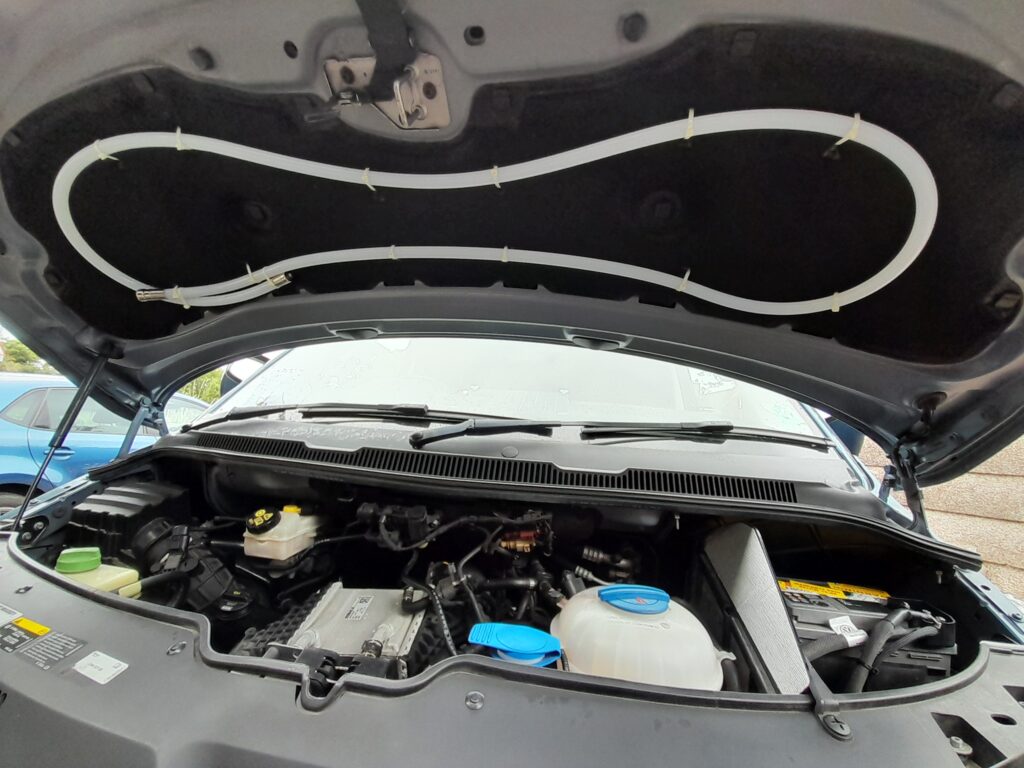
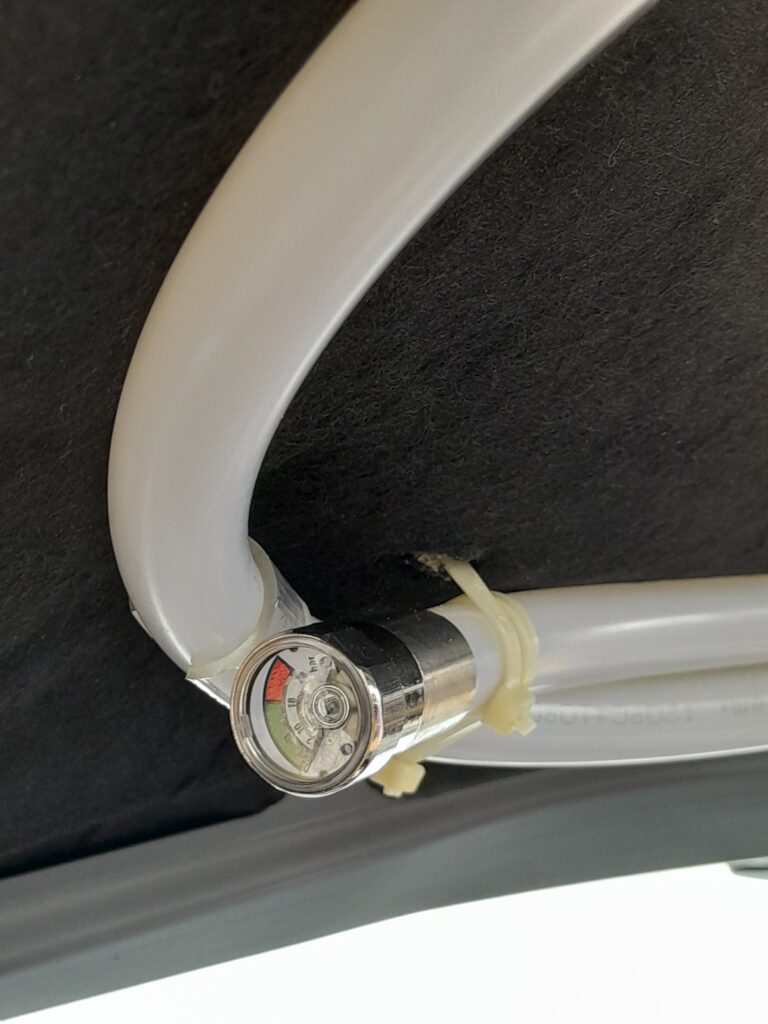
It’s 3m in length, has a burst temperature of 120 degrees centigrade, fire rating class A,B,C,E and only takes five minutes to install (as long as you don’t have to work around other fittings such as an under bonnet insulation pad that is). It’s still not a long job though!
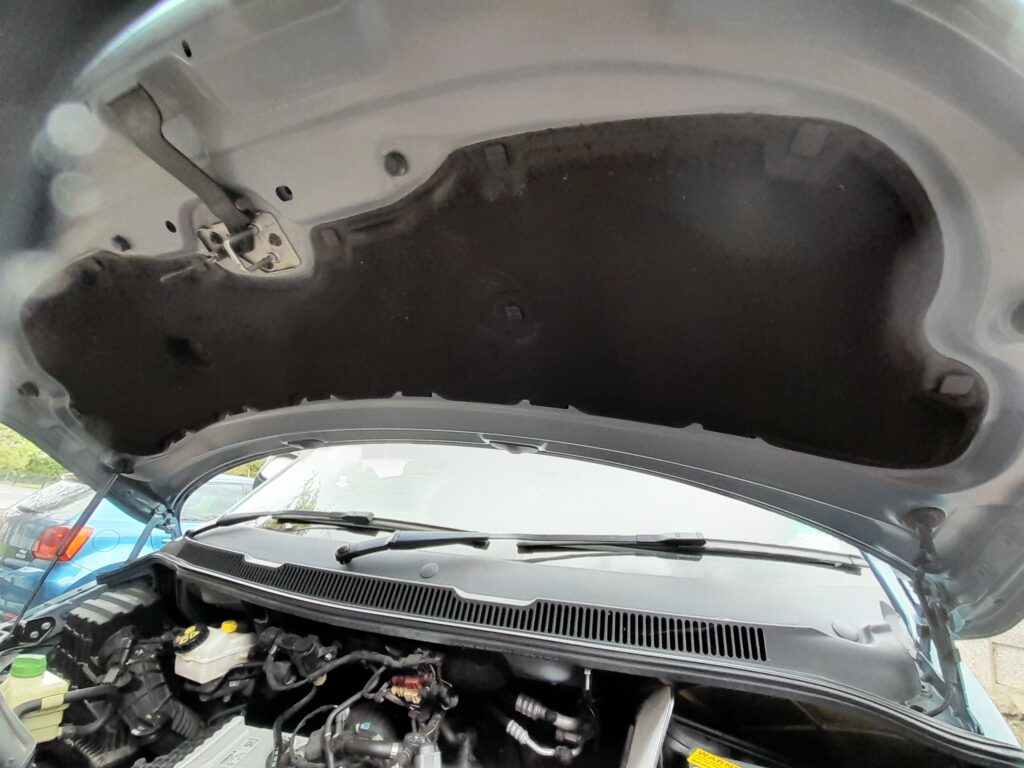
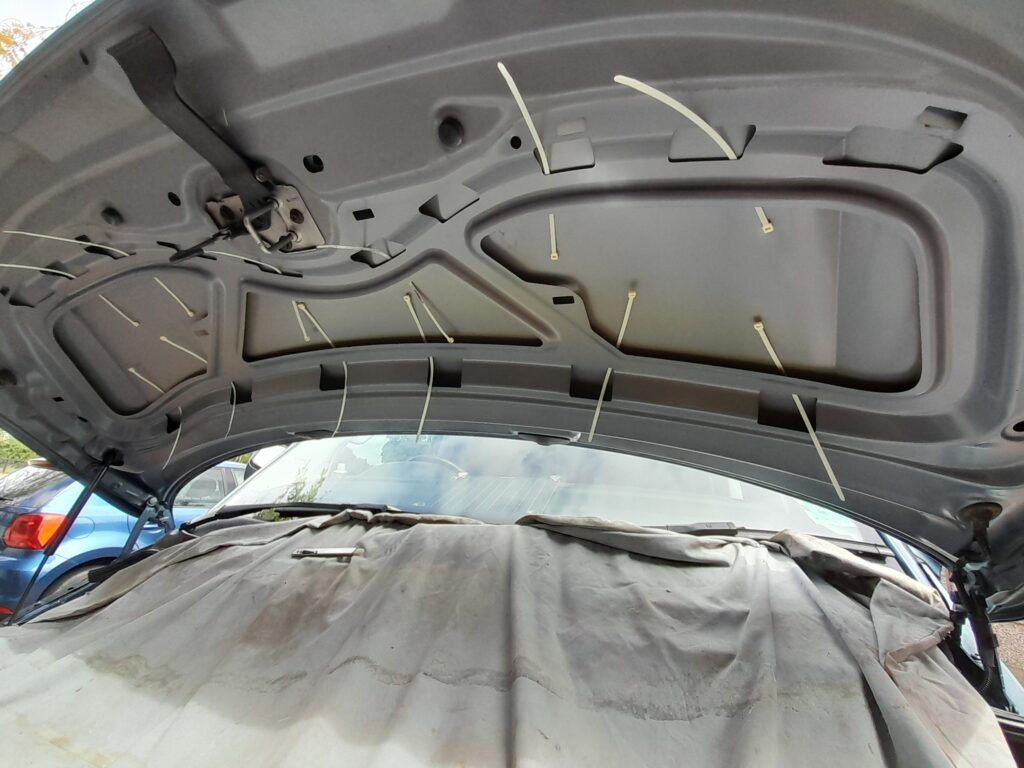
I decided to remove the pad and utilize the bonnet framework to attach the included cable ties to secure the extinguisher to the bonnet.
It is advised to use these cable ties as opposed to wire because part of their job is to melt in the eventuality of an engine fire and allow the extinguisher to drop onto the engine.
Passing the ties behind the framework wasn’t too hard, although I did have to make some small holes through the factory mastic in a few places. Next, I marked and made holes in the bonnet pad to enable it to be put back in place. This was the trickiest part, achieved by temporarily taping the two ends of each cable tie once passed through the pad and when all were in position I could reattach the pad to the bonnet. It was then just a matter of cable tying the extinguisher into position and hope it’s never called into action.
Yes, it is that time again, winter is very much heading our way. For anyone with a vehicle, VW or not (apparently other vehicles are available!), winter in the UK is the worst time for metal on the roads.
Some suggestions:
Inside
Water
If you have anything containing water, drain it all out. Water tanks, boilers, kettles. Don’t just empty the tank, drain the whole system including the pipes. Remember that water in pipes still expands when it freezes, not just in the tank. It also goes stale after a period of standing. If possible take the tank indoors to keep it above freezing and/or clean it thoroughly.
We use a mild Milton solution to thoroughly clean ours including the impeller that sits in our tank and its associated pipe and electric cable. Then we rinse everything and air dry it all. Other options are available too!
Power
Leisure batteries like ambient temperatures and extreme cold will reduce their operational life. Keep them above freezing by removing them and keeping them in the garage or similar. Remember to keep the electrical contacts in the van safely insulated if applicable.
Keep those batteries charged using a trickle charger that is fit for purpose, which will also prolong their life.
Gas
Butane or propane tanks and bottles should be removed from your vehicle and stored safely with their openings closed properly – don’t leave the regulator open relying on the gas tap on the cooker as these can fail. Now is a good time to weigh them against their empty counterparts to know when you need to change them!
Boring cleaning
Now that you have opened up your van, removed the relevant tanks and bottles, you can get all misty eyed and miss the peace and tranquility of your van by getting in there and cleaning it all. It gives you a great sense of personal achievement as well as going into the winter with a nicely clean kitchen area, the fridge has been bleached and rinsed, and if applicable the bathroom, the shower and maybe the hot tub are all clean. Leave internal doors slightly ajar to keep mould and mildew at bay.
Soft furnishings
If possible, remove curtains, bedding, that emergency woollen blanket from Granny and take them indoors for a good wash or airing.
Ingress
Don’t be tempted to leave doors open or windows more than cracked open. All sorts of miscreants can get in and eat your lovely interior.
Outside
If possible store your vehicle in a garage. If that is not possible, a car port will do a similar job. A breathable cover can be good but make sure it is listed as fully breathable otherwise moist air gets under the cover, rises when things warm up and the vehicle will get wet, holding that wet against the bodywork. Avoid a heavy cover for sure!
Tyres
Tyres degrade from extreme temperatures and long periods of standing still. Winter does that very well! Inspect the tyres, check the pressures and consider putting the van on axle stands if you are not using it for a very long time, taking the wheels into the garage or shed. It also makes theft more difficult!
Moving parts
Lubricate everything. Hinges, moving parts, sliders, mechanical parts. Check the oil level. Use the right lubricant for the part in question. It will pay dividends next year and will keep water away, which is good for the life of the part.
Boring cleaning
Again, give the outside of your vehicle a proper clean, ideally by hand. Dry fully including the fiddly bits inside doors and between panels. Give it all a good quality wax polish. This also keeps water away and prolongs the panels and parts. It also makes you happy as you pass over the cold season when you don’t want to be away.
Underneath
If you are an advocate of underseal and waxoil, get the old visible stuff removed and apply new underseal to dry clean parts. The jury seems out on the benefits of underseal against the downside of it trapping moisture but waxoil or similar applied hot into cavities must be better than not applying it?
Engine
Some texts state to start your engine once a month and run it on idle for 30 minutes. More than that is not necessary and I don’t touch our air cooled engine at all.
An oil change just before the winter alongside a fuel-storage additive in the fuel tank if you like that sort of thing.
Main battery
We leave the main battery connected and the solar panel bolted to the roof of a van in a car port for the leisure battery. If that was not the case, we would trickle charge the main battery once a month over the winter. Again, this just makes sure that you don’t degrade the battery and end up having to replace it all of the time.
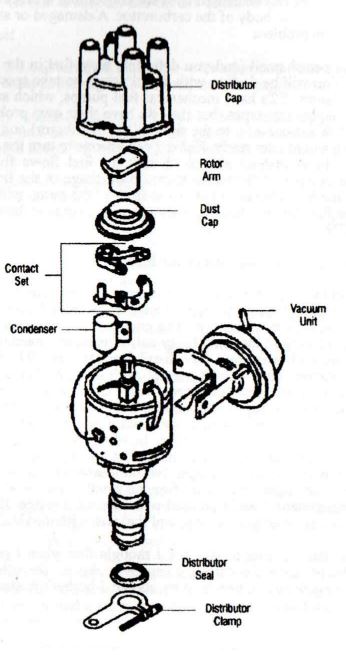
Within a petrol engine, a spark is required at the exact moment when a gas (of air and petrol) is compressed by a piston. For the spark to exist at all depends upon three essential parts: the distributor, the coil and the contact breaker. There are two electrical components in this system, called the High Tension (HT) and Low Tension (LT) circuits.
The LT circuit consists of the battery, the coil and the bottom bits of the distributor, namely the contact (with its points) and the condenser. The HT circuit has the spark plugs (and their leads), the top part of distributor, namely the cap and the rotor arm, and the link cable from the coil to the cap.
The coil is essentially two windings of cable; a primary winding of only a few turns of thick wire and a secondary winding of many thousands of turns of finer wire. Initiating voltage to the coil (and starter) is activated by the ignition switch and supplied by the battery. The energy goes directly to the coil’s primary winding, then to the condenser and contact breaker. (The condenser is there to prevent excessive arcing at the points). The primary coil is now active but at an exact moment (when the contact breaker points open), the circuit is broken, and this generates a very high voltage within coil’s secondary winding.
We now begin to follow the HT circuit. From the short link between the coil and distributor, thousands of volts are fed to the rotor arm via a graphite bush, inside the distributor’s cap. Here also are the terminals to all of the engine’s spark plugs. The rotor arm feeds each one in turn as it rotates, again at an exact moment, and the spark plugs receive several thousand volts, arcing across their end terminals.
The HT circuit is completed and an explosion occurs within the cylinder, forcing the piston down.
Ignition fault finding
Symptom – The engine turns over, but doesn’t fire at all.
The chances are that it’s an ignition problem; to make sure, pull a lead off a spark plug, hold it near the engine block and get someone to turn the engine over. A big blue spark means a carburettor (fuel) problem (see later), or defective plugs.
So there’s no spark at all. It’s a good idea now to determine whether fault lies in the Low Tension or High Tension circuit, as this then eliminates a number of variables, saving time.
Pull out the short HT link from the coil terminal and hold it a few millimetres away from its socket. Get someone to turn the engine and watch for a spark. If there is a spark, the HT leads to the plugs or the upper part of the distributor is defective. No spark at all means the coil is suspect and the LT circuit needs testing.
Testing the HT circuit
Put the link back into the coil terminal and remove its other end from the distributor cap. Hold the end close to the engine block and turn the engine over. A weak spark probably means the condenser is short circuiting; don’t mess about with it, it’s irreparable, and easy to replace. No spark at all means the HT link from coil to distributor is defective, or the coil has had it. Replace both.
A strong spark means that we have to apply another test.
Replace the short link into the distributor cap terminal and remove one of the plug leads from the cap, and hold it close to its terminal. Tum the engine over. If there’s no spark, the distributor cap is defective (dirt, moisture or cracks). Ensure the graphite bush and its spring are clean; examine the rotor arm and clean if necessary. Clean the spark plug terminals. If damp, spray everything with WD 40.
If there’s a spark, the leads to the plugs are defective; it is possible that the plugs themselves are also suspect. Take out each lead in turn, hold it close to the engine block, and turn over the engine. If there’s no spark, the HT lead is defective; replace it.
If there is a spark, the plug is defunct; again, replace it.
Dealing with the Low Tension circuit
Notice the term – dealing. Testing the Low Tension side of the distributor and coil requires the use of a test light or meter. If you suspect this is where the trouble lies (after going through the High Tension circuit), it saves time and trouble to just replace the contact breaker points, condenser and maybe the coil (though having no moving parts, it seldom goes wrong). Double-check the wiring; frayed or loose terminals increase electrical resistance, loading the circuit. Sometimes all
that is required is application of a screwdriver, and you’re on the way again. Carrying spare points, condenser and a rotor arm should be as second nature as having a spare alternator belt and bulbs.
Carburettor problems
The carburettor is a precision device and shouldn’t be tinkered with unless you know what you’re doing. Flooding the engine (with petrol) is a very common fault, especially when the vehicle is new to you, or when the engine’s hot. In most cases, all that is required is to rest the engine for a few minutes and try starting again. If the engine fires and splutters, press the accelerator gently (choking). If it still splutters and dies and there’s a definite petrol smell, flooding is the problem.
Repeated flooding can be caused by a sticking choke, a blocked air filter or damage to the float in the body of the carburettor. A damaged or sticking needle valve may also be the problem.
If there’s no petrol smell (and you definitely have fuel in the tank), suspect fuel starvation. You will be dealing with liquid petrol, so take special care with sparks and naked flames. Type 1 upright engines are likely to have mechanical fuel pumps, which are more robust than electrical (diaphragm) types, but they do have their own problems. Find the fuel pump (on air-cooleds, to the right of the distributor) and disconnect the fuel inlet, having a container ready. Either get someone to turn the engine over or do it yourself by hand (safest) and check that the fuel flows from the pump. If it doesn’t, the pump is defective or there’s a blockage in the line or the fuel filter.
Removing the brass hexagon nut at the front of the pump will reveal the pull-out filter. If the fuel line is blocked, a garage will arrange to have the system blown through.
Where am I going wrong? A cry for help.
I have a 1600 twin port in a 1971 T2 camper and average 21 mpg. I drive around at 50-55 mph and don’t go for rapid acceleration. It’s a Devon Moonraker conversion with a low profile pop-top. The engine is a new Veggie replacement, but gives the same mpg as the rattly leaky nail it replaced – much smoother, though.
Timing is set with a strobe – 009 distributor (10 deg BTDC), TDC mark confirmed as correct, plug colour normal with a slight tan coloured deposit and there’s no sign of fuel leaks anywhere. Valve clearances at 0.006 thousandths, checked regularly, but never much adjustment needed and no signs of a misfire; starts well and idles smoothly. New coil, normal carburettor and exhaust (9 months old); tailpipe is always black inside, but no build-up of carbon. The carb has been stripped, cleaned and rebuilt with new float valve, adjuster screws, diaphragms and gaskets with no effect on mpg. No noticeable smoke when driving; oil bath air cleaner looks clean; brakes are free, no smell of petrol when parked, or in the engine compartment; 20w50 oil used with negligible usage. Even on a long run at 55mph I’ve only ever got 24 mpg, and that was with the OLD engine. HELP! !??
Sounds familiar? It does to me; and I thought that when I got round to fitting a 009 distributor, gave the carb a going over and all the things the poster has done, my mpg would improve. Why should I bother? Better to save the money and spend it on petrol!
Why is the mixture so rich – are we to believe that a black inside to the exhaust is normal? (But the plugs seem OK). Can anyone help? Is there something obvious that can be done to improve the mpg that the poster tried? Even if it only improves by 3 or 4 mpg, it’s got to cheer him up, after spending all that money. This guy seems to know what he’s doing, and I sure as hell don’t want to fill the pockets of Shell/Esso/Texaco shareholders while I’ve got my T2.
Vacuum unit
It may seem unlikely, but the answer could lie within this clever gadget on the side of the distributor. The vacuum unit changes the timing of the engine at higher revs giving you a more accurate spark at the time that you need it. This means a better burn, in turn giving the spark at the right time, giving more power, less wasted fuel and therefore better economy.
A worn distributor or the lack of a vacuum unit can be done easily and does not take long for a professional mechanic if you want to outsource it. To buy a brand new SVDA distributor from Accuspark with electronic ignition to dispense with old fashioned points will cost you around £80. This should give you another 3mpg over a non vacuum 009 distributor – more if it is worn!
At 21mpg the fuel is costing you 33 pence per mile.
If the new distributor increases that by 3mpg to 24mpg then the price per mile drops to 28.5p saving you 4.5 pence. Payback on your £80 is in 1,800 miles.
Plus your oil temperature will be slightly lower, what’s not to like?
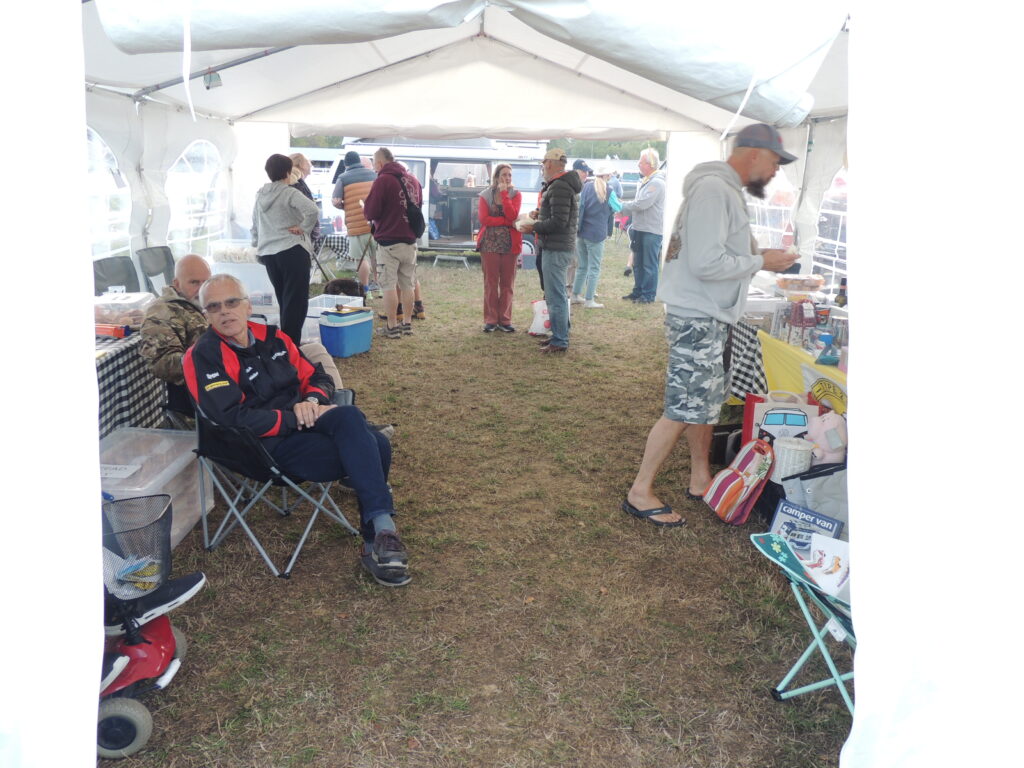
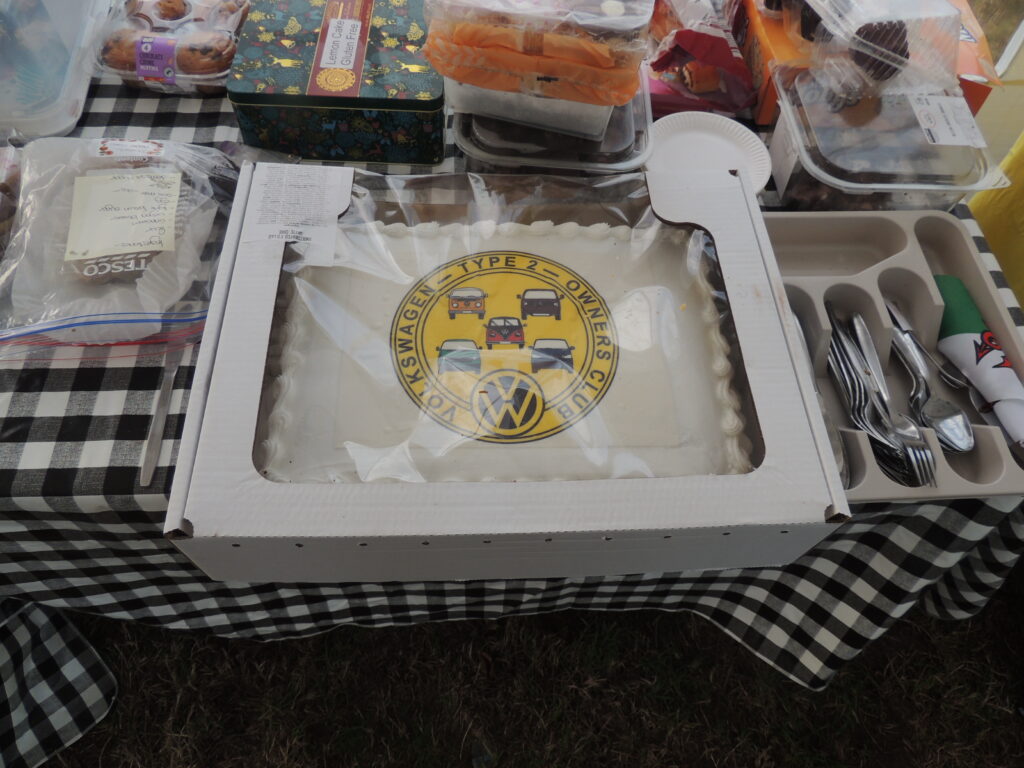
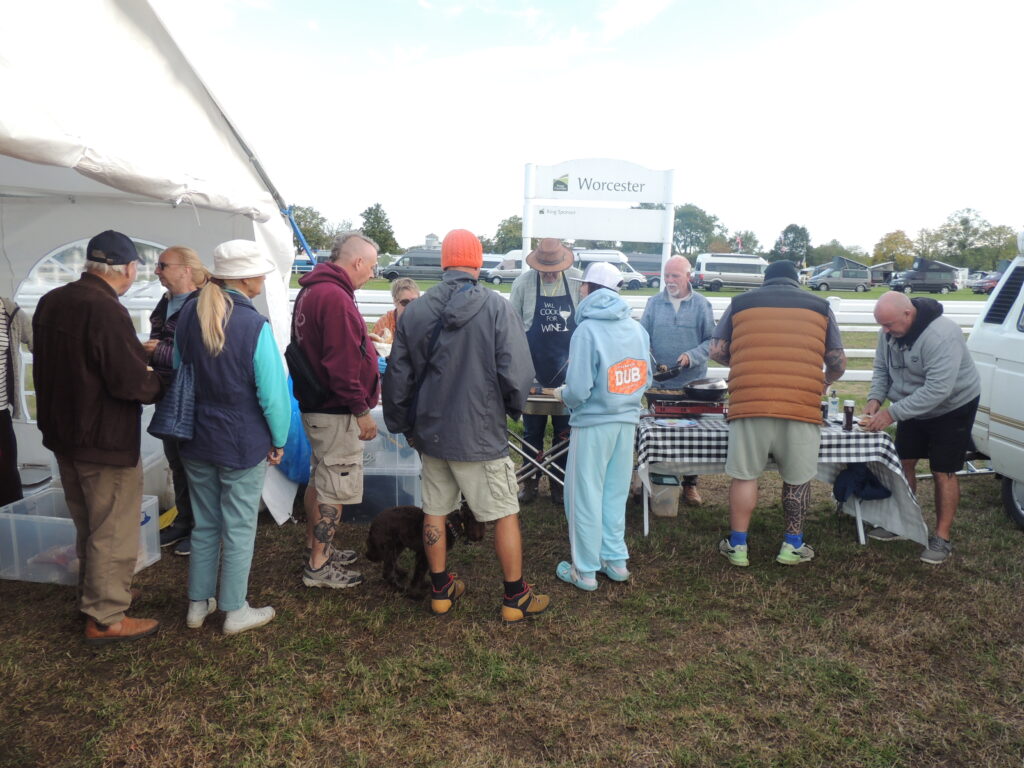
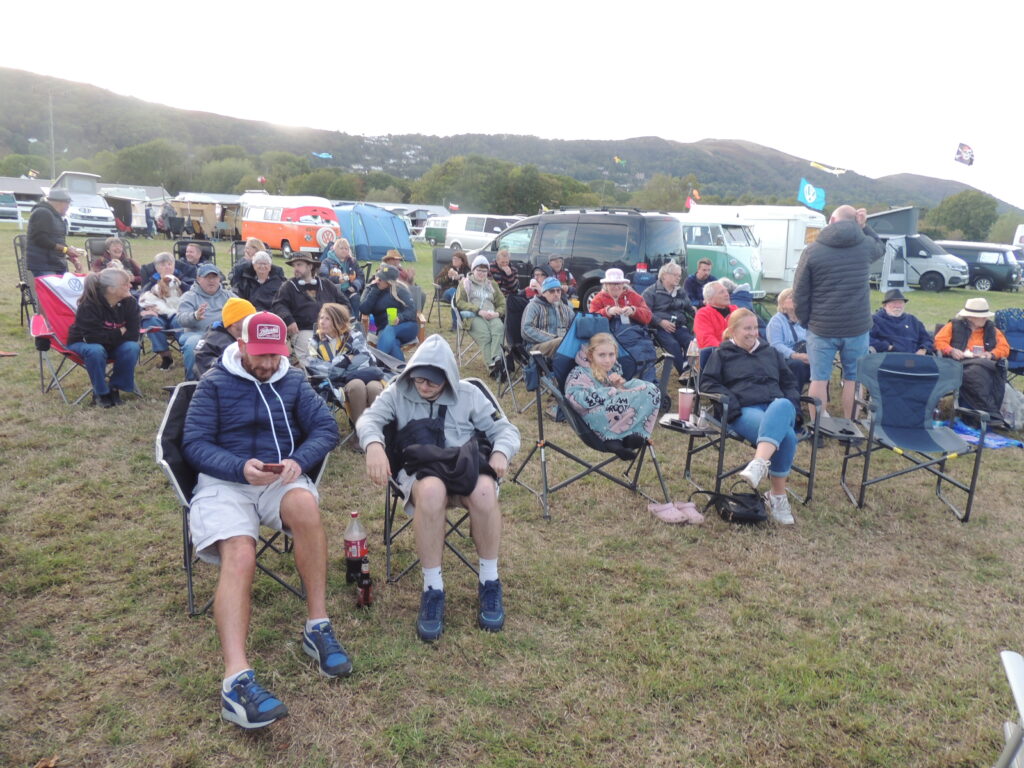
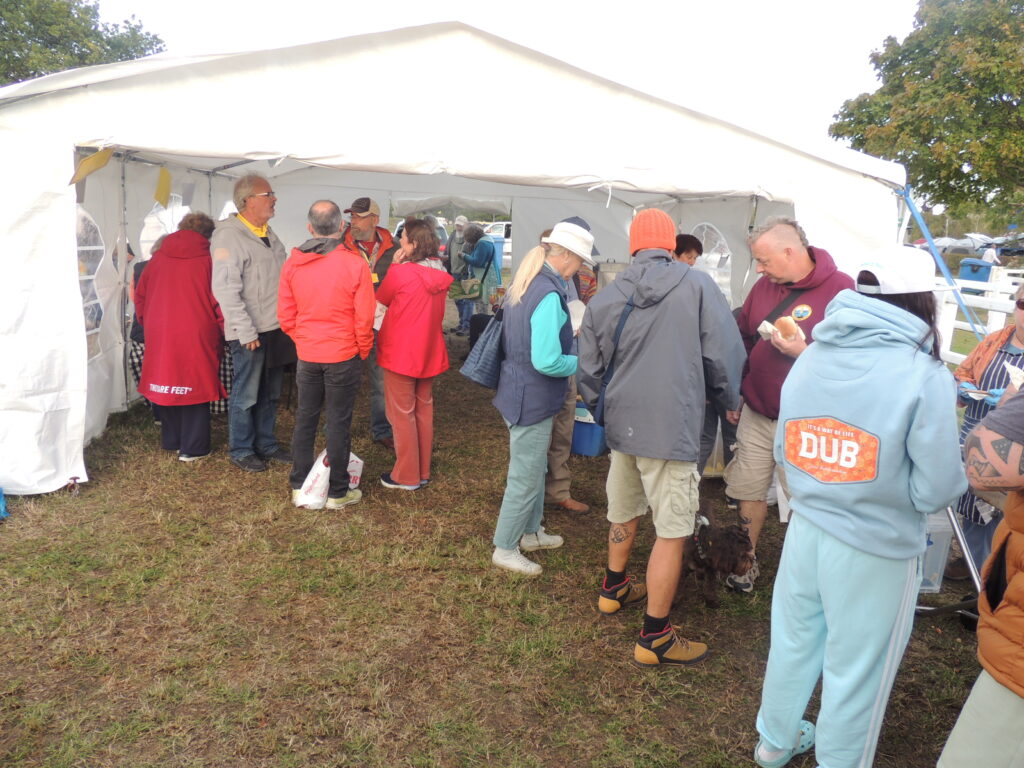
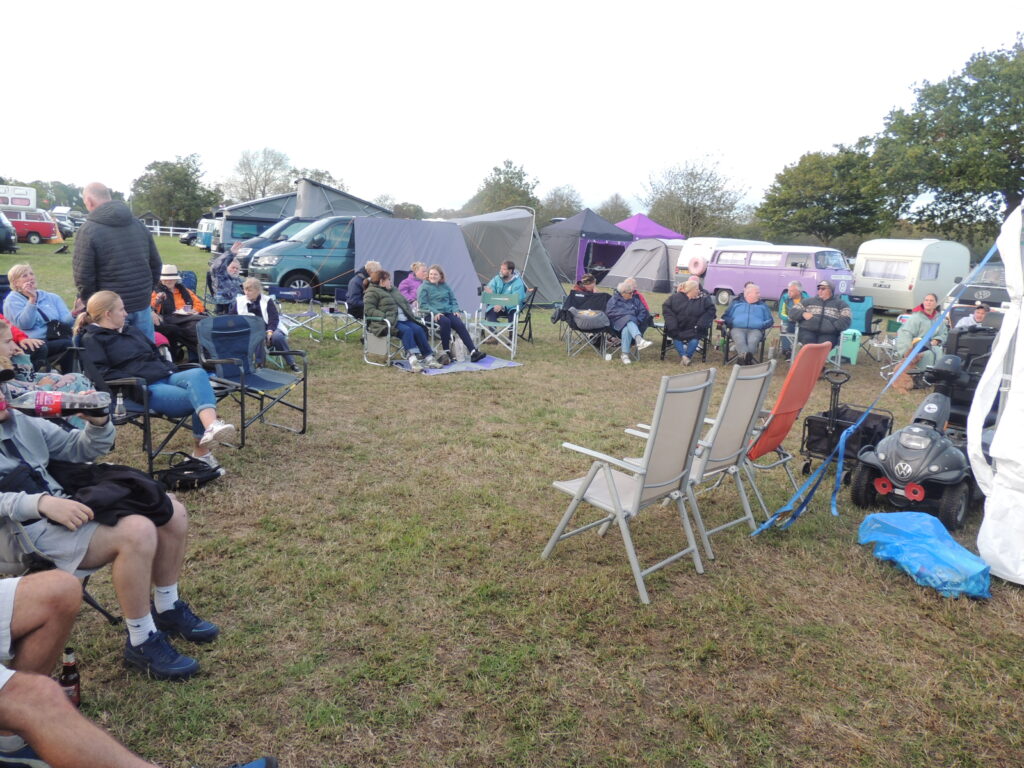
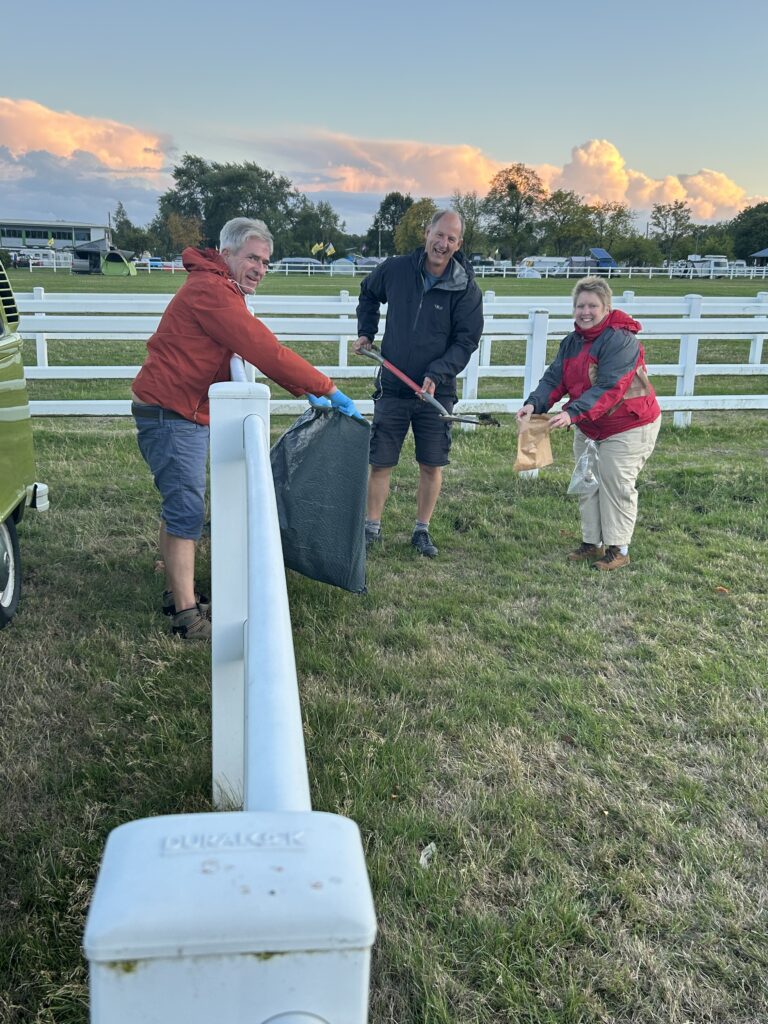
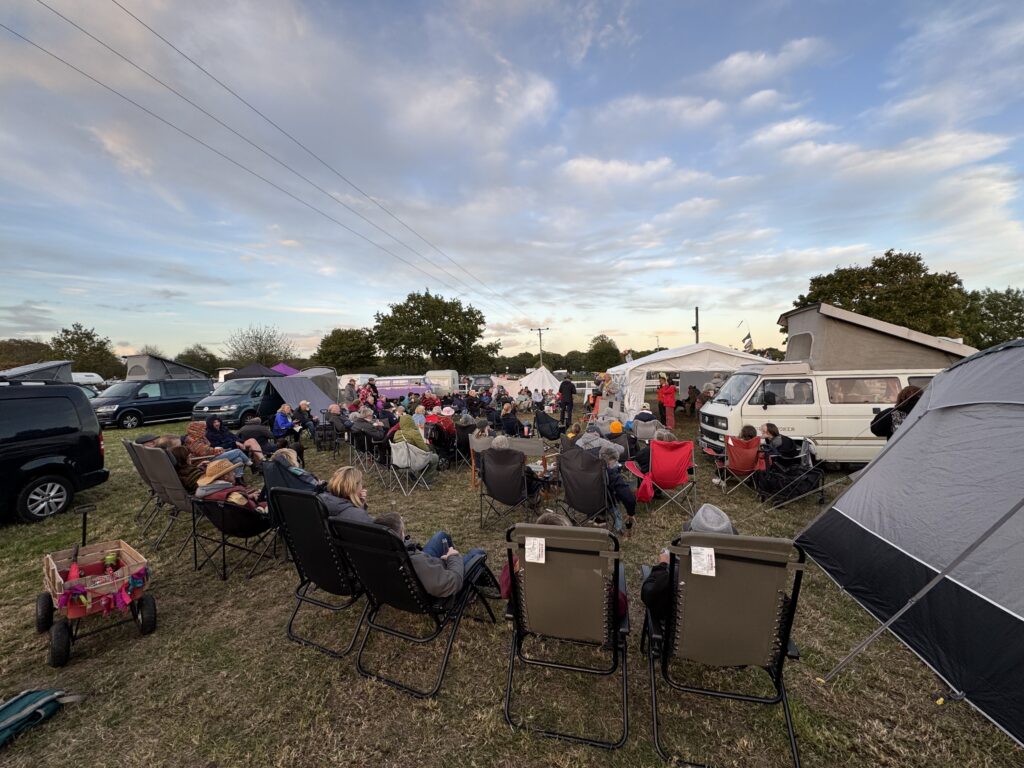
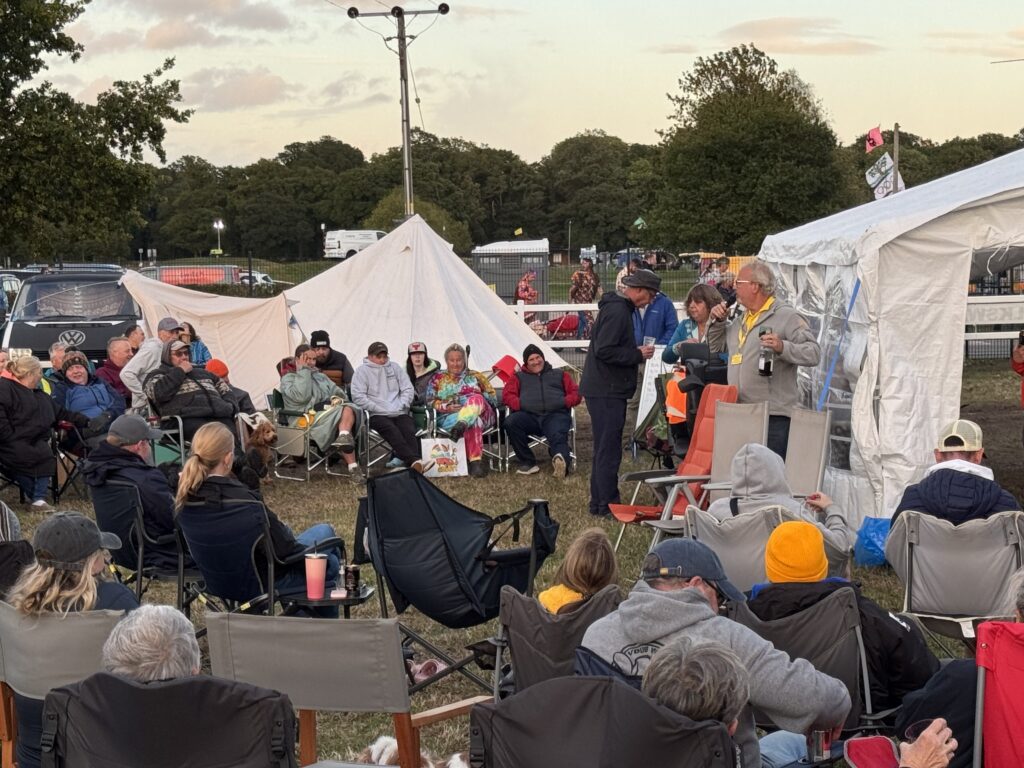
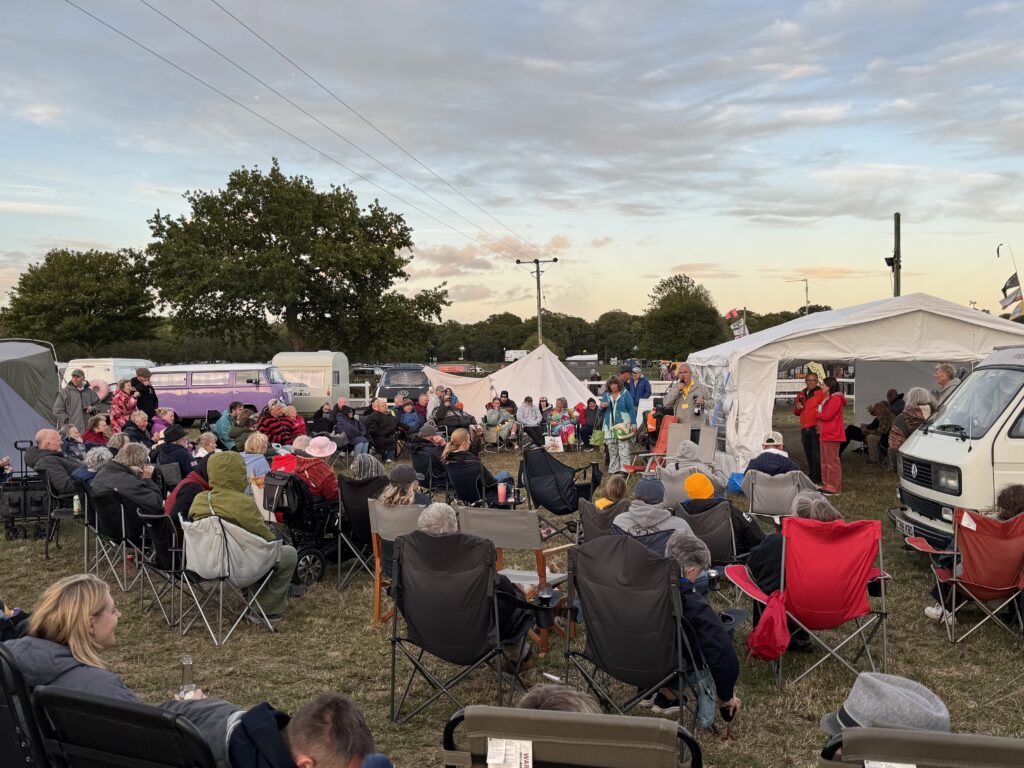
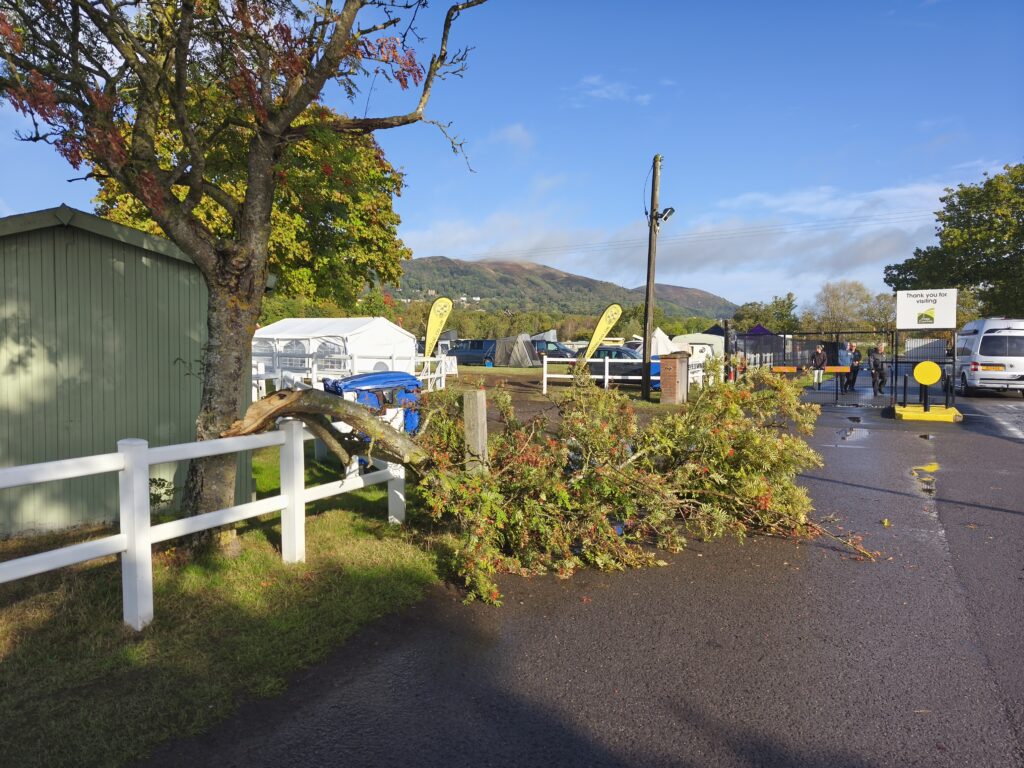
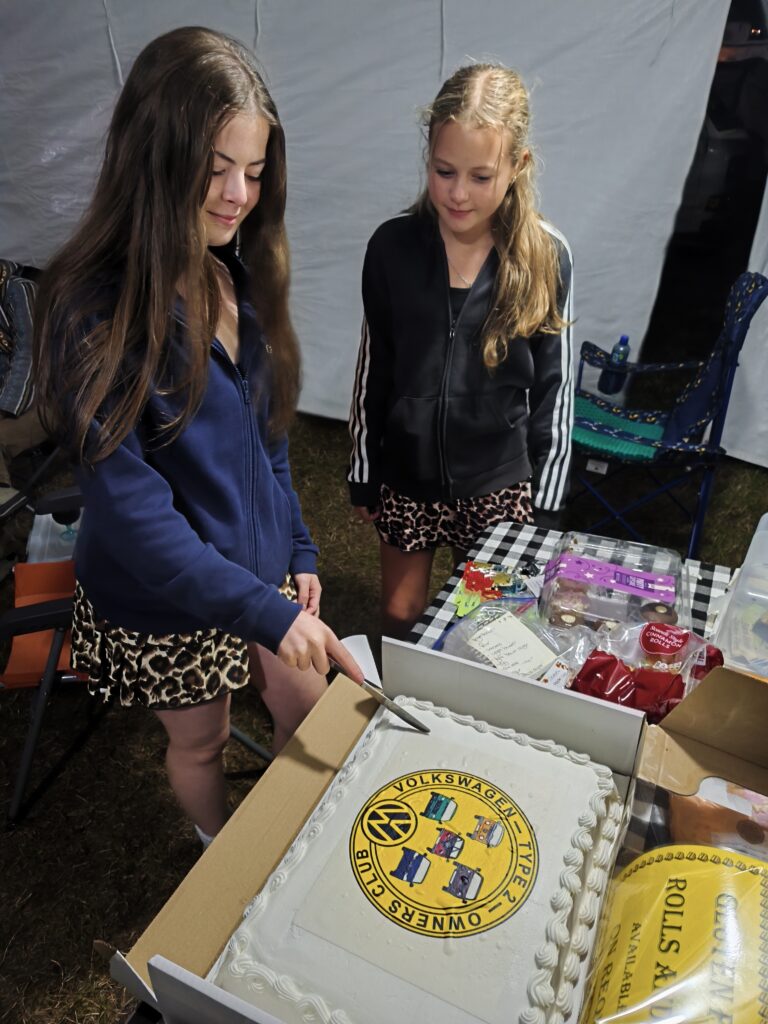
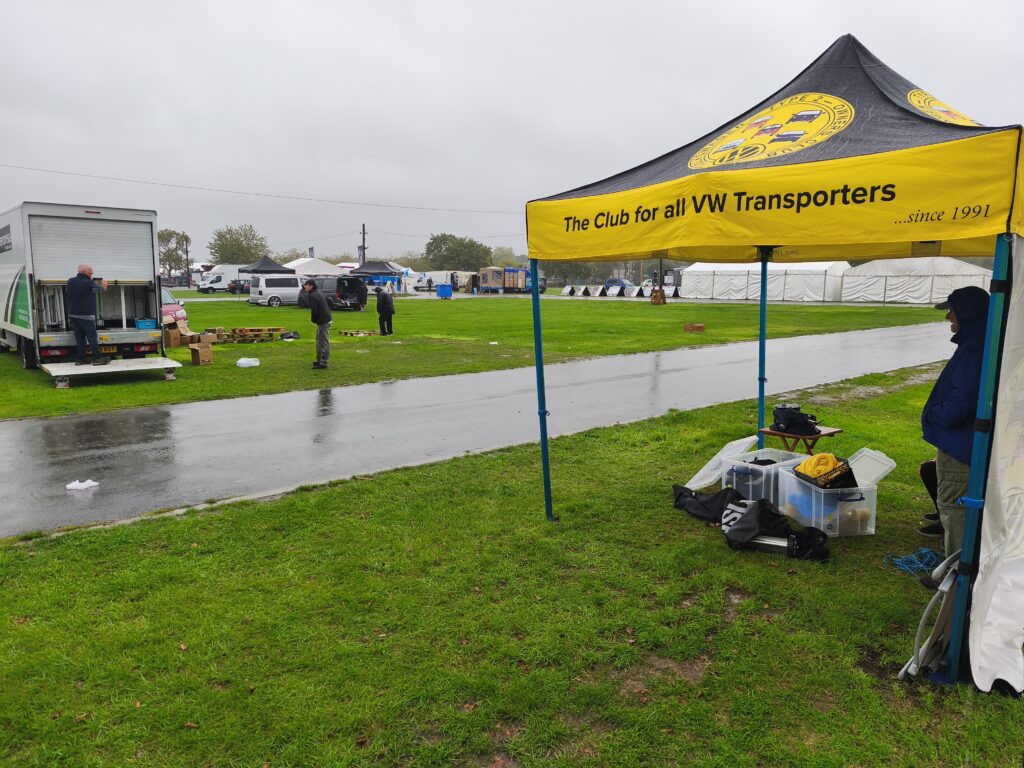
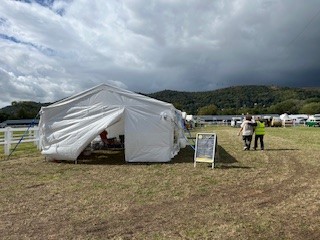
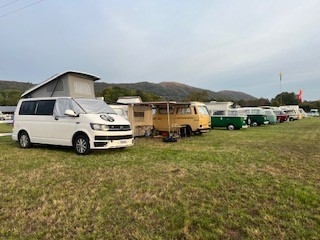
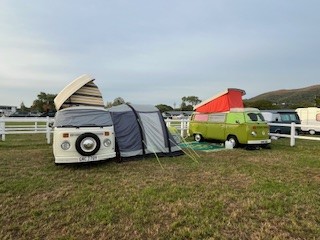
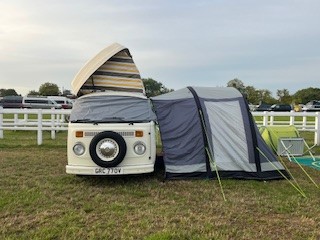
Four seasons in one day! About 100 members arrived into our club field, had burgers on both Friday and Saturday nights, had tea, coffee, cake and biscuits on Saturday and Sunday mornings.
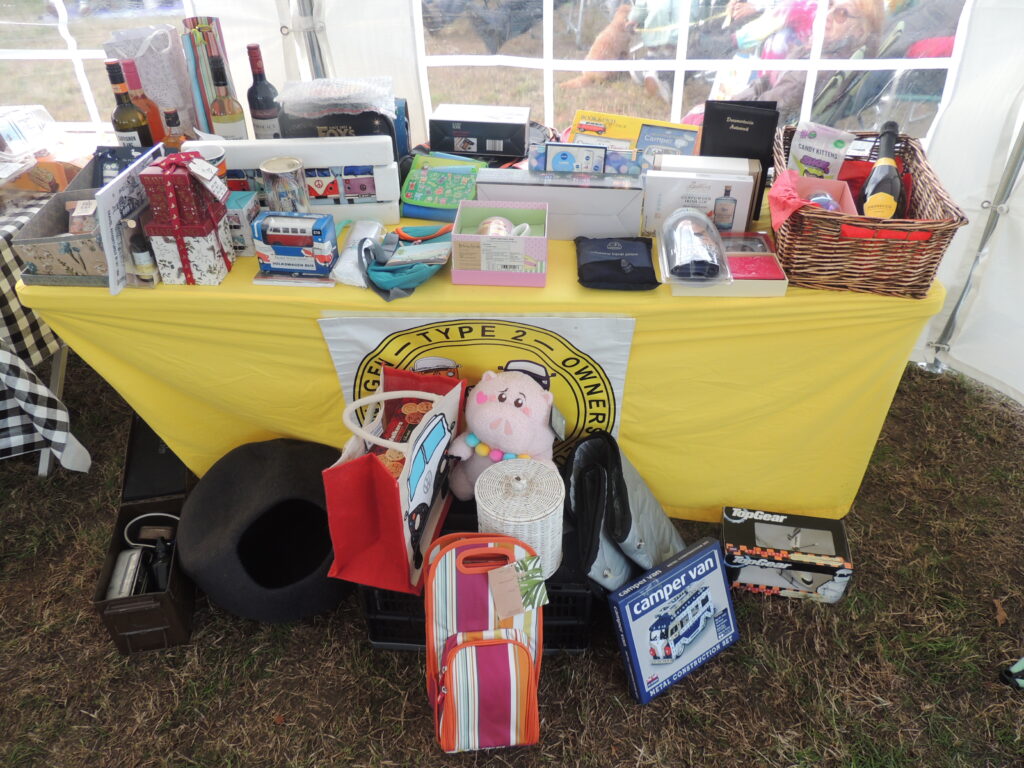
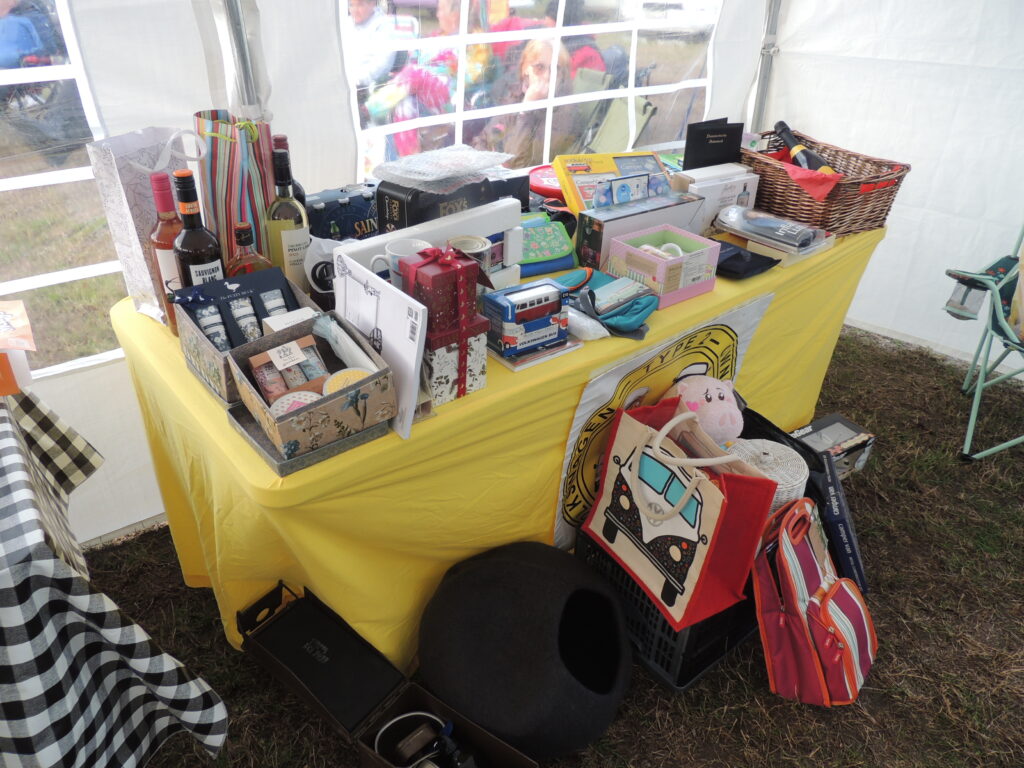
There was a raffle with dozens of prizes, a lot of laughter, some rain, some wind, some sun and that was just our field. Busfest gave its usual array of stalls, music, kids entertainment, displays, for sale, autojumble and lots lots more.
Check the Body (Chassis) to Engine (Drive unit) Earth braid, it is 6″ min. & 8″ max long. It is situated underneath the vehicle at the N/S rear, from the diagonal arm axle mounting bracket to a gear casing bolt, (best to replace this braid anyway!)
Also check & clean the following points: –
Battery un-insulated braid to body (earth)
Battery un-insulated braid to battery (-) Negative post
Battery cable to battery (+) Positive post (a 25 mm2 thick black insulated cable) this connects to
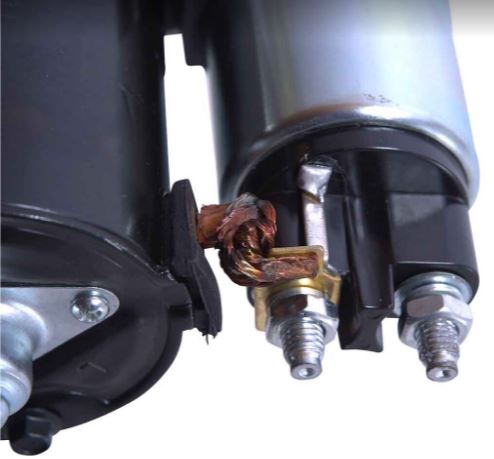
Starter motor solenoid (connection 30) (this is a ring terminal on a bolt)
Starter motor solenoid (connection 30) also has a ring terminal connecting to a 6 mm2 wire having red with white tracer insulation. This connects via a push on ‘250 Faston’ terminal to
Fuse box (fuse No. 9) (a brass link joins this to fuse No. 8) so from
Fuse box (fuse No. 8) has a push on ‘250 Faston’ terminal connecting to a 4mm2 wire having red insulation. This connects via a push on ‘250 Faston’ terminal to
Terminal black ‘T4’ (which has a through connector) so from the other side of
Terminal black ‘T4’ a push on ‘250 Faston’ terminal connected to a 4mm2 wire having red insulation. This connects via a soldered connection to
Ignition switch (connection No. 30) so from
Ignition switch (connection No. 50) a soldered connection to a 2.5mm2 wire red with black tracer insulation. This connects via a push on ‘250 Faston’ terminal to
Terminal block ‘T4’ (which has a through connector) so from the other side of
Terminal black ‘T4’ a push on ‘250 Faston’ terminal connected to a 4 mm2 wire having red with black tracer insulation. This connects via a push on ‘250 Faston’ terminal to
Starter motor solenoid (connection No. 50)
Approximate length of wire between E and N is 13 mtrs varying from 2.5 to 6mm2. Between A and N + starter flange, soldered internal, crimp joints, riveted and loaded switch there are 42 connections and these cause voltage drops!
NOT ALL OF THEM ARE SERVICEABLE!
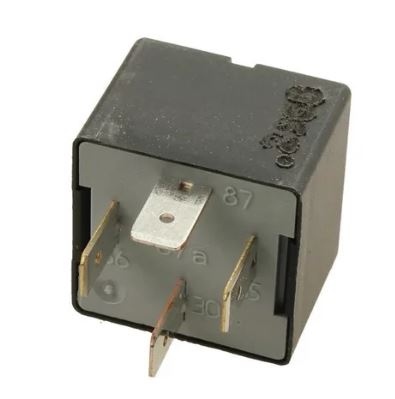
That is an awful lot of cable to navigate. Next time, we will look at simplifying this with a hot start relay system that can be installed in about 30 minutes.
The next edition of the club magazine has been finished by our Editors and looks fantastic. It should be arriving through your door soon! If you are enjoying the club magazine and have a story about a trip, an upgrade, a restoration or just a tip, send a contribution to our Editor at editor@vwt2oc.co.uk.
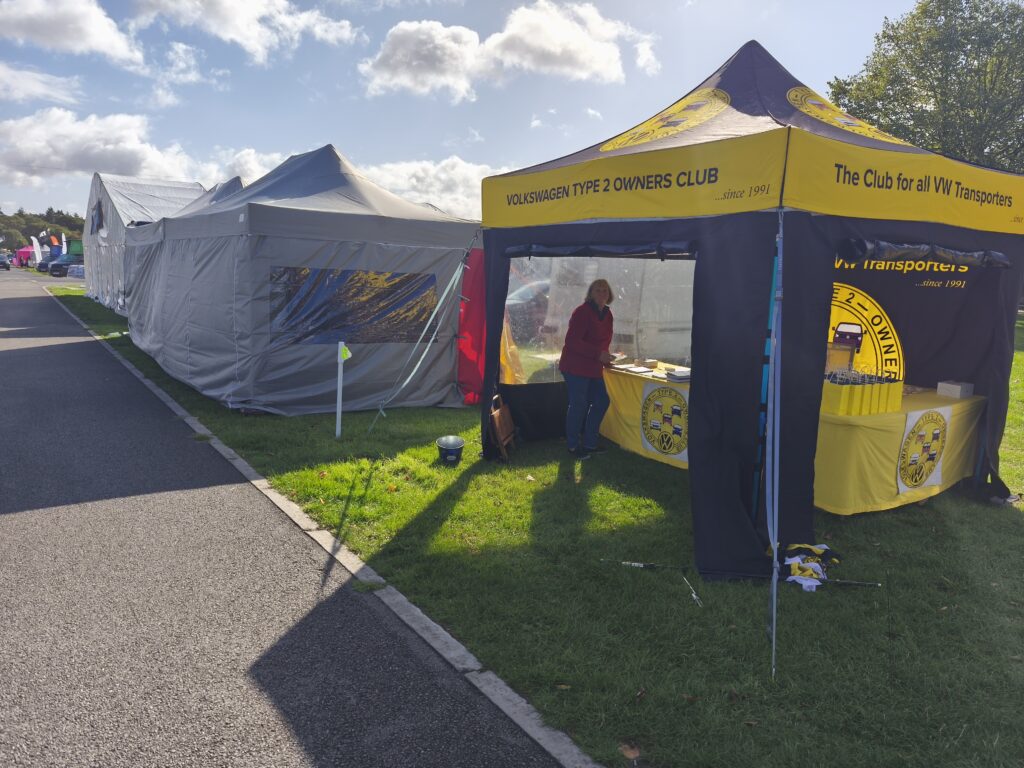
Are you going? Over 100 member vehicles will be in the club field, nearly 500 burgers will be served, the ever popular raffle, tea and cake, prizes and that’s just our field. Then there’s every type of stand, sales, auto jumble, dog beds, blankets, rugs, music, food and so much more.
Jayne and I decided to use up a Shuttle ticket that we had carried over since last year.
As she teaches, it had to be Easter holidays. It was a great trip, the Dutch spoke good English, the French were frighteningly helpful but spoke no English. I don’t honestly think this was belligerence, they just have very few UK visitors in this area. Fuel was up to two Euros a litre, we did fill up before we left and arrived back nearly empty. We used Google maps extensively. There is so much information about towns, links to camping and websites.
We planned most of the trip this way, but we left with no itinerary except the shuttle times going and return. To have the best view of this trip, get google maps up and look at the links for towns and campsites – there’s lots of history and pictures.
So, here it is:
Sunday 31st March 2024
Left Somerset at 13.00 hours to Folkestone – Premier Inn – Operation Brock in Situ but good journey with no hold ups. We decided to break the first half of the journey up. Coming from Somerset it was about a four-hour drive to the tunnel. NB One should NOT come off at junction 8 services as have to go back up motorway to junction 7 to re-join motorway. Also note there is a Tesco petrol station at junction 13, worth a last fill up before jolly expensive fuel abroad. Premier Inn at junction 12. Premier Inn is perfectly adequate. There is a restaurant, good beer and adequate food. It does what it says on the tin.
Monday 1st April 2024
Breakfast 7.30 all you can eat- full English or continental. Just 10 mins to the Chunnel check in – perfect. We were able to get earlier crossing (they allow you two hours early free). Arrived France – 11.00 hrs French time.
Calais to Tournai (86 miles) for lunch stop – much longer than anticipated. Nice lunch in the historic square but very slow service – hey we are in France! It’s a very historic town, once ruled by Henry VIII. This could easily have been a day or two in its own right.
Tournai to Dinant 99 miles. – smaller and more enjoyable roads. Route Nationale rather than motorways.
Arrived in Dinant Went straight to Campsite – Camping Parc de vacances Villatoile, Pont – a- Lesse – £ 27 for 1 night with electricity and free showers. Possible to order bread and croissant for morning but we had just missed the time. Beautiful river side campsite with climbing, fishing, kayaking, but super muddy. Bar and café disappointingly closed – one reason why we had chosen it. However, very helpful and friendly hosts – English speaking Dutch. Absolutely stunning setting with old manor house converted into Gites and bar. The sun was shining and Belgium was a beautiful place.
Tuesday 2nd April 2024
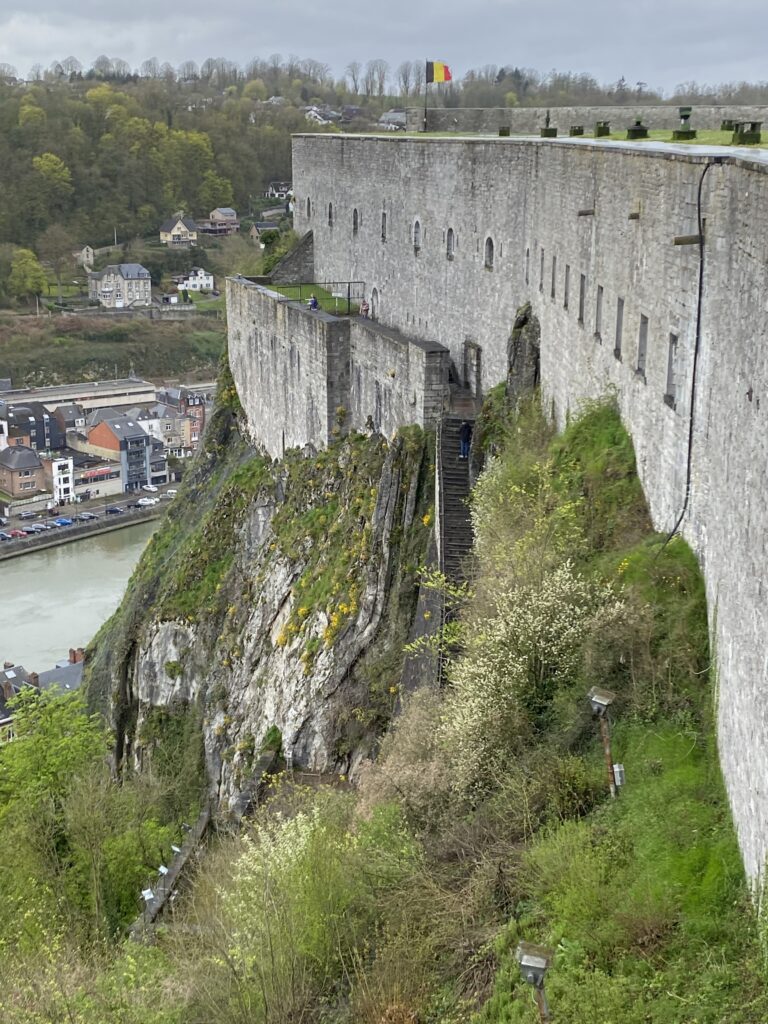
Woke up to warm toasty van due to electricity and 10.5 arctic quilt! Packed up and drove to Dinant – Issue with French parking machine – gave up as assumed they were not working so free parking for us! Coffee and vanilla custard croissants and then up to the cable car to the Chateau. Cable car and chateau 12 Euros. Lovely views, very interesting. On August 14th 1914 in WW1 634 civilians shot as the Meuse was a major crossing point for the Germans. Lt Charles de Gaulle was injured in the leg while reinforcing the French troops. The Germans destroyed the city and shot the civilians. The oldest was 88 years old, the youngest 3 weeks old. Hard to comprehend. Church rebuilt afterwards, beautiful. Home of Adolphe Sax – Inventor of the saxophone. Can imagine superb jazz festivals here.
In the opening weeks of World War One, as the million-strong German army raced alongside the River Meuse in an attempt to outflank the French Army, its troops carried out a series of atrocities against civilians who were not in a position to defend themselves. Area known as the martyr towns – Dinant paid the heaviest price. Suspected to be the base of Belgium’s guerrilla force, the town was torched and the population slaughtered. In one incident, soldiers fired indiscriminately into a crowd that included mothers with babies; in another, 150 factory workers were ordered outside and summarily executed. In all, 674 townsfolk died.
Then 53 miles on to Dohan – Camping Maka – wow! Absolute paradise. No sounds apart from nature, beautiful scenery, great host. 50 euros for 2 nights with free showers. Able to order bread and croissants. Small shop on site with terrace and bar serving basic but good food. The sun is shining. It is the very beginning of the season but everything is open and we have everything we could possibly need. Decided to eat in the bar – superb pizza and ambience. Extremely helpful host – Nancy. Slept wonderfully to the sound of nature. We love it here – absolutely love it. Could stay forever. This is probably the nicest campsite we have ever done this lifetime so far!! – No WiFi, no phone signal, no TV, no loud music permitted. Certainly look that one up guys.
Wednesday 3rd April 2024
After coffee in the easy chairs in the bar, we headed for Herbeumont upon recommendation for friends. Tres Bien – well worth the visit. Chateau de Herbeumont – ruined fort. Even in the rain it was stunning and we could imagine just how fantastic it would be in the sunshine. Beautiful views of the meandering Semois river amongst pine forests.
Drive to Bouillon along route nationale – beautiful scenery en route. Boullion – great river side town with cafes, restaurants, hotels but dominated by the elevated by the castle above us. The town is known as the Pearl of the Semois. It survived WW1 and 2 unscathed although the Germans Panzers stormed through the town in preparation for the Battle of the Bulge.
After a coffee in a riverside Brassiere, we headed along through the tunnel along an avenue or beautiful pollarded Lime trees and into the castle itself. Free parking outside with stunning scenery. Entrance a mere 10 Euros each for a fabulous journey back in time. Louis XIV seems to feature rather a lot. Castle hewn out of solid rock. Running from 800 BC to present day. Well worth a visit. Stopped and enjoyed a picnic in the rain with our fishing umbrella enjoying the fabulous views. We want this trip to be many weeks rather than one.
On to Sedan, Quick drive around the castle – absolutely huge, lively city, possibly worth a day or two in its own right but for us, we were castled out and our hearts were calling us back – back to paradise at Camping Maka – Wine – cheese – dinner – peace and tranquillity.
Thursday 4th April:
Journey from Bouillan to Preux-au-Bois – Camping la Foriestier – 91 miles. Weather absolutely tipping it down. Headed towards Cambrai but destination in La Foret de Mormal now part of the Regional National Park of the Avenois. Camping la Foriestier – 17.6- euros per night free showers. Very rustic and old facilities but very clean and super friendly host. Enjoyed a sunny 6 mile walk around the forest – from acorns of WW1. Cambrai was the first time tanks were used in battle. Screech owls, birds singing.
The Forêt de Mormal (Forest of Mormal) is a forest in France, near the Franco-Belgian border. It is best known to the British for its role in the retreat from Mons in August 1914
Battle of Cambrai nearby, British offensive (November–December 1917) marked the first large-scale, effective use of tanks in warfare. Unfortunately, the museum in Cambrai was not open.
Friday 5th April
Preux au Bois to St Omer 89 miles for lunch stop and a bit of reminiscing for Matt. St Omer nice river side town. Large canals and irrigation systems in fields where our crops are grown.
The market town of Saint-Omer was for centuries a key staging post between London and Paris. It has an impressive network of canals in the lower town.
Another 33 miles later and we arrived in Escalles – camping Opal – Blanc Nez, just outside Calais. Very convenient ideal stop over. 18 euros per night with 1 euro shower tokens.
Walked to Calais beach and looked around a couple of old WW2 defences. Could see the white cliffs of Dover.
Saturday
Just under 8 miles from tunnel, we stopped off at Cite Europe to stock up. Don’t rely on Sat Nav to get you to the correct terminal from here though as Gloria (satnav) sent us to the freight area and had to be escorted out. The French guy thought we had been drinking until I showed him my phone screen. Top tip – don’t head for terminal tunnel – head for Flexiplus tunnel!!! Still managed to get on an earlier train and back in Blighty for midday before a busy but not too arduous journey back to Somerset.
For the Belgians, an ‘s’ makes all the difference between one country and another. Signs in Belgium that are inscribed with ‘Ardenne’ refer to the Belgian region, whereas those with ‘Ardennes’ are on the French-side.
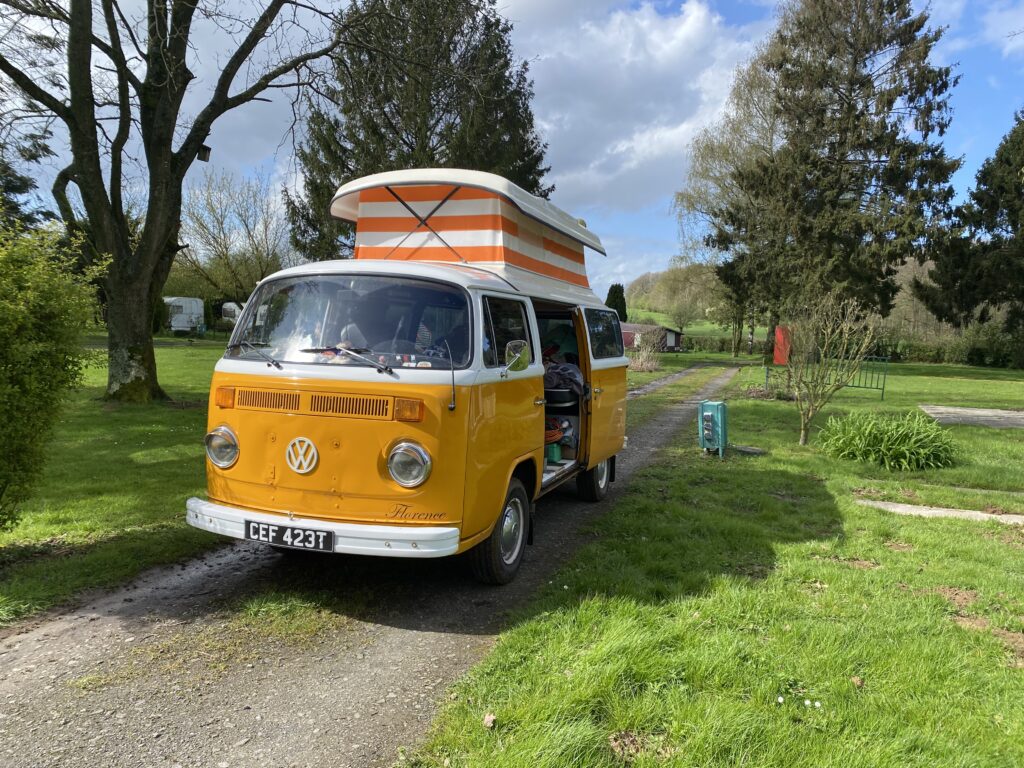
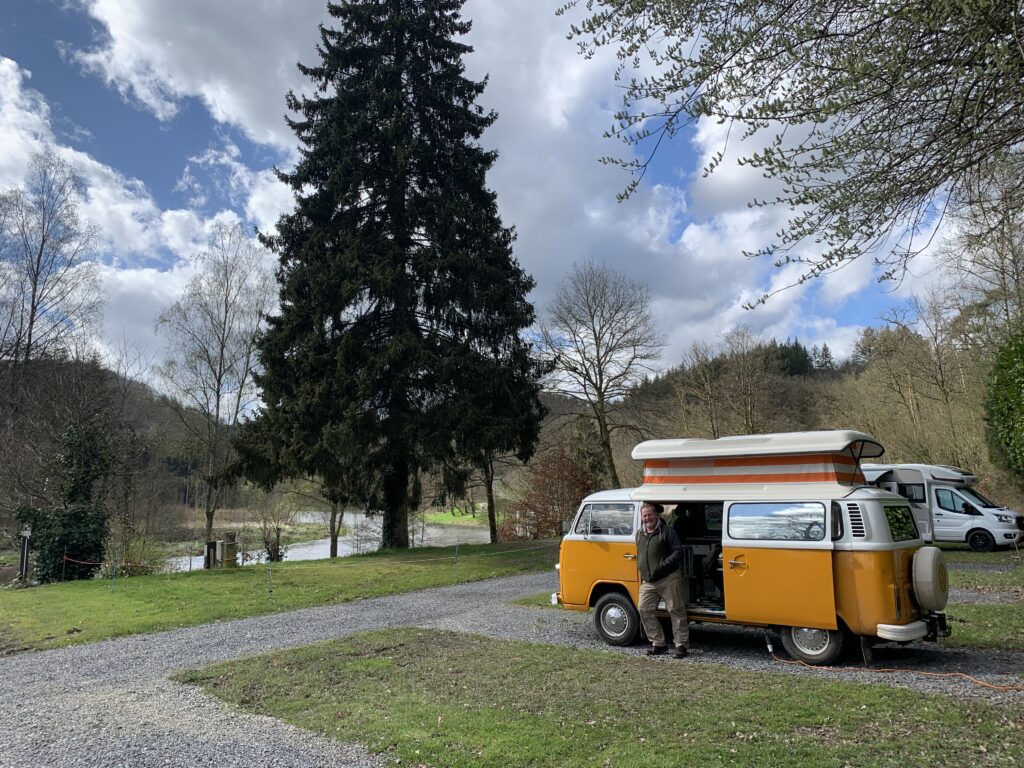
Julius Caesar called the Ardennes ‘The greatest forest in all of Gaul’, lots of history in this area, particularly WW1. It was a great trip and superb scenery. Campsite of the trip award is definitely Camping MAKA. It was a week of sunshine and torrential showers. Florence didn’t miss a beat in the 950 odd miles of the trip. Love and hugs to all Matt and Jayne